18.08.2026
You bought your travel eSIM a week before your flight and installed it immediately to be fully prepared. But as you watch the setup complete on your screen, a sudden panic sets in: Did your data plan just start right now—or will it only begin when you actually arrive at your destination next week?
This is arguably the most common source of anxiety for modern travelers using digital connectivity. The terminology can be confusing, and the fear of wasting your purchased data days while still sitting in your living room is completely valid. The reality is that the digital telecommunications world operates differently than buying a physical object.
Buying an eSIM does not always start the plan.
Installing an eSIM does not always start the plan.
For many travel eSIM plans, the validity period only begins upon your first connection to a supported network abroad. But this is not a universal rule. Depending on the provider, the mobile operator, and the specific technological backend, some plans might activate the exact second you install them, the moment you complete the checkout process, or on a predefined calendar date.
If you are wondering exactly how this works and how to set up your device safely, reading our comprehensive guide on How to Prepare Your Phone Before Traveling Abroad is a great first step. However, the most critical takeaway regarding plan validity is simple:
Always check the activation policy of the specific eSIM plan before installing it.
To eliminate the confusion, we need to separate the journey of a travel eSIM into four distinct stages. People often use words like "bought," "installed," and "activated" interchangeably, which is exactly what leads to unexpected data expiration.
Here is what each stage actually means in the context of mobile networks:
|
Stage |
What It Means |
|
Purchase |
You buy and receive the eSIM (usually a QR code or direct link). |
|
Installation |
The eSIM profile is added to your phone's internal hardware. |
|
Activation |
The plan becomes active according to the provider's specific network rules. |
|
Validity |
The countdown period during which the data package can be used. |
The confusion stems from mixing these four concepts together. Just because you have purchased a ticket does not mean the train has departed. Just because you have installed software on a computer does not mean a subscription has begun. Understanding the absolute separation between putting the digital profile on your phone (Installation) and the network officially starting your data timer (Activation) will save you money and frustration on every trip you take. Before buying any plan, you should also ensure your hardware is fully compatible by checking Does Your Phone Support eSIM?.
Because mobile networks operate using different billing and provisioning systems across the globe, there are four primary scenarios for when your validity timer will begin ticking.
This is the most traveler-friendly option and, thankfully, the most common setup for international roaming packages.
Under this policy, you can buy the eSIM from your couch at home. You can scan the QR code and install the profile onto your phone. You can then wait days, weeks, or sometimes months before your trip. The mobile network essentially puts your profile in a dormant "standby" mode. Your data plan validity will remain untouched until you physically arrive at your destination and your phone communicates with a designated local cellular tower.
For example:
Certain products are engineered so that the mere act of scanning the QR code and downloading the profile signals the network to begin your subscription. The moment the installation is successful on your device, the validity timer starts counting down, regardless of your physical location in the world.
Installing this type of eSIM too early could reduce the number of days available during your actual trip.
If you have a 7-day plan that activates on installation and you install it three days before your flight, you will only have 4 days of internet left when you land.
This scenario is rare for international travel plans but common for strict local carrier plans. In this case, the moment your payment is processed and the QR code is generated, the validity clock starts ticking.
With this type of product, you should never buy it weeks in advance unless the validity period is long enough to cover your waiting time plus your entire vacation. You must buy it right before you need it.
Some specialized connectivity providers ask you to input your exact travel dates during the checkout process. The eSIM is then programmed to remain completely dormant until that specific calendar date arrives.
For example:
Purchase: August 1
Selected activation date: August 15
Plan starts: August 15
In this scenario, it does not matter when you install it, and it does not matter when you arrive. The network will open the data gates precisely on the date you scheduled.
Because this is the most common and preferred scenario for travelers, it deserves a closer look. What exactly is happening inside your phone?
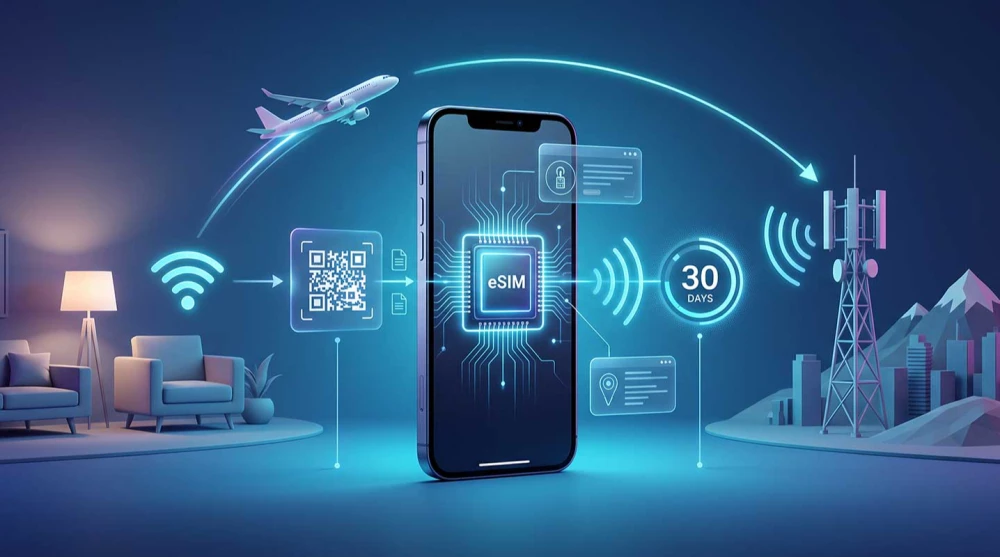
Think of your newly installed eSIM as a VIP pass to an exclusive club. The pass is securely stored in your pocket (your phone's hardware), but it is essentially meaningless until you present it to the bouncer at the club's door (the cellular network). The eSIM is installed, but the plan is not yet active.
Here is the step-by-step process of what happens after your airplane lands:
Turn on the eSIM: You toggle the digital SIM line to "On" in your device settings.
Set it for Mobile Data: You tell your phone's operating system to use this specific eSIM for internet access.
Enable Data Roaming if required: You grant the eSIM permission to utilize foreign partner networks.
Phone searches for a supported network: Your device's antenna scans the local airwaves.
eSIM connects: A digital handshake occurs. The local cell tower recognizes your profile and authenticates your device.
Plan becomes active: The network registers your first byte of data usage, and your validity timer officially begins.
Often yes — and in many cases, it is actually recommended.
Experienced digital nomads and frequent flyers almost always install their connectivity profiles before heading to the airport. There are numerous advantages to doing this from the comfort of your home:
You have a stable, secure Wi-Fi connection, ensuring the download process is not interrupted.
You have plenty of time to contact customer support and resolve any unexpected installation problems without the stress of an impending flight.
You do not have to scramble to find and scan a QR code on a chaotic, crowded airport terminal floor.
You arrive at your destination with the eSIM already installed, meaning you just toggle it on and instantly have internet for a taxi or map.
However, only install it in advance if the plan's activation policy confirms that installation itself does not start the validity period.
If the policy states that validity begins upon installation, you must wait until the day of your departure or immediately upon arrival to scan your code.
When planning a trip, it is highly beneficial to separate the act of buying from the act of installing.
You can generally purchase your digital plan weeks or even months in advance. Doing so allows you to cross a major task off your travel checklist. However, before making the purchase, you must verify several critical details in the product description:
Activation policy: Does it start on purchase, installation, or first connection?
Installation deadline: QR codes are not immortal. Some providers require you to scan and install the code within 30 or 90 days of purchase, or the code expires.
QR code validity: Is it a single-use code?
Plan validity: How long does the package last once active?
Whether activation is automatic: Does it happen seamlessly in the background?
Whether a specific activation date is required: Do you need to email the provider to activate it?
By checking these details, you can safely buy your plan two months in advance, keep the QR code in your email, and install it exactly when the time is right.
Validity is another area where travelers get tripped up. When you browse the HandySIM store and look at a product description, you will typically see something like:
10 GB / 30 Days
It is a common mistake to assume that this means:
30 days from the moment of purchase.
In the vast majority of cases, it actually means:
30 days from the moment of activation.
If you buy a 30-day plan in June, install it in July, and activate it by arriving at your destination in August, your 30 days of internet access begin in August. Furthermore, understanding what happens to your internet speed during those 30 days is crucial. We highly recommend reading our detailed guide on What Does Unlimited Data Really Mean? to understand Fair Usage Policies and data throttling during your validity period.
If you get overexcited and scan your QR code weeks before your flight, the consequences depend entirely on the activation policy of that specific package.
Usually, there is absolutely no problem. The profile will sit quietly in your phone's settings. It might say "Activating..." or "Searching..." but because it cannot find the specific foreign network it needs, the plan remains dormant. Your validity timer is safe.
This is where you have made a costly error. Your validity period is now actively ticking down while you are still at home.
For example:
If you have a 30-day plan, and you install it 10 days before your departure, the clock has started. By the time you step off the plane, you will only have 20 days left for your trip.
If you make this mistake, do not panic and do not try to delete the profile from your phone in an attempt to "pause" it. Deleting a profile is a permanent action, and you will lose your money. To understand why, please read our technical breakdown: If You Delete Your eSIM, Can You Reinstall It?.
This is a very interesting technical scenario. Let's say you install a plan that is supposed to activate upon "first network connection." You think you are safe. However, you leave the following settings active on your phone while still in your home country:
eSIM toggled ON
Data Roaming toggled ON
Mobile Data switching toggled ON
Depending on the specific product and its roaming agreements, there is a risk of accidental early activation. If the travel plan you bought happens to have a roaming partnership with a domestic mobile network in your home country (for example, you bought a Global plan that includes coverage in both your destination and your current location), your phone might quietly connect to a local tower.
The moment it connects, the network registers the activity, and your validity begins. To prevent this:
Follow the activation instructions provided with your specific plan rather than assuming that every travel eSIM works the same way. Always keep your travel line turned off until you are actually traveling.
Yes. From a practical standpoint, managing your device settings properly is the best way to avoid accidental data usage and preserve battery life.
If the instructions allow for advance installation, the safest methodology is:
Install the profile → keep the line manually disabled in your settings → enable it only when you land.
Turning the line off ensures your phone does not waste battery constantly searching for a foreign network that does not exist in your home country. For a deeper understanding of managing multiple lines in your settings, check out our guide on whether Can You Use Two eSIMs at the Same Time?. Just remember that turning a profile off does not pause or alter the fundamental activation rules of the product you purchased.
If this seems overly complicated, you might be wondering why the industry doesn't just agree on one single, universal rule. The answer is that an eSIM is not just a standardized "internet package." It is a highly complex digital key to a vast global infrastructure.
When you browse HandySIM, you are looking at products created by entirely different entities. The technological rules are dictated by:
The primary mobile operators (MNOs) hosting the data.
The roaming partners negotiating the connections.
The backend provisioning systems of different telecom enablers.
The specific nature of local, regional, and global plans.
Because these companies use different software systems to track data usage and bill customers, they use different systems for activation. Therefore, two different data plans sitting side-by-side on the same website can easily have two completely different sets of activation rules.
While you must check every individual plan, there are some broad trends you will notice depending on the scope of the coverage you are buying.
A local plan is designed exclusively for a single country and is often tied directly to one specific domestic mobile operator. Because these operators run strict, localized billing systems, it is slightly more common to find local plans that activate upon installation or purchase.
A regional plan spans multiple countries (like all of Europe or all of Asia). These are explicitly designed for international travelers. Because the providers know you are crossing borders, these plans almost always utilize the "activate on first connection to a supported network" model. They are built for flexibility.
However, do not treat this as an absolute rule. Always verify the details, whether you are buying for a single city or an entire continent.
Before you finalize any purchase, you should actively look for a dedicated section in the product details regarding activation. Treat this checklist as your pre-purchase protocol:
Activation: When exactly does the plan start counting down?
Validity: How many total days does the package last once active?
Installation: Does the provider explicitly state it can be safely installed before travel?
Coverage: In which specific countries can the profile successfully connect and activate?
Expiration: Is there a deadline for scanning the QR code before it becomes invalid?
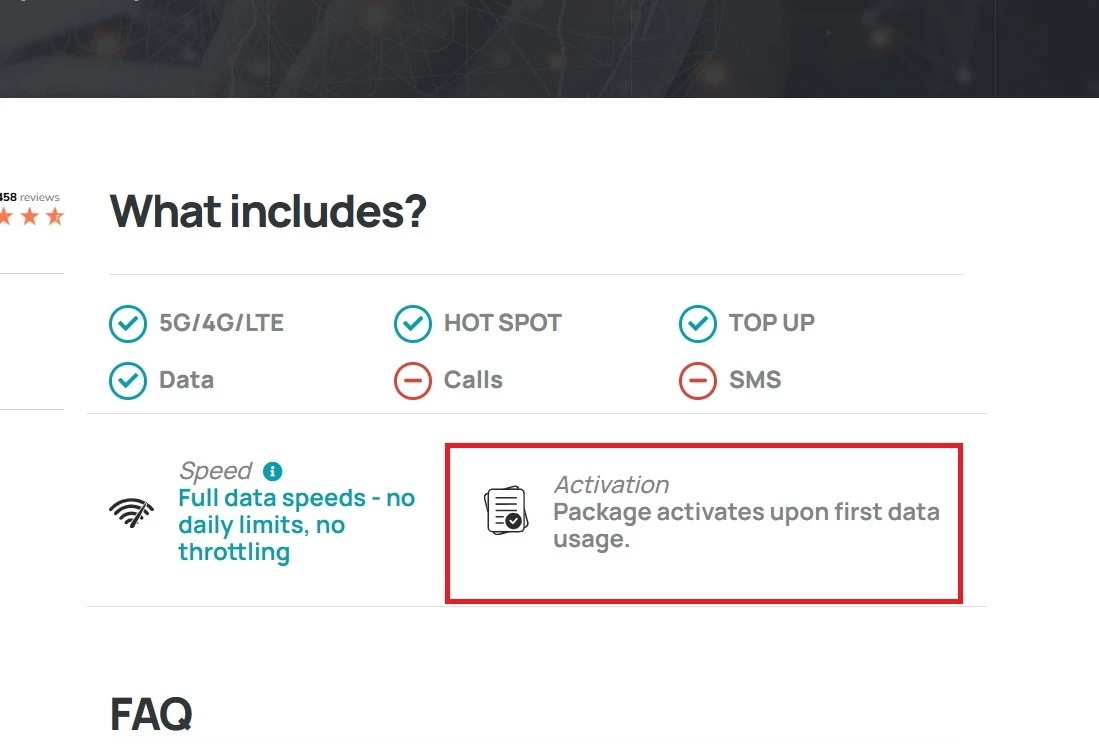
Activation rules can vary heavily depending on the destination, the local mobile operator infrastructure, and the specific eSIM plan you choose. Before traveling, always review the activation details of your chosen plan, especially if you intend to purchase or install your profile weeks in advance.
Explore tailored plans for some of the most popular travel destinations around the world:
Traveling to more than one country? It is often more cost-effective and easier to manage a single profile. Explore regional eSIM plans instead:
To make all of these concepts easy to digest, let us look at a perfect timeline for a typical traveler heading across the globe.
August 1: Buy eSIM online and receive the QR code.
August 5: Install eSIM using home Wi-Fi and toggle the line off.
August 15: Arrive in Japan, toggle the line on, and enable data roaming.
August 15: The phone connects to a supported Japanese network.
August 15: The 30-day validity officially begins.
This example applies only to a plan that activates on the first connection to a supported network. If the plan had a policy of activating upon installation, the validity would have started on August 5, wasting ten days.
If you take away only one piece of advice from this entire guide, let it be this:
Never assume that installing an eSIM and activating its data plan are the same thing. Check the activation conditions of your specific plan first.
There is no universal activation rule for every eSIM on the market. The digital telecommunications landscape is diverse, and while many travel plans start when they first connect to a supported network abroad, others may start the exact second of installation, the moment of purchase, or on a selected calendar date.
Before scanning that QR code and installing your travel profile, take thirty seconds to read the activation and validity conditions provided by your carrier. That brief moment of checking can prevent you from accidentally starting your data plan before your trip even begins, ensuring you have flawless connectivity from the moment you land to the moment you fly home.
The exact start time of your eSIM plan depends on the specific product's activation policy. Most travel eSIMs activate only when they connect to a supported network at your destination. However, some plans may start immediately upon installation or on a pre-selected calendar date. Always check the provider's details before making a purchase.
Installing an eSIM simply downloads the digital profile to your phone, but it does not always start your data plan. For most regional and global travel eSIMs, activation requires a physical connection to a foreign network. However, certain local plans trigger activation the second the installation process is complete. You must verify your specific plan's rules to avoid wasting data days.
Yes, installing your eSIM before heading to the airport is highly recommended. It allows you to use a stable Wi-Fi connection and resolve any potential setup issues comfortably at home. You just need to confirm that your specific plan does not activate upon installation. Once installed, simply keep the line turned off until you reach your destination.
Yes, if your plan is designed to activate upon first network connection, it will start automatically after you land. You just need to turn on the eSIM line and enable data roaming in your phone settings. Your device will then find the local partner network and seamlessly trigger your data validity period.
An eSIM can accidentally activate early if it has roaming agreements in your home country and is left turned on. If the plan supports your current location, your phone might connect to a local tower and start the validity countdown. To prevent this, always leave your newly installed travel eSIM disabled until you actually arrive abroad.
The validity period usually begins the exact moment your eSIM successfully connects to a supported mobile network abroad. This means a 30-day plan starts counting down from your arrival day, not your purchase day. However, if your plan activates upon installation, the validity period begins the second you download the profile.
Yes, you can purchase most travel eSIMs weeks or even months before your scheduled trip. The QR code will remain dormant in your email until you are ready to scan and install it. Just be sure to check if the QR code has a specific expiration deadline before making your advance purchase.
If your plan activates on first network connection, installing it early will cause no problems at all. However, if your specific plan activates upon installation, the validity clock will start ticking immediately while you are still at home. In this case, you will lose valuable days of internet access before your vacation even begins.
Yes, turning off your travel eSIM after a pre-trip installation is the safest way to manage your device. It prevents your phone from wasting battery life by constantly searching for a foreign network. Simply toggle the line back on when your plane lands so it can connect and activate properly.
No, activation rules differ significantly depending on the mobile operator, the region, and the telecom provider. While many plans start upon connecting to a supported network, others begin at installation or on a scheduled calendar date. You should always read the specific terms of the eSIM package you are buying to understand exactly how it works.