12.07.2026
The word "unlimited" is one of the most powerful terms in the telecommunications and travel industry. When preparing for an international trip, purchasing a digital connectivity plan labeled as "unlimited" provides an immediate sense of relief. It paints a picture of endless scrolling, hours of high-definition video streaming, and unrestricted hotspot usage without ever having to worry about counting megabytes or facing surprise roaming charges. However, many travelers arrive at their destination, begin using their device heavily, and suddenly find their internet connection slowing down to a crawl.
This disconnect between the marketing promise of unlimited data and the reality of mobile network limitations is a common source of frustration. The truth is that in the world of mobile connectivity, "unlimited" rarely means infinite, unrestricted maximum speed for the entire duration of your trip. Instead, it means that your access to the internet will never be completely cut off, and you will not be charged extra, but the speeds at which you access that data may fluctuate based on your consumption.
Understanding why your speed drops requires looking behind the curtain of how international roaming and mobile networks operate. Almost all travel eSIM providers utilize a framework designed to balance network resources among millions of users simultaneously. This invisible mechanism dictates how much high-speed data you get before your connection is purposefully slowed down. In this comprehensive guide, we will break down exactly how mobile data works, why limits exist, and how you can choose the right plan for your travel needs without any unexpected slowdowns.
At the core of every unlimited data plan is a concept known as the Fair Usage Policy, commonly abbreviated as FUP. A Fair Usage Policy is a set of rules implemented by internet service providers and mobile network operators to ensure that all customers have equitable access to network resources.
To understand why a Fair Usage Policy exists, it helps to visualize a mobile network as a physical highway. A cell tower has a fixed amount of bandwidth, just as a highway has a fixed number of lanes. Under normal circumstances, traffic flows smoothly because everyone is driving at a steady pace. However, if a handful of massive commercial trucks suddenly decide to take up all the lanes and drive erratically, the entire highway comes to a standstill. In the mobile data world, these "massive trucks" are users who consume terabytes of data by downloading huge files, streaming continuous 4K video, or acting as a permanent Wi-Fi hotspot for multiple devices.
Operators use the Fair Usage Policy as a traffic management tool. It protects the network from becoming congested by a tiny percentage of extreme users. If one person at a crowded tourist landmark is trying to download a 50 GB video game update over a cellular connection, they are actively degrading the internet speed for hundreds of other travelers who just want to check a map, send a WhatsApp message, or hail a ride.
By enforcing a Fair Usage Policy, the network operator identifies users who are consuming disproportionately large amounts of bandwidth and temporarily reduces their speed. This throttling ensures that the cellular tower does not become overwhelmed. It guarantees that the network remains stable, reliable, and functional for the vast majority of users who are engaging in normal, everyday digital activities. For travel connectivity providers, adhering to these local network policies is mandatory. When you buy an international plan, you are a guest on a local operator's network, and that local operator demands that temporary visitors adhere to their fair usage guidelines to protect their domestic customers.
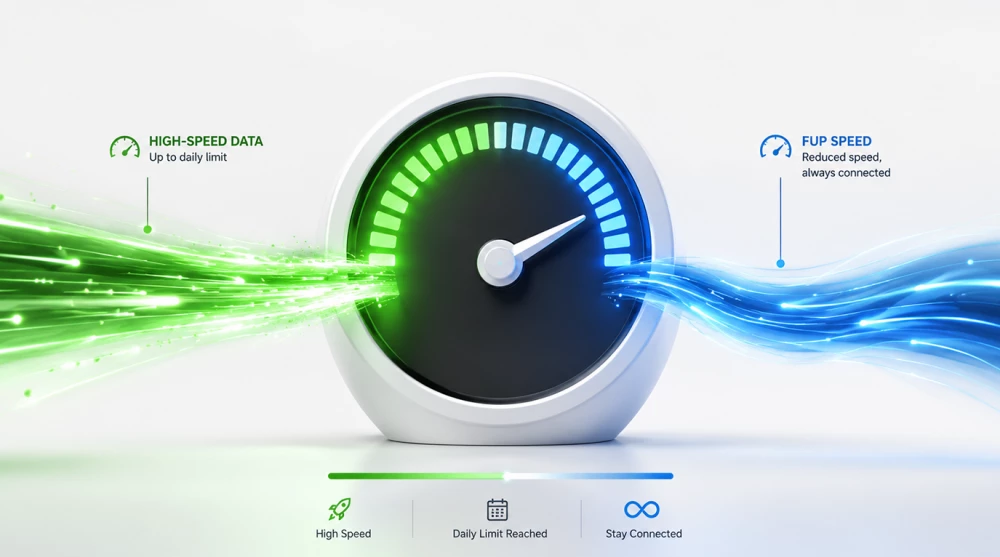
When you purchase an unlimited digital travel profile, the underlying mechanism is designed to provide you with a daily allowance of premium, unthrottled connectivity, followed by a safety net of slower, but continuous, access. Here is the exact lifecycle of how these plans function on a day-to-day basis:
Step 1: High-speed data
Your day begins with a pristine, high-speed connection. Depending on the local network infrastructure and your device capabilities, this means you are surfing on 4G LTE or 5G networks. You get the maximum possible bandwidth the local cell tower can provide.
Step 2: Daily allowance reached
As you navigate the city, upload photos, and stream music, your data consumption is tracked by the network. Every plan has a predetermined, invisible or visible, high-speed threshold. Once your device consumes that specific amount of data within a 24-hour period, you hit the Fair Usage Policy cap.
Step 3: Reduced speed
The moment you cross that daily threshold, the network automatically throttles your connection. You are not disconnected from the internet, and you will absolutely not receive a bill for extra charges. However, your maximum speed is capped. The severity of this speed reduction depends entirely on the specific tier of the plan you purchased.
Step 4: Resets automatically the next day
This is the most crucial and comforting part of the unlimited model. The speed reduction is not permanent. Mobile operators track usage on a strict 24-hour cycle. At a specific time—usually midnight according to a designated time zone—your data counter resets to zero. The network lifts the throttle, and you immediately regain access to your full, unthrottled high-speed allowance for the new day.
One of the biggest frustrations travelers face is the lack of transparency regarding when their speeds will drop and how slow they will become. Many providers hide their Fair Usage Policy deep in the terms and conditions. We believe in complete transparency.
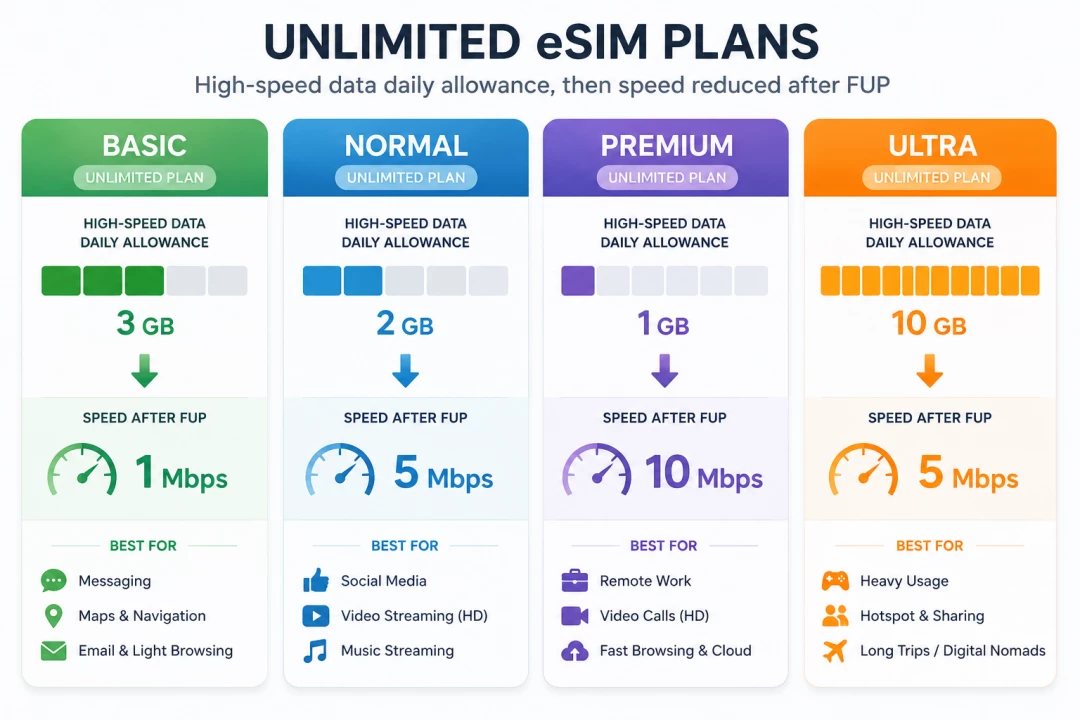
To give travelers absolute control over their connectivity and budget, we offer distinctly categorized unlimited plans. You choose exactly how much high-speed data you need per day and exactly what fallback speed you want if you happen to exceed that limit.
| Plan | High-speed Data | Speed After FUP | Best For |
| Basic | 3 GB/day | 1 Mbps | Maps, Chat, Email |
| Normal | 2 GB/day | 5 Mbps | Social Media, Streaming |
| Premium | 1 GB/day | 10 Mbps | Fast browsing, Remote work |
| Ultra | 10 GB/day | 5 Mbps | Heavy users, Digital nomads |
Each Unlimited plan is designed for a different type of traveler. Some users need more high-speed data every day, while others prefer a faster connection after reaching the daily Fair Usage Policy limit. There is no universal "best" plan—only the plan that best matches your travel style.
To help visualize how these tiers function throughout your day, here is a simple breakdown of the high-speed allowance and the safety net that follows:
Selecting the right plan requires an honest assessment of how you use your smartphone. Here is a detailed breakdown to help you match your digital lifestyle with the perfect connectivity tier.
The Basic plan is designed for the pragmatic, traditional traveler. If you view your smartphone primarily as a utility rather than an entertainment center while on vacation, this is your ideal choice.
With this plan, you have a generous amount of high-speed data to download your itineraries in the morning, navigate city streets using digital maps, and send text messages to your family. If you hit the cap, the fallback speed is designed to keep these essential utilities functioning perfectly.
The Normal plan targets the modern tourist who loves to document and share their journey. If your phone is constantly in your hand to capture the moment, you need a plan that supports media-rich applications.
This tier balances a solid daily chunk of high-speed data with a very capable fallback speed. It allows you to watch travel vlogs over breakfast and upload Instagram Stories throughout the afternoon. It is the sweet spot for the average smartphone user.
The Premium plan is engineered for business travelers and professionals who cannot afford to be offline. When you are traveling for work, reliability and speed are not optional.
Even if you exhaust your initial high-speed allotment by downloading large presentations, the secondary 10 Mbps speed remains incredibly fast. You can comfortably transition into back-to-back video conferences and utilize cloud-based collaboration tools.
The Ultra plan is the absolute pinnacle of mobile connectivity. It is built for power users whose livelihoods or lifestyles demand massive amounts of constant data.
If you are a digital nomad working from a laptop tethered to your phone, or a family sharing a single hotspot connection among multiple devices, this is the only logical choice. It offers an immense daily allocation of unthrottled data.
It can be difficult to visualize what "Gigabytes" look like in everyday terms. Here are a few real-world examples of how you might consume data on your trip:
Example 1: The City Explorer
You spend the entire day walking around Rome.
Result: You will probably use around 1–2 GB for the entire day. The Normal or Basic plan would handle this perfectly.
Example 2: The Hotel Binger
You arrive back at your hotel after a long day and decide to watch Netflix for three hours before bed, relying on your cellular data instead of the spotty hotel Wi-Fi.
Result: You will consume around 3–6 GB. A Basic plan would likely drop to 1 Mbps during this binge, while the Ultra plan would absorb it without slowing down.
The most common question travelers ask when looking at Fair Usage Policies is: "What happens when my speed actually drops?" People hear words like "throttling" and immediately assume their phone becomes a useless brick. This is a massive misconception.
Here is exactly how different applications perform depending on your throttled speed tier:
| Activity | 1 Mbps | 5 Mbps | 10 Mbps |
| ✅ | ✅ | ✅ | |
| Google Maps | ✅ | ✅ | ✅ |
| Spotify | ✅ | ✅ | ✅ |
| YouTube HD | ❌ | ✅ | ✅ |
| Netflix HD | ❌ | ✅ | ✅ |
| Zoom | ⚠️ | ✅ | ✅ |
| Teams | ⚠️ | ✅ | ✅ |
| Hotspot | ⚠️ | ✅ | ✅ |
When people ask, "What can I do with 1 Mbps?", they are often surprised to learn that it is perfectly adequate for essential communication.
At 1 Megabit per second, you are not streaming 4K movies, but your phone remains highly functional as a travel tool. Text messages send instantly. Voice calls are crystal clear. Maps continue to provide real-time turn-by-turn navigation without delay.
The question "Is 5 Mbps enough?" is easily answered: Yes, it is more than enough for the vast majority of daily tasks.
Five Megabits per second is a highly capable broadband speed. Streaming services like Netflix officially recommend a connection of exactly 5 Mbps to watch video in crisp 1080p High Definition. At this speed, social media algorithms compress videos seamlessly, meaning your TikTok feed will scroll smoothly.
When you ask "How fast is 10 Mbps?", the answer is that it is fast enough that you likely will not even notice you have been throttled.
At 10 Megabits per second, the internet feels instantaneous. Professional video conferencing software like Microsoft Teams and FaceTime run flawlessly, even with screen sharing enabled. For a mobile device with a relatively small screen, 10 Mbps delivers an uncompromised, premium internet experience.
You might be wondering why we go through the trouble of explaining these complex tiers instead of just slapping a generic "Unlimited Data" label on all our products.
Some providers advertise "Unlimited Data" without clearly explaining when speeds are reduced or how severely they are throttled. You might buy a cheap unlimited package only to find out that after just 500 MB, your speed drops to an agonizingly slow 128 kbps, rendering your phone nearly useless for anything beyond a simple text message.
At HandySIM, we believe transparency is more important than marketing terms.
We want our customers to know exactly what they are paying for and exactly what their digital experience will look like from the moment they step off the plane to the moment they fly home. By offering clear FUP tiers, we ensure that you are never caught off guard.
The telecommunications industry is filled with confusing jargon, leading to widespread misunderstandings about how data plans actually operate.
Unlimited means infinite full speed
This is the most pervasive myth in the industry. As explained through the Fair Usage Policy, physics and network infrastructure simply do not allow for infinite, maximum-speed bandwidth for every user simultaneously. "Unlimited" applies to the volume of data you can consume without being cut off, not the speed at which that data is delivered.
Unlimited plans never slow down
Many travelers assume that if they pay a premium price, they are immune to throttling. This is mathematically impossible on a shared cellular network. Every unlimited plan on the market has a threshold where the speed will be reduced. The difference between a good plan and a bad plan is not whether it slows down, but when it slows down and how fast the reduced speed actually is.
All unlimited eSIMs work the same
This myth causes travelers to simply buy the cheapest plan they can find, assuming all providers offer identical services. In reality, the backend configurations differ wildly. This is exactly why checking the Fair Usage Policy and understanding your fallback speeds is crucial before making a purchase.
Understanding the Fair Usage Policy is the secret to unlocking stress-free travel connectivity. When you know how much high-speed data you truly need and exactly how your device will behave if you exceed it, you completely eliminate the anxiety of roaming abroad. Choose the plan that fits your personal travel style, download your profile before you leave, and focus on enjoying your journey with absolute confidence.
Fair Usage Policy (FUP) is a set of network rules implemented by mobile operators to prevent network congestion. It ensures that all users have equal and fair access to cellular bandwidth by managing heavy data consumers. If a user exceeds a certain daily threshold, their connection is temporarily slowed down to protect the network's stability.
Yes, the data volume is truly unlimited because your internet connection is never completely cut off. However, the maximum speed you experience is not infinite for the entire duration of your usage. After you consume your daily allocation of high-speed data, your connection will continue at a reduced fallback speed.
Your speed slows down because you have reached the daily high-speed threshold set by the local network's Fair Usage Policy. This temporary reduction, known as throttling, prevents a few heavy users from overwhelming the cellular tower. Your full high-speed access will automatically reset and restore the following day.
Yes, nearly all international travel plans operate under some form of Fair Usage Policy mandated by local network providers. Since you are roaming on a foreign cellular network, you must abide by their domestic traffic management rules. The main difference between providers is how transparent they are about their specific data thresholds and fallback speeds.
Your daily data needs depend entirely on your travel habits and smartphone usage. A traveler relying only on maps and messaging typically needs about 1 GB to 2 GB per day. Power users who stream high-definition videos, upload heavy content, or use mobile hotspots will require significantly larger daily allocations.
A speed of 1 Mbps is perfectly adequate for essential travel utilities and basic communication. At this speed, you can easily send WhatsApp messages, navigate using digital maps, and check your email inbox. However, it is not suitable for streaming high-resolution videos or downloading large application updates.
A 5 Mbps connection is highly capable and supports the vast majority of standard mobile activities. You can comfortably stream YouTube or Netflix in 1080p high definition without experiencing frustrating buffering. It also allows you to smoothly scroll through video-heavy social media feeds like TikTok and Instagram.
Yes, 10 Mbps provides an excellent, premium internet experience that handles demanding remote work tasks flawlessly. At this speed, you can participate in high-quality video conferences on Zoom or Microsoft Teams while simultaneously sharing your screen. It also allows for quick cloud synchronization and fast web browsing with zero noticeable lag.
Different FUP limits exist to offer travelers a variety of pricing and performance options tailored to their specific needs. By creating distinct tiers, providers allow you to pay only for the high-speed data volume you actually plan to consume. This structure gives you the freedom to choose a budget-friendly basic plan or a premium package for intensive usage.
The right plan depends on whether you view your smartphone as a basic travel utility or a mobile entertainment center. If you simply need navigation and messaging, a basic tier will save you money while keeping you securely connected. If you intend to work remotely or stream heavy media, investing in a premium tier with a higher daily allowance is absolutely essential.
Start by honestly evaluating your typical daily data consumption and the specific applications you plan to use abroad. Review the plan's daily high-speed limit and verify the exact fallback speed provided once that limit is reached. Selecting a transparent package ensures you get exactly the digital experience you expect without encountering any hidden restrictions.