

04.08.2026
The planning phase of an international journey is often filled with excitement, but when it comes to organizing your digital connectivity, that excitement can quickly turn into frustration. Consider a very common travel scenario: You are visiting Germany, Austria, Italy, France, Switzerland, and Spain on a comprehensive European tour. Do you really need six different eSIMs to stay connected throughout this journey?
For decades, the physical telecommunications market conditioned us to believe that cellular access is strictly confined by national borders. Travelers are accustomed to landing at an airport, finding a local kiosk, handing over their passport for registration, and purchasing a plastic chip that only works within that specific country. Because of this deeply ingrained habit, many people assume that the digital equivalent functions in the exact same restrictive manner.
The truth is much more convenient. In the vast majority of cases, a single regional plan is absolutely sufficient, provided that it covers all the countries on your designated route. You do not need to juggle multiple digital profiles or constantly monitor different data balances. By understanding how modern cellular networks cooperate, you can simplify your preparation immensely. If you are preparing for such an itinerary, exploring a unified Europe eSIM or a comprehensive Asia eSIM is the first step toward a completely seamless connectivity experience.
The short answer is no, you do not need a separate data plan for every single nation you cross into. The digital cellular market has evolved rapidly, and network providers have established extensive international roaming agreements that allow a single digital profile to connect to dozens, or even hundreds, of different local networks. To make the best choice for your itinerary, it is essential to understand the three primary categories of plans available on the market today.
First, there are Local eSIMs. As the name suggests, these are single-country plans. If you are flying into London and staying exclusively within the borders of the United Kingdom for a week before flying home, a local plan is the perfect solution. It connects to the domestic operators and provides localized data allowances.
Second, there are Regional eSIMs. These are bundled packages designed to cover an entire continent or a specific geopolitical area. They leverage agreements between multiple telecommunications companies to provide uninterrupted service across borders.
Third, there are Global eSIMs. These are the most expansive options available, covering the vast majority of the connected world. They are the ultimate borderless solution for digital nomads and frequent flyers who might be in New York on Monday, London on Wednesday, and Tokyo on Friday.
Consider a popular travel route through the Far East. An itinerary that includes Japan, South Korea, Singapore, and Malaysia can be entirely covered by one regional package. Instead of buying a Japanese plan, a Korean plan, a Singaporean plan, and a Malaysian plan, a single digital profile acts as your master key to the networks in all four nations, switching operators silently in the background as your flight touches down in each new destination.
While the availability of regional and global plans is a massive advantage, the sheer volume of options on the market has introduced a new kind of modern travel anxiety: decision fatigue. Finding the perfect plan for a complex, multi-stop journey using traditional search methods is an incredibly tedious process that drains time and energy.
Imagine a user visiting a standard cellular marketplace. Their itinerary is complex, and they want to make sure they have guaranteed coverage everywhere they go. They start by searching for Germany. They scroll through the options, find a suitable package, and open it in a new browser tab. Then, they return to the search bar and type in France, opening another set of options in a new tab. They repeat this manual, repetitive process for Italy, Austria, and Switzerland.
Before long, this traveler has fifty tabs open across their browser. They are attempting to manually cross-reference data allowances, trying to remember if the French plan offered five gigabytes or ten. They are meticulously comparing prices across different currencies and validity periods. They are digging through the fine print to see which local network operators are supported in each territory, hoping they do not accidentally buy a package that relies on a subpar local carrier.
This manual comparison process forces the consumer to do the heavy lifting that an algorithm should be doing. A traveler can easily waste thirty minutes to an hour just writing down prices, comparing gigabytes, and trying to build a patchwork quilt of connectivity for their vacation. It is a frustrating, inefficient bottleneck in the trip planning process.
The telecommunications industry has realized that travelers do not want to buy connectivity based on geographical restrictions; they want to buy connectivity based on their unique, personal journey. The technology should adapt to the traveler, not the other way around.
Instead of searching country by country, simply enter every destination on your trip.
This approach shifts the entire paradigm of how travelers shop for mobile data. By utilizing intelligent, multi-destination search architecture, platforms like HandySIM allow the user to define their exact travel parameters upfront. The system's underlying logic does the heavy lifting, analyzing thousands of potential roaming agreements and data packages in milliseconds to curate a personalized list of solutions.
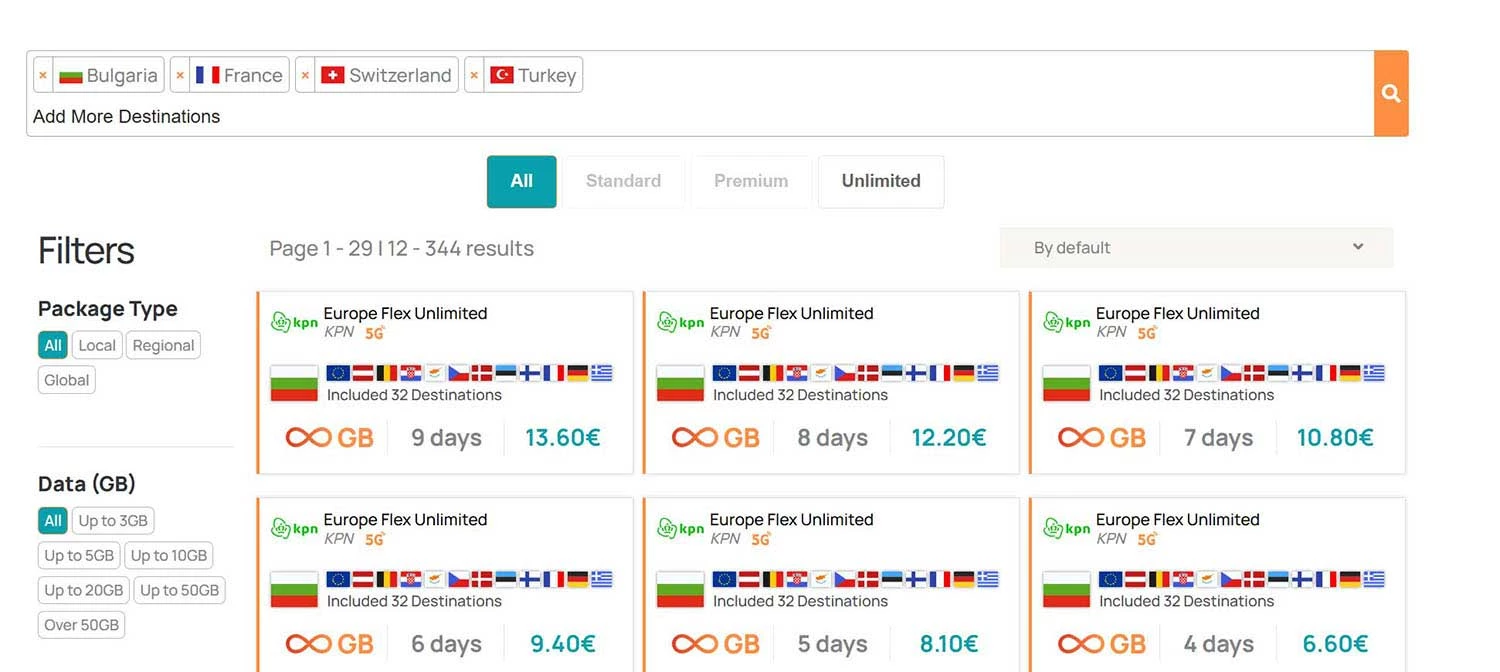
The mechanics of this intelligent search function are designed to eliminate manual cross-referencing entirely. Rather than forcing you to isolate your search to a single geographic parameter, the system allows you to build a comprehensive list of your required coverage areas before you even look at a single product.
Consider an extensive European road trip. You type Germany, France, Austria, Italy, Switzerland, the Netherlands, Belgium, Spain, and Portugal into the search engine all at once. You are asking the system a highly specific question: "Which of your products will keep me online in every single one of these locations?"
You hit the search button. In a matter of seconds, the algorithm scans the entire inventory and instantly filters out any package that drops coverage in even one of those specified countries. If a plan covers eight of those countries but fails to provide service in Portugal, it is immediately removed from your view. The only products that remain on your screen are the exact, verified matches that guarantee full coverage for your entire journey.
If your travels take you to other parts of the world, this multi-destination logic applies just as flawlessly. You can easily find comprehensive coverage by exploring a Latin America eSIM, a North America eSIM, or a Middle East eSIM that perfectly aligns with your multi-stop itinerary.
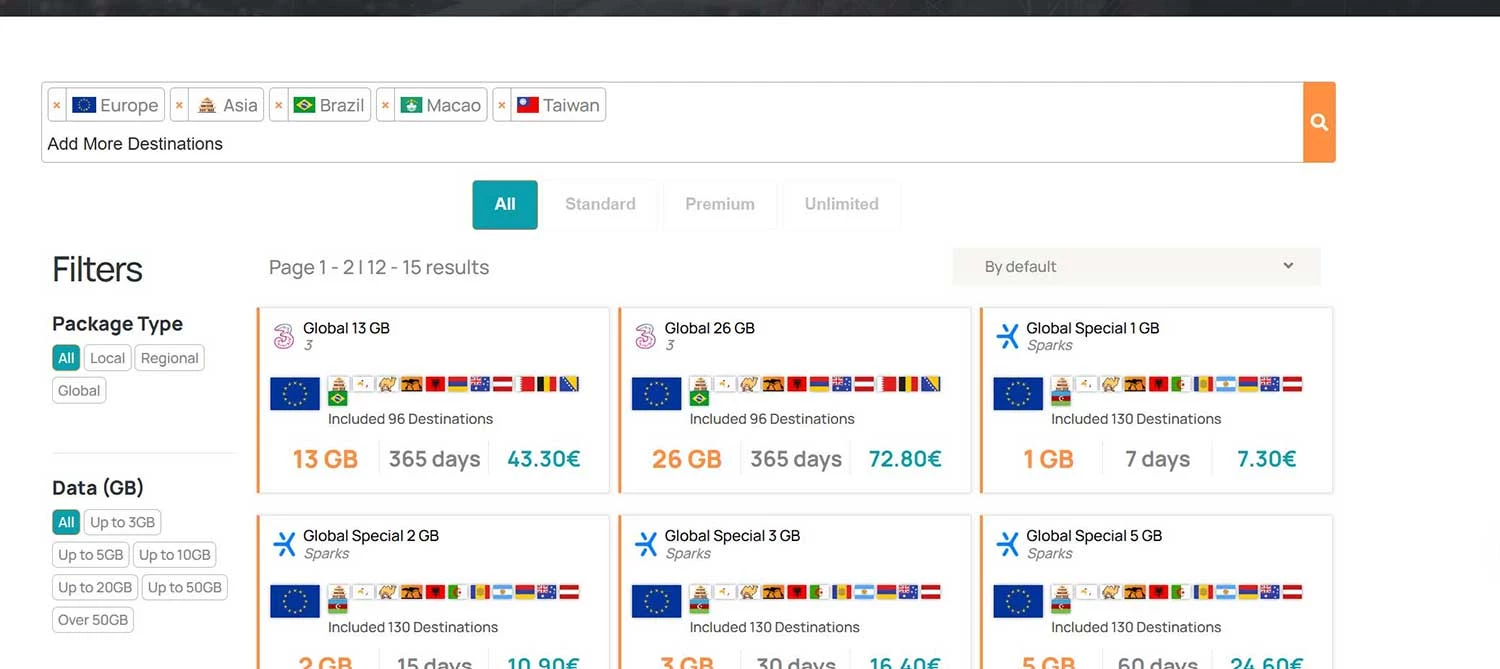
The most significant benefit of this consolidated search functionality is the total elimination of guesswork. When you are planning an expensive, highly coordinated international trip, the last thing you want is uncertainty regarding your ability to navigate, translate, or communicate.
With traditional search methods, travelers constantly second-guess their purchases. They find themselves forced to read through dense, complicated coverage sheets. They have to check operator by operator, verifying if a specific telecom company in one nation has an active roaming treaty with a provider in the next. They have to open fifteen different product pages just to find the overlapping territories and ensure there are no hidden dead zones in their coverage map.
An intelligent multi-destination search engine takes on this entire burden. Because the system's logic validates the network availability against your specific input, you do not have to worry about the technical details. The platform handles the complexity behind the scenes, allowing you to purchase with absolute confidence.
Flexibility is paramount when planning international travel, and modern search tools accommodate both broad strokes and highly specific routing. You are not limited to typing in individual nations; you can search by massive geopolitical areas or blend different types of geographical data to match your flight path.
If you are embarking on a massive continental tour, you can simply select entire regions from the search parameters. You can filter the database by Europe, Asia, North America, the Middle East, Latin America, or Africa. Selecting one of these macro-regions will instantly display the packages designed specifically for those continents.
However, travel often defies standard geographic boundaries. What if your itinerary is highly specific and crosses multiple continental lines? You might be flying from Germany to France, then taking a long-haul flight to Japan, followed by a stop in Thailand, and finally finishing your trip in Singapore. A traditional regional plan might not cover this unique blend of European and Asian destinations. By inputting this exact combination of countries into the search bar, the engine can process these cross-continental queries and return global plans that fit that unique, personalized flight path perfectly.
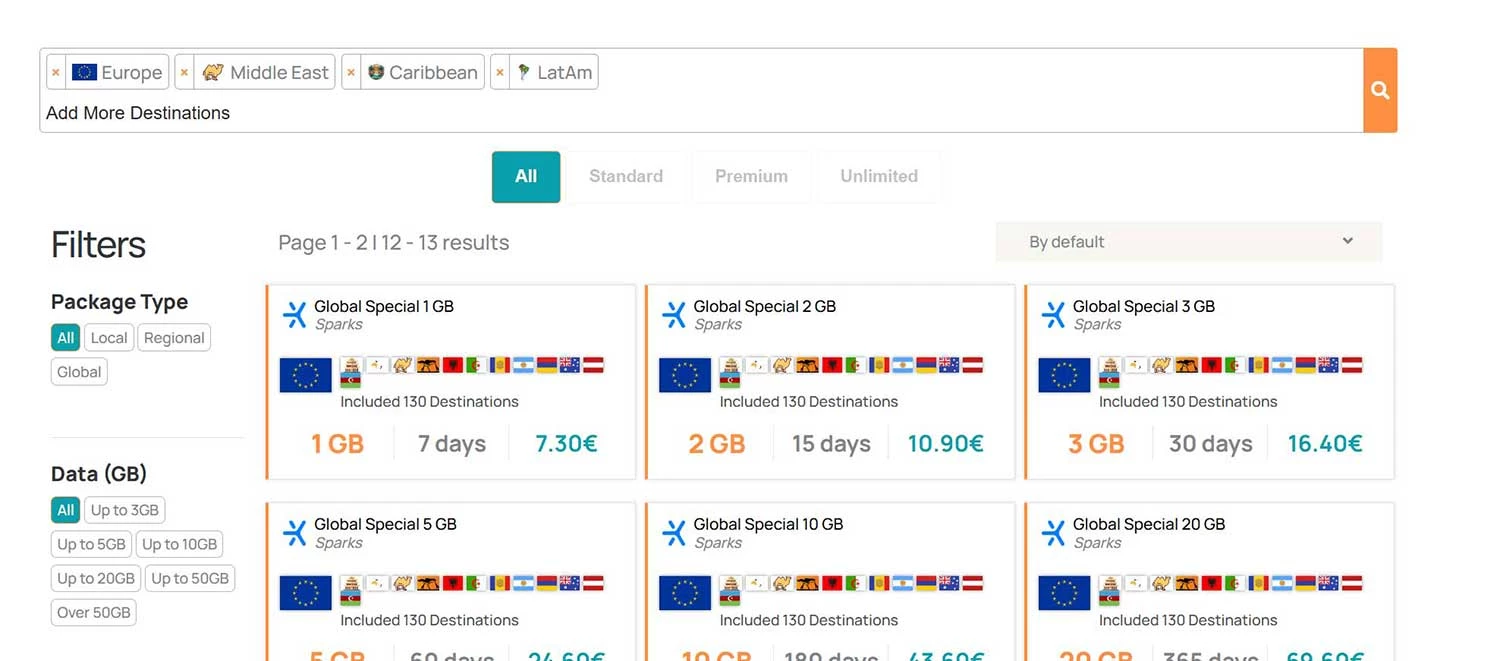
Filtering by geography is only the first half of the equation. Once the system has isolated the plans that cover your required destinations, you still need to find the specific package that matches your data consumption habits and your travel budget.
After the initial search yields the geographically compatible plans, you can utilize a suite of secondary filters to narrow down the results instantly. If you are a heavy data user who plans to stream video, conduct remote video conferences, or use your phone as a mobile hotspot for your laptop, you can immediately filter for Unlimited data packages. If you are a lighter user who only needs data for basic navigation and messaging, you can filter for fixed data tiers like 10 GB, 20 GB, 50 GB, or 100 GB.
Time is also a crucial factor. You can filter the results by the duration of your trip, selecting validity periods of 15 days, 30 days, or longer. Furthermore, you can sort the remaining options by Price, by the specific Provider issuing the plan, or even by Network preference if you have a loyalty to or preference for a specific local telecom operator's infrastructure. Because all these filters apply after the multi-country selection, you will never waste time looking at a plan that does not fit your exact criteria.
The utility of a multi-destination search and a unified data plan becomes most apparent when you look at how modern travelers actually move through the world. Fast-paced, multi-country itineraries are increasingly common, and the logistics of staying connected must keep up with the speed of travel.
Consider the classic European road trip. You rent a car in Germany and plan to drive through Austria, Italy, France, and Spain. In Europe, border crossings happen incredibly fast. You might have breakfast in Munich, drive through the Austrian Alps by midday, and arrive in Northern Italy for dinner. If you rely on single-country plans, you would lose your GPS navigation connection every time you crossed a border, forcing you to pull over, connect to a roadside diner's Wi-Fi, and install a new digital profile. With a single regional plan covering all those nations, your phone simply switches towers automatically as you drive, ensuring uninterrupted navigation.
The same logic applies to an Asian backpacking adventure or a multi-city business tour. An itinerary spanning Japan, South Korea, Singapore, Malaysia, and Thailand involves multiple flights and distinct cultures. Having to source local connectivity in five different airports is exhausting. A unified plan means one single QR code, one seamless installation, and one activation process that covers the entire journey.
To summarize the differences and help you identify the most appropriate category for your next journey, here is a clear breakdown of how the three main types of digital cellular plans compare.
|
Local |
Regional |
Global |
|
1 country |
Multiple countries |
Worldwide |
|
Cheapest |
Best value |
Maximum flexibility |
|
Good for one destination |
Best for trips |
Best for frequent travelers |
Understanding this hierarchy allows you to align your purchase with your travel style. Local plans prioritize absolute lowest cost for stationary trips. Regional plans offer the best overall value by balancing broad coverage with competitive pricing, making them the standard choice for vacations and tours. Global plans prioritize maximum flexibility, ensuring that highly mobile professionals never have to worry about their connectivity, regardless of where their next flight lands.
There are several specific travel scenarios where opting for a regional package is not just a convenience, but a significant strategic advantage that saves both time and money.
A standard Europe holiday is the most common example. Whether you are utilizing a Eurail pass to hop between capital cities or flying on budget airlines from London to Rome to Barcelona, the ability to maintain a single data balance across the entire continent removes a massive layer of logistical stress from your vacation.
A Balkan road trip presents a slightly different challenge. Many countries in this region fall outside of standard European Union roaming regulations. Buying physical SIM cards in these nations can sometimes involve complicated registration processes, language barriers, and providing extensive documentation just to get a few gigabytes of data. A regional plan that encompasses these non-EU nations bypasses this bureaucracy entirely, keeping you online as you drive across borders.
Travelers exploring South America or Southeast Asia face similar dynamics. These regions feature incredible geographic diversity and require frequent flights or long bus rides between nations with entirely different technological infrastructures. Arriving in a new, chaotic transportation hub is stressful enough without the added pressure of negotiating for a local data plan with currency you have just exchanged.
Finally, business travel and cruises are prime candidates for regional coverage. A business professional might touch down in three different financial hubs over the course of a single workweek, requiring instant, reliable access to email and cloud services the moment the plane reaches the gate. Similarly, a cruise passenger will wake up in a new port in a completely different country every morning. A regional package ensures that connectivity is waiting for them the moment they walk down the gangway.
When evaluating the benefits of a unified connectivity solution, the conversation often defaults to financial savings. While avoiding multiple activation fees certainly protects your travel budget, the true value of a regional or global plan lies in the preservation of your time and the elimination of friction.
Managing connectivity should be invisible, not a daily chore. When you utilize a single plan for a multi-country trip, you are issued exactly one QR code. You perform one installation process while you are still sitting comfortably at home on your own secure Wi-Fi network. There is only one activation sequence, which happens automatically the moment you connect to a supported network abroad.
Furthermore, you only have one data balance to monitor. If you buy six different local plans, you are constantly trying to remember if you have two gigabytes left in France or five gigabytes left in Italy. A unified plan pools your data into a single, easily manageable balance for the duration of your trip. It results in significantly less hassle, a cleaner device settings menu with fewer profiles to manage, and absolutely zero manual switching required when your train, car, or plane crosses an international border.
The logistics of international travel are complex enough without adding the burden of managing half a dozen different cellular contracts. If your trip includes more than one destination, choosing a regional eSIM is often the easiest and most cost-effective solution.
Instead of searching country by country, simply enter every destination and let the search show only the plans that cover your entire journey. By leveraging modern, multi-destination search technology, you can secure seamless, borderless connectivity in seconds, allowing you to focus entirely on the experience of the journey itself.
Yes, a single digital profile can easily keep you connected across several nations. Regional and global eSIMs are specifically designed to partner with various local networks, eliminating the need to buy separate plans. As long as your itinerary matches the covered destinations, you will enjoy seamless internet access throughout your trip.
No, you do not need to install a new profile if you are using a multi-country plan. Your device will temporarily lose signal at the border before automatically connecting to the new country's supported network. Just make sure your data roaming is turned on in your device settings for the transition to work.
Yes, modern digital plans are configured to seamlessly transition between partner networks as you travel. Once you arrive in a new covered territory, your phone's antenna will detect the local provider and authenticate your connection. This background process usually takes just a few moments, keeping you online without any manual intervention.
If you are visiting three or more countries, a regional package is almost always more cost-effective. Buying separate local plans means paying multiple activation fees and wasting unused data every time you leave a nation. A unified regional plan pools your data allowance, offering much better overall value for multi-stop journeys.
The coverage depends entirely on the specific package you choose before your trip. Some regional plans cover a handful of neighboring countries, while broader continental packages can include over 40 nations. Global options offer the most extensive reach, providing connectivity in over 100 countries worldwide with just one digital profile.
Yes, advanced search platforms now allow you to input your exact itinerary to find the perfect match. You can simply enter all the countries you plan to visit simultaneously into the search bar. The system will then instantly filter the results and display only the plans that offer guaranteed coverage for your entire route.
If your regional plan does not include a specific stop on your journey, your mobile data will temporarily stop working while you are within those borders. In such cases, you can easily purchase and install an additional local plan just for that specific destination. Your phone can store multiple profiles, allowing you to switch back to your regional plan once you leave that country.
A regional plan is the best choice if your trip is confined to a specific continent or geopolitical area, like a tour of Europe or Southeast Asia. However, if your itinerary involves crossing multiple continents or having frequent long-haul layovers, a global package is much more convenient. Assess your flight path carefully to determine which option provides the most uninterrupted coverage for your needs.
Absolutely, a unified European plan is the perfect solution for driving across borders. It allows your GPS navigation apps and streaming services to run smoothly without dropping out every time you enter a new country. This completely eliminates the stress of having to pull over and find local Wi-Fi to buy a new data package.
Yes, it acts as a universal key that grants your device access to various local telecom operators. As you move from one country to another, the eSIM communicates with local cell towers and automatically switches to the designated partner network. You simply need to leave your data roaming enabled and let the technology handle the technical details in the background.