21.07.2026
Planning a trip abroad? Discover whether 5G really makes a difference for travelers, when 4G is more than enough, and how to choose the right mobile connection for your next destination. Explore flexible international coverage with Travel eSIM Plans.
When mobile carriers market 5G, they focus heavily on eye-watering top speeds and futuristic technology. But for someone landing at an airport in a foreign country with a suitcase in one hand and a smartphone in the other, technical specs matter far less than real-world performance.
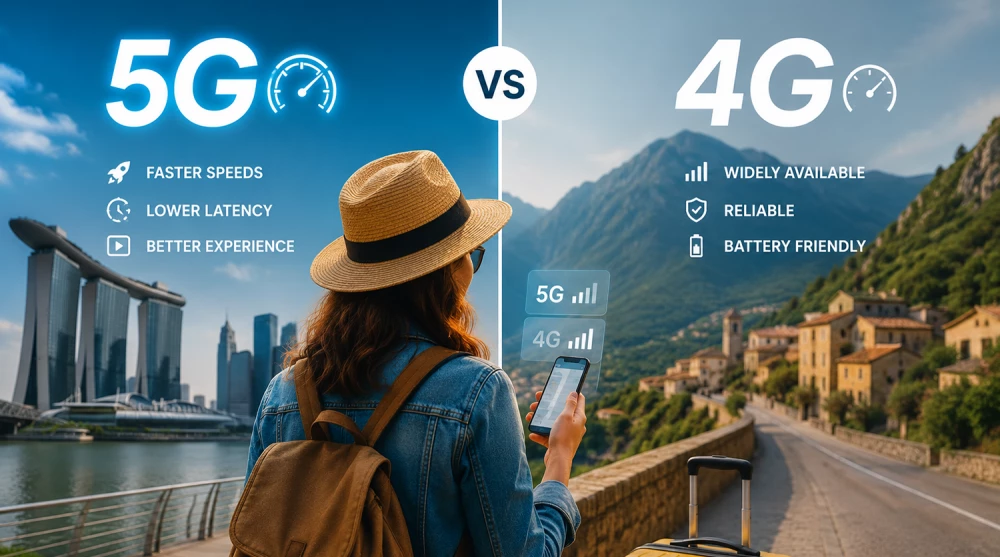
To understand how network generations affect your trip, you do not need a degree in telecommunications engineering. The differences between 4G (LTE) and 5G come down to four core pillars:
Marketing campaigns suggest that traveling without 5G means settling for a second-class experience. In reality, the impact of 5G on your day-to-day travel activities varies dramatically depending on what you are doing with your phone.
It sounds counterintuitive, but there are many travel situations where intentionally using 4G results in a smoother, less frustrating experience than chasing a 5G connection.
Yes, 5G drains your smartphone battery faster than 4G—and understanding why can help you manage your device’s power while on the move.
The primary reason for battery drain lies in how 5G infrastructure is deployed globally. Most operators use Non-Standalone (NSA) 5G networks. Under an NSA deployment, your phone does not connect to 5G alone; it maintains an active 4G connection for background signaling and control while opening a second 5G channel for high-speed data transmission. Running two cellular radios simultaneously requires significantly more power.
Furthermore, because 5G networks are still expanding, cell towers are spaced further apart than mature 4G towers. When your phone is far from a 5G tower or indoors behind thick walls, it boosts its internal transmitter power to maintain the connection. This extra power output generates heat and rapidly drains battery capacity.
Traveler Tip: If you are embarking on a long sightseeing day, navigating unfamiliar streets, or traveling on an overnight bus where charging ports are unavailable, turn off 5G in your phone's cellular settings. Operating purely on 4G can keep your device running several hours longer.
5G deployment varies wildly across continents. Some countries boast near-universal coverage in urban centers, while in others, 4G remains the main backbone of mobile connectivity.
In these tech-forward destinations, 5G coverage is widespread, highly reliable, and delivers blistering speeds even on public transit systems and indoors.
In many popular travel destinations, 5G is still limited to tiny financial districts or undergoing early testing. In these regions, 4G LTE is the gold standard for speed and broad coverage.
A common misconception among travelers is that buying a modern digital SIM card automatically gives you 5G access. The short answer is no—not every eSIM supports 5G.
Whether your travel eSIM connects to 4G or 5G depends on four distinct factors working together:
When purchasing an eSIM, always check the plan details. If a plan is listed as 4G/LTE, it will deliver fast, reliable data on local 4G networks—which, as we have seen, is more than enough for almost every travel need.
Manually switching your smartphone’s network mode to "4G Only" or "LTE Only" is one of the most effective, underutilized travel hacks. While automatic mode works fine in your home country, roaming in foreign environments presents unique challenges.
Here are key scenarios where forcing 4G makes sense:
To help you decide whether seeking out a 5G connection is worth the effort, here is a practical side-by-side comparison of everyday travel activities on 4G versus 5G:
| Travel Activity | 4G Performance | 5G Performance |
| Google Maps & Navigation | ✅ Excellent | ✅ Excellent |
| WhatsApp & Messaging | ✅ Instant | ✅ Instant |
| Instagram & TikTok | ✅ Smooth | ✅ Smooth |
| Email & Web Browsing | ✅ Instant | ✅ Instant |
| HD Video Calls | ✅ Good | ⭐ Superior in crowds |
| 4K Video Streaming | ✅ Good (occasional buffer) | ⭐ Instant buffering |
| Cloud Photo Backup | ⚠ Slow (drains power) | ✅ Ultra-fast |
| Downloading Large Files | ⚠ Moderate wait times | ✅ Seconds |
Legend: ✅ Works great | ⭐ Noticeable improvement | ⚠ Slow or inefficient
Separating network marketing from reality helps you avoid common connection pitfalls while traveling abroad.
Before heading out on your next international journey, use this checklist to ensure your mobile connection works smoothly without unexpected hiccups:
When traveling abroad, 5G is a fantastic luxury, but it is far from a necessity.
For the vast majority of international tourists, a healthy 4G LTE network delivers more than enough speed for navigation, instant messaging, social media updates, and video calls. In fact, intentionally choosing 4G often grants you better battery life, wider rural coverage, and a more stable overall connection.
Rather than stressing over whether your phone displays a 5G icon, focus on securing reliable coverage, managing your device's power, and choosing a dependable travel eSIM tailored to your destination. At the end of the day, staying seamlessly connected to what matters is what turns a good trip into a great one.
For basic tasks like navigation on Google Maps, messaging, and social media, you will not notice a major difference between 4G and 5G. However, 5G truly shines in heavily crowded areas like airports or train stations where 4G networks often slow down due to congestion. It also makes uploading large high-resolution photos and 4K video clips to the cloud significantly faster. For most everyday travel activities, a healthy 4G connection is already more than fast enough.
Yes, 4G LTE easily handles almost every common travel activity, including real-time translation, HD video calling, and streaming music or video. It provides reliable speeds that comfortably exceed what is required for navigation apps and browsing the web. In fact, 4G often delivers broader and more consistent coverage in rural, mountainous, or coastal regions compared to 5G. This makes a solid 4G connection a completely dependable choice for international trips.
Yes, maintaining an active 5G connection drains your smartphone battery faster than operating on 4G. This happens because many global networks use Non-Standalone 5G, which forces your phone to connect to both 4G and 5G towers simultaneously. Additionally, if the 5G signal is faint, your device increases transmitter power to hold the connection, generating extra heat and draining power rapidly. Manually switching your device to 4G can extend your daily battery life by up to 25% when exploring all day.
Yes, modern smartphones automatically toggle between 5G and 4G based on signal strength and availability. When you move away from a 5G coverage zone, your phone quietly drops back to 4G to keep your data flowing without interruption. However, frequent switching in areas with patchy 5G coverage can cause minor lag spikes and drain your battery faster. Locking your phone to 4G in settings during long travel days eliminates this signal hunting.
5G coverage is heavily concentrated in major metropolitan areas, transit hubs, and commercial centers. Outside these urban zones, telecom infrastructure relies almost entirely on widely deployed 4G LTE base stations. Furthermore, high-frequency 5G signals struggle to penetrate concrete walls, thick foliage, or geographical barriers like hills and valleys. Your connection also depends on whether your travel plan includes active 5G roaming access with local operators.
Not all travel eSIM plans automatically include 5G access, as connectivity depends on specific roaming agreements with foreign operators. While some plans explicitly offer 5G capabilities, others are intentionally provisioned for 4G LTE to deliver more affordable pricing and consistent coverage. Before purchasing, check the product details of your chosen travel package to see which network generations are supported. Even on a 4G-only plan, you will still enjoy fast and seamless mobile data throughout your journey.
5G features lower latency and higher capacity, which helps keep HD video calls crisp and lag-free even in crowded public places. It also allows 4K Ultra HD video streams to buffer instantly without temporary pauses. However, for standard 1080p streaming and casual calls to family back home, a stable 4G connection performs remarkably well. 5G is primarily beneficial if you are attempting high-bandwidth tasks in dense crowds.
No, 5G deployment varies significantly across different parts of the world. Tech-forward destinations like South Korea, Japan, Singapore, and the UAE boast widespread, high-speed 5G networks in urban areas. In contrast, many popular tourist destinations in Southeast Asia, Africa, and Latin America still rely primarily on reliable 4G LTE infrastructure. Always review destination-specific network details when planning your mobile data needs abroad.
For the vast majority of travelers, a high-speed 4G eSIM provides more than enough bandwidth for maps, social media, messaging, and web browsing. Choose a 5G plan if you plan to upload massive video files, work remotely with large cloud backups, or travel to major cities with universal 5G coverage. Otherwise, a reliable 4G plan often offers better battery efficiency, wider coverage in regional areas, and better overall value.
First, ensure your smartphone model includes built-in 5G hardware, which is standard on iPhone 12 or newer, Samsung Galaxy S20 or newer, and Google Pixel 5 or newer. Second, check your device's cellular settings menu to verify that 5G options (such as 5G Auto or 5G On) are enabled. Finally, keep in mind that international 5G compatibility also depends on whether your phone hardware supports the specific frequency bands used in your destination country.