21.05.2026
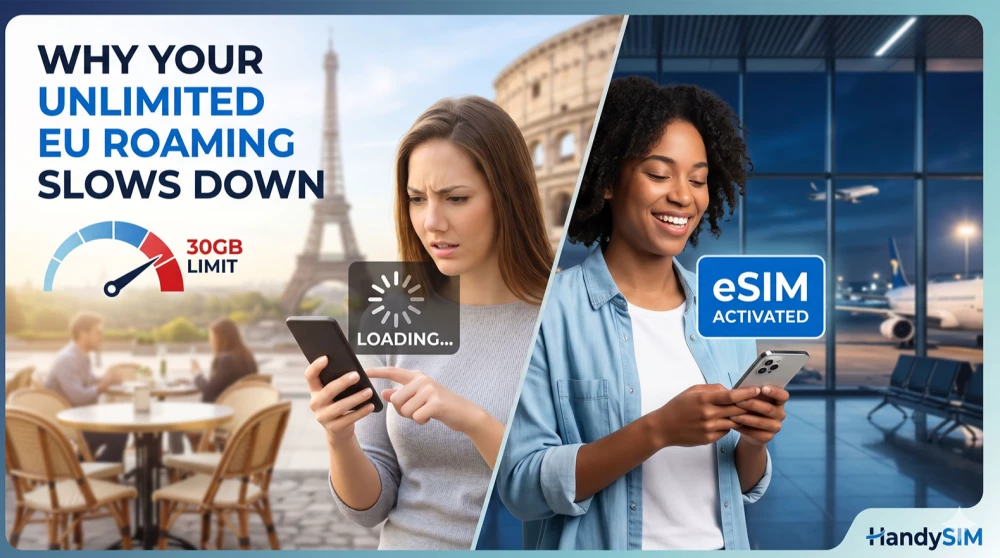
Many travelers believe that their domestic unlimited data plan translates to truly unlimited internet abroad. In reality, almost all mobile operators enforce a Fair Usage Policy. Once you hit a specific threshold, you face severe speed throttling, network deprioritization, or extra charges. This is especially true for European travel, leading many to seek alternative travel eSIM plans for Europe to maintain a stable connection.

When the European Union introduced the "Roam Like at Home" regulation, it was hailed as a massive victory for consumers. The legislation mandated that mobile operators could no longer charge prohibitive daily fees or excessive per-megabyte rates when their customers traveled to other member states.
However, this regulation was designed specifically for periodic travel, such as short holidays or brief business trips. It was never intended to support permanent roaming or heavy, continuous data consumption outside of a user's home country.
To protect domestic telecom companies from financial losses, the regulation allows operators to implement a Fair Usage Policy (FUP). This means that "unlimited" rarely means unlimited high-speed data when you cross a border.
Instead, your operator calculates a specific roaming allowance based on the wholesale cost of data. Depending on how much you pay for your monthly domestic contract, your actual high-speed roaming allowance will usually hit a hard ceiling.
Typical limits implemented by major domestic carriers include thresholds of 20GB, 30GB, or occasionally 50GB.
Once you consume this allocated amount, your operator will take immediate action to curb your usage. The most common response is a severe speed cap, throttling your connection down to 2G or 3G speeds.
In other instances, you will face aggressive deprioritization, where local users are given preference on the cell tower, leaving you with page load errors. Finally, some operators will simply cut your data off entirely or apply a per-gigabyte surcharge for any continued usage.
For travelers who rely heavily on mobile data for navigation, remote work, or entertainment, hitting this invisible ceiling can ruin a trip. This is why understanding your exact limits and exploring dedicated high-data Europe plans before departure is highly recommended.
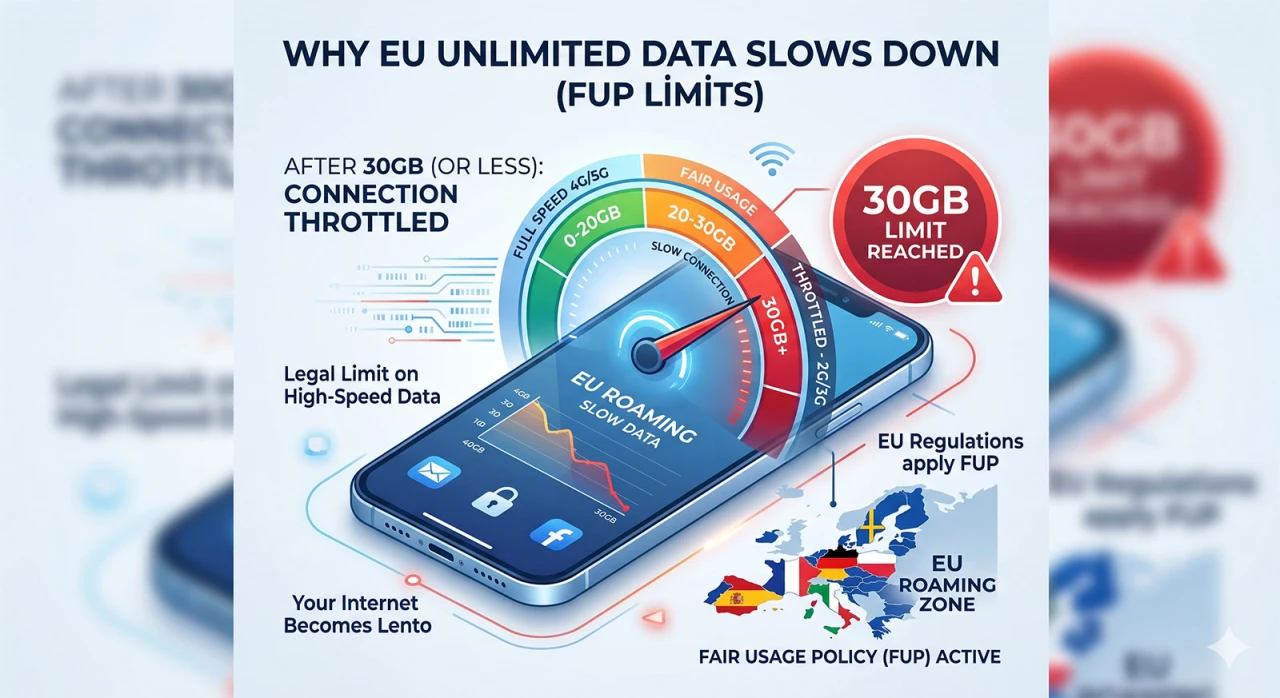
Understanding why your connection suddenly drops to a crawl requires a brief look at the economics of international telecommunications.
When you use your phone abroad, your home operator does not own the cell towers you are connecting to. Instead, they must establish roaming agreements with foreign local operators.
These agreements cost money. Every single time you download a file, stream a song, or load a map in another country, your domestic operator must pay a wholesale price per gigabyte to the local network hosting you.
While these wholesale caps are regulated within the EU, they still represent a direct financial loss for your home provider if you consume massive amounts of data. Heavy users cost operators a significant amount of money.
To mitigate these costs and maintain their profit margins, domestic operators utilize automated network management systems. Once a user crosses the predefined 20GB or 30GB threshold, the system automatically intervenes.
The primary intervention is speed throttling. The operator artificially caps your bandwidth, reducing it from high-speed 4G or 5G down to speeds barely capable of sending a basic text message.
The second intervention is traffic shaping. Operators can identify the type of data you are consuming and selectively slow down high-bandwidth activities while allowing basic web browsing to function normally.
This financial and technical reality means certain types of travelers hit these hidden limits incredibly fast:
Because domestic operators are fundamentally disincentivized to provide you with massive amounts of cheap data abroad, heavy users must look toward alternative solutions that are designed specifically for high-volume consumption.
A Fair Usage Policy (FUP) is a set of rules outlined in the terms and conditions of your mobile contract. It gives the network provider the legal right to restrict your service if they determine your usage is excessive or abusive.
Almost every operator has an FUP. While telecom marketing departments loudly advertise "Unlimited Data," the restrictive clauses of the FUP are often hidden deep in the small print of your service agreement.
This policy applies heavily to roaming, as the costs associated with international data transfer are significantly higher than domestic routing. However, it also frequently applies to personal hotspot usage, even when you are in your home country.
Many operators explicitly state that unlimited plans are for personal smartphone use only. If they detect that you are using your phone as a permanent router for multiple devices, they will invoke the FUP to throttle your speeds.
Furthermore, the EU roaming regulation includes a specific four-month tracking rule. If an operator observes that you have spent more time abroad than at home over a continuous four-month period, they can legally assume you are permanently roaming and begin applying surcharges to your account.
Many travelers discover this only after their speeds suddenly become unusable abroad. You might be in the middle of a foreign city trying to load directions to your hotel, only to find that your map application constantly times out because you watched a movie on the train earlier that day.
Understanding that the FUP exists is the first step in protecting your connectivity. It is not a suggestion; it is an automated network rule that will inevitably trigger if you rely solely on a domestic unlimited contract while traveling.
To bypass the restrictive thresholds and unpredictable throttling of domestic roaming plans, experienced travelers utilize alternative methods to secure reliable internet access.
The goal is to find a solution that offers a transparent data allowance without hidden speed caps or punitive fair usage clauses.
The traditional method is to purchase a local physical SIM card upon arrival. By buying a package directly from a provider in the country you are visiting, you operate on a domestic tariff rather than a roaming tariff. This entirely bypasses your home operator's FUP. While effective for single-country trips, this method becomes complicated if your itinerary involves crossing multiple borders.
The modern alternative is to download a dedicated digital profile directly to your smartphone. These packages are specifically engineered for international visitors. Because you pay a transparent, upfront price for a set data allowance, the provider has no incentive to throttle your speeds midway through your trip. You get exactly what you pay for.
If you are spending two weeks strictly in one location, purchasing a localized package offers excellent value. These plans tap directly into the primary national infrastructure, ensuring low latency and high priority on the cell towers.
For heavy users, the best strategy is to purchase a prepaid travel package that offers massive, defined data bundles (such as 50GB or 100GB). Because the limit is explicitly stated, you do not have to worry about the vague "fair usage" rules that plague domestic unlimited contracts.
| Option | Pros | Cons |
| Domestic EU Roaming | Free to use initially; keeps your primary number active seamlessly. | Hidden FUP limits; severe speed throttling after 20-30GB; high risk of extra charges. |
| Local Physical SIM Card | Access to local domestic data rates; avoids home operator limits. | Requires removing your primary SIM; language barriers during purchase; inconvenient for multi-country travel. |
| Dedicated Travel eSIM | Instant digital setup; highly transparent data limits; allows dual SIM usage. | Requires a modern, compatible smartphone; initial setup requires an active internet connection. |
| Public Wi-Fi Networks | Completely free to use; widely available in cafes and hotels. | Severe security risks; incredibly slow during peak hours; completely useless for navigation while moving. |
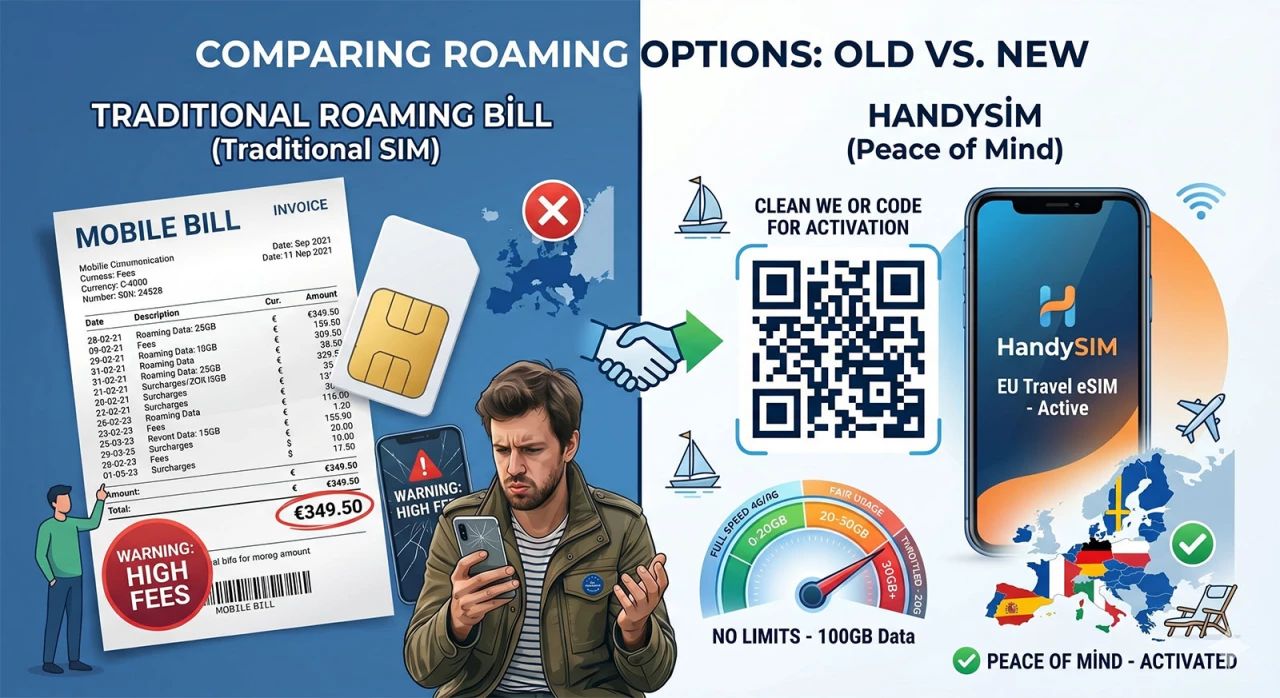
When comparing standard roaming against a dedicated travel profile, the advantages of the latter become very clear, particularly for users who require reliable, high-speed connectivity.
The fundamental difference lies in network architecture. Standard roaming relies on a process called "home routing." When you open a webpage in Madrid using an English SIM card, your data request is routed from Spain, all the way back to servers in the UK, and then out to the internet. This massive physical distance creates high latency, resulting in sluggish load times even if you have a 4G connection.
Dedicated travel data, on the other hand, frequently utilizes local or regional breakout points. Because these profiles are designed explicitly for international use, they negotiate direct local roaming agreements with top-tier networks. Your data request stays within the region, providing a much faster, more responsive browsing experience.
Furthermore, travel profiles provide highly transparent limits. You purchase a specific data package, and you can track your exact usage down to the megabyte via your smartphone settings. There is no guessing when an invisible fair usage policy will trigger.
Hotspot support is another major advantage. While domestic operators frequently restrict tethering while roaming to prevent bandwidth drain, prepaid travel profiles almost universally allow unrestricted hotspot usage until your purchased data allowance is fully consumed.
Finally, the ease of activation makes digital profiles superior. You can browse and select the best prepaid Europe mobile data packages from the comfort of your home, install the profile before heading to the airport, and instantly connect to the local network the moment your plane lands.
While fair usage policies apply uniformly across the continent, travelers report hitting these frustrating speed caps much more frequently in certain high-traffic destinations.
This usually occurs due to a combination of high tourism volume, congested local networks during peak summer months, and strict data monitoring by the hosting telecom operators.
Germany is a major business and transit hub, meaning mobile networks handle an immense amount of international traffic daily. Some users report that roaming speeds can fluctuate significantly depending on the specific domestic partner network their home SIM connects to. Because the country is vast, travelers relying on navigation and translation apps consume data quickly. To bypass these issues, many travelers notice better stability by utilizing a dedicated Germany eSIM that connects directly to primary networks without home-operator interference.
From the busy streets of Paris to the rural roads of Provence, France is one of the most visited countries in the world. During the peak summer tourist season, cell towers in popular areas become highly congested. When local networks get busy, roaming users are often the first to experience deprioritization. Slower speeds make it difficult to load high-resolution maps or upload photos. Using a specific France eSIM ensures you operate on an independent data allowance, shielding you from domestic throttling rules.
Spain attracts millions of tourists who spend extensive time outdoors, relying heavily on mobile data for beach navigation, restaurant reviews, and ride-sharing services. The heavy reliance on mobile internet over hotel Wi-Fi means travelers hit their 30GB roaming limits remarkably fast. Once the FUP triggers, streaming music or video calling home becomes impossible. Securing a prepaid Spain eSIM guarantees a defined, high-speed data pool that won't suddenly drop to 3G speeds in the middle of your holiday.
Italy's geography, characterized by dense historical city centers and mountainous regions, makes network management challenging. Many travelers notice that their domestic unlimited plans struggle to maintain consistent high-speed connections as they move between cities like Rome, Florence, and Venice. To maintain a robust connection for booking train tickets and navigating winding streets, utilizing an Italy eSIM provides a much more reliable and transparent mobile data experience.
The concept of unlimited mobile data is a powerful marketing tool, but in the context of international travel, unlimited roaming is rarely truly unlimited.
The reality of wholesale data costs and network management means that a Fair Usage Policy exists almost everywhere. Whether it triggers at 20GB, 30GB, or 50GB, the resulting speed throttling and deprioritization can severely impact your travel experience.
Relying blindly on your domestic contract leaves you vulnerable to sudden connectivity drops at the worst possible moments. Understanding your specific limits and the mechanics behind data throttling before traveling matters immensely.
Travelers who need stable high-speed internet often prefer dedicated Europe eSIM plans with clear data limits and hotspot support. By taking control of your international connectivity upfront, you ensure a seamless, stress-free digital experience wherever your journey takes you.
Mobile data speeds slow down because domestic operators implement a legally permitted Fair Usage Policy (FUP). Even on "unlimited" home contracts, carriers are charged wholesale fees by foreign networks for the data you use abroad. To protect their financial margins, they drastically throttle your speed (often down to 2G/3G or 128 kbps) once you cross their hidden calculated data threshold.
Traveler Tip:
The Fair Usage Policy (FUP) is a regulatory mechanism built into the EU's "Roam Like at Home" initiative. It allows telecom companies to cap high-speed data usage abroad based on a strict legal formula: (Monthly Contract Price ÷ Current EU Wholesale Rate) × 2. Any data consumed past this calculated volume is legally subject to speed throttling or heavy surcharges.
Traveler Tip:
No, "unlimited" mobile data in Europe is almost never truly unlimited when roaming. While you may have infinite data within your home country, EU regulations explicitly permit operators to enforce data ceilings when you cross international borders. Once you hit this invisible cap, your connection is either heavily throttled or billed per gigabyte.
Traveler Tip:
Your internet is slower abroad due to two main reasons: data deprioritization and network routing latency. Foreign cellular towers prioritize their own local, direct subscribers over roaming tourists. Additionally, your mobile traffic must be routed from the foreign country back to your home operator's servers before reaching the internet, creating massive lag.
Traveler Tip:
Yes, virtually all European mobile operators apply roaming limits on competitive or unlimited plans to prevent "permanent roaming" and financial losses from wholesale network fees. While a few premium, high-cost contracts offer larger caps, standard consumer plans universally enforce strict Fair Usage Policies (FUP).
Traveler Tip:
Yes, a dedicated travel eSIM completely avoids domestic roaming speed throttling. Because a travel eSIM operates on a standalone, prepaid mobile data profile independent of your home network carrier, it does not fall under your domestic plan's hidden Fair Usage Policy (FUP) restrictions or speed caps.
Traveler Tip:
Once you reach your roaming data limit in Europe, your operator will immediately restrict your device using one of two methods: artificial speed throttling down to unusable legacy speeds (2G/3G) or automated data blocking until you purchase incredibly expensive "roaming add-on" data passes.
Traveler Tip:
Yes, mobile hotspot and data tethering are heavily restricted or entirely blocked on most unlimited domestic roaming plans. Operators use Deep Packet Inspection (DPI) to detect when a phone shares its roaming data with laptops, tablets, or other devices, triggering immediate data blocks or accelerated FUP speed throttling.
Traveler Tip:
A Europe eSIM is technically superior for data-heavy travelers because it provides dedicated local network access without the hidden FUP speed limits, high latency, and deprioritization that plague standard domestic EU roaming plans. Roaming is only preferable for brief, low-data weekend trips.
Traveler Tip:
Travelers can secure fast mobile internet without roaming fees by downloading a prepaid digital travel eSIM. This technology bypasses your home carrier's roaming infrastructure entirely, routing your mobile data directly through local European telecom networks at local consumer rates, with zero hidden surcharges.
Traveler Tip: