26.05.2026
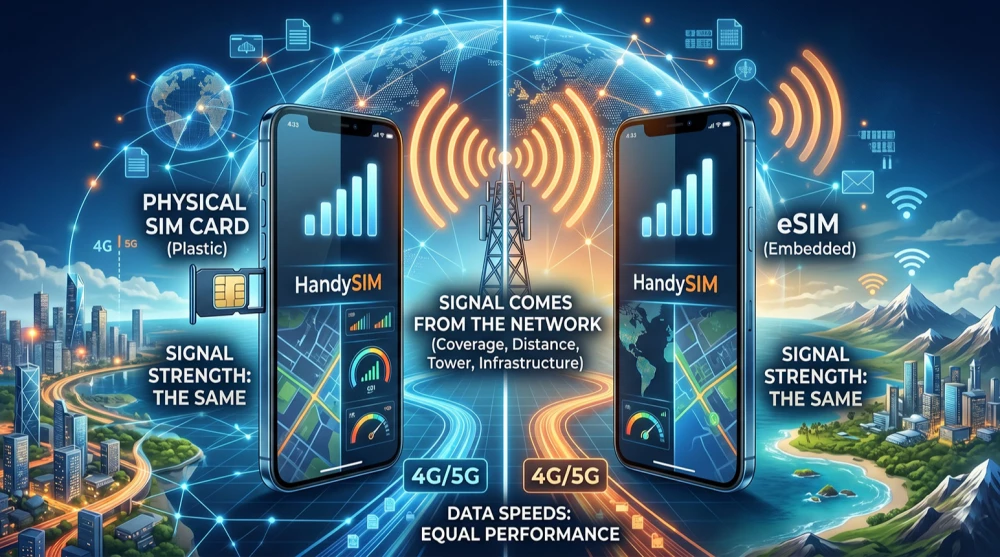
No. An eSIM does not provide better or worse signal than a physical SIM card by itself. Signal quality depends primarily on the mobile network, coverage, network priority, and local conditions rather than the type of SIM technology used. Both profiles use the exact same internal antennas and modem inside your smartphone to connect to cellular towers.
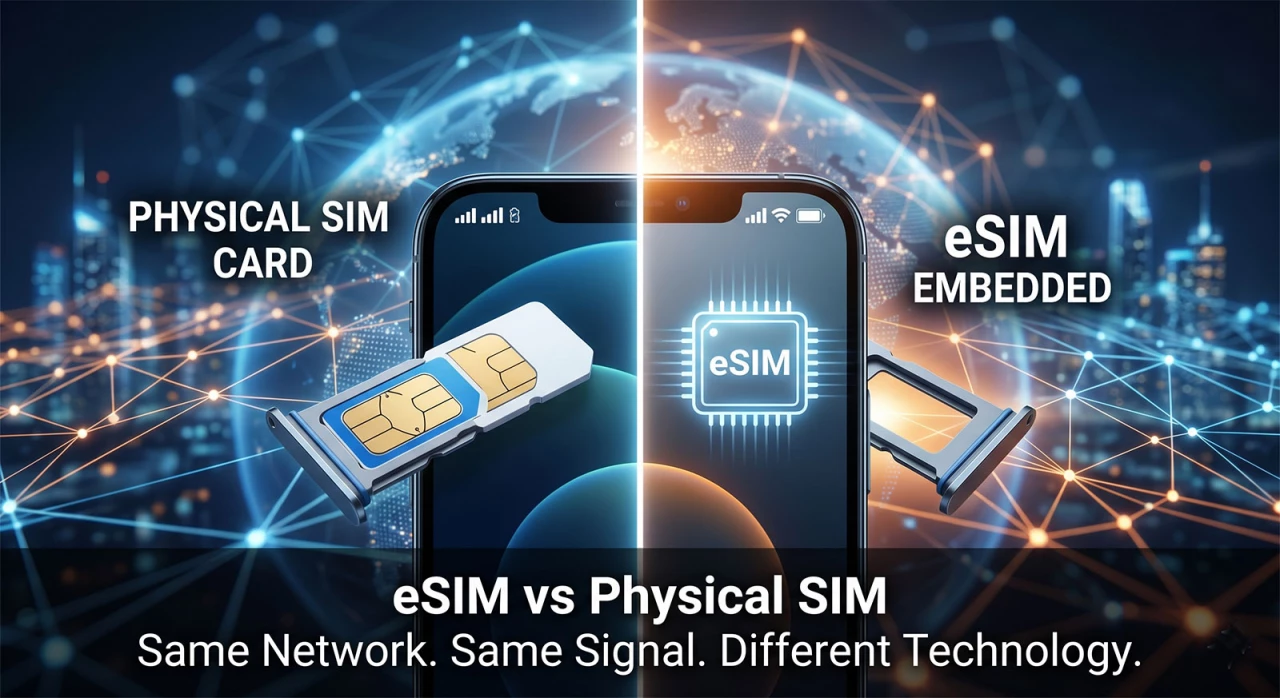
Despite the technical reality, a massive wave of confusion surrounds embedded SIM technology. As millions of travelers and digital nomads transition away from plastic cards, a common debate has emerged on travel forums and tech blogs: Does switching to an eSIM improve your reception, or does it cause dropped calls and slower data speeds? This confusion typically stems from a mix of psychological biases, hardware upgrades, and hidden network variables. When users switch to an eSIM, they are often switching network providers, upgrading to a newer smartphone, or activating a travel data plan abroad at the exact same time. These overlapping changes lead people to attribute changes in network performance to the eSIM itself, rather than the actual root causes: network coverage, roaming agreements, and infrastructure.
To understand why network signal remains unaffected by the form factor, it helps to break down what a Subscriber Identity Module (SIM) actually does. A SIM card does not pull signal from the air; it is simply a secure identification token.
[Physical SIM] ---> Removable Plastic Card ---> Slides into SIM Tray
[eSIM] ---> Built-in Motherboard Chip -> Programmed Digitally
Both technologies perform the exact same core function: they securely store your international mobile subscriber identity (IMSI) number and the authentication keys needed to validate your device with a specific carrier.
Once your identity is verified by the network, the chip's job is essentially done regarding your connection. The actual physical link to the cell tower, the transmission of data packets, and the maintenance of voice calls are handled entirely by your phone's internal modem and radio antennas. Because the handshake between the chip and the phone's processor happens at identical speeds internally, the network connection remains completely identical.
In most cases, signal strength is exactly the same. Because an eSIM relies on the identical cellular modem and internal antenna array as a physical SIM, changing the format of your subscription credential has zero impact on how your device captures radio frequencies.
Signal strength is determined by physics and radio frequency (RF) engineering. When a cell tower broadcasts a signal, your phone receives it through specialized metal antennas embedded along its outer frame or back panel. Whether your phone decodes that signal using data stored on a plastic card or an embedded chip is completely irrelevant to the radio waves themselves.
There is no such thing as a specific "eSIM antenna" or a "physical SIM transmitter" inside a modern smartphone. Both profiles share the exact same hardware path. If you are standing in a concrete basement with poor cellular reception, your phone will show one bar of signal regardless of whether you are using a legacy plastic card or a digital profile. The internal modem treats both lines as equal inputs, executing the same signal-processing algorithms to lock onto the nearest compatible cellular frequency.
If the technology is identical, why do thousands of users report a noticeable boost in reception after activating a digital profile? This misconception is driven by three distinct factors:
When people transition to an eSIM, they rarely keep the exact same plan with the exact same carrier conditions. For instance, a traveler might replace a physical SIM from a budget home carrier with a travel eSIM powered by a premium local tier-1 network. The sudden jump from two bars to five bars isn't because the technology changed—it is because the new network simply has a tower closer to their current location.
The option to use embedded profiles is exclusively reserved for modern, mid-to-high-end smartphones. When a user upgrades from an older device (like an iPhone 11) to a flagship device (like a Pixel 10 Pro XL or iPhone 15), they move to a device equipped with significantly better hardware. Newer phones feature advanced MIMO (Multiple-Input Multiple-Output) antennas and updated modems capable of aggregating multiple frequency bands simultaneously. The user notices a massive upgrade in reception and erroneously credits the eSIM, when the credit actually belongs to the brand-new smartphone hardware.
There is a natural cognitive bias to perceive a newer, entirely digital technology as superior. When a user experiences a flawless connection on a new travel profile, they consciously notice the performance and associate it with the cutting-edge setup process they just completed.
To properly evaluate your connection quality, it is important to ignore the SIM format and focus on the real real-world factors that dictate cellular reception:
Not directly. An eSIM does not alter the maximum theoretical data speed capabilities of your smartphone. However, data speeds can differ drastically between lines based on network load, subscription tiers, data priority levels, and roaming agreements.
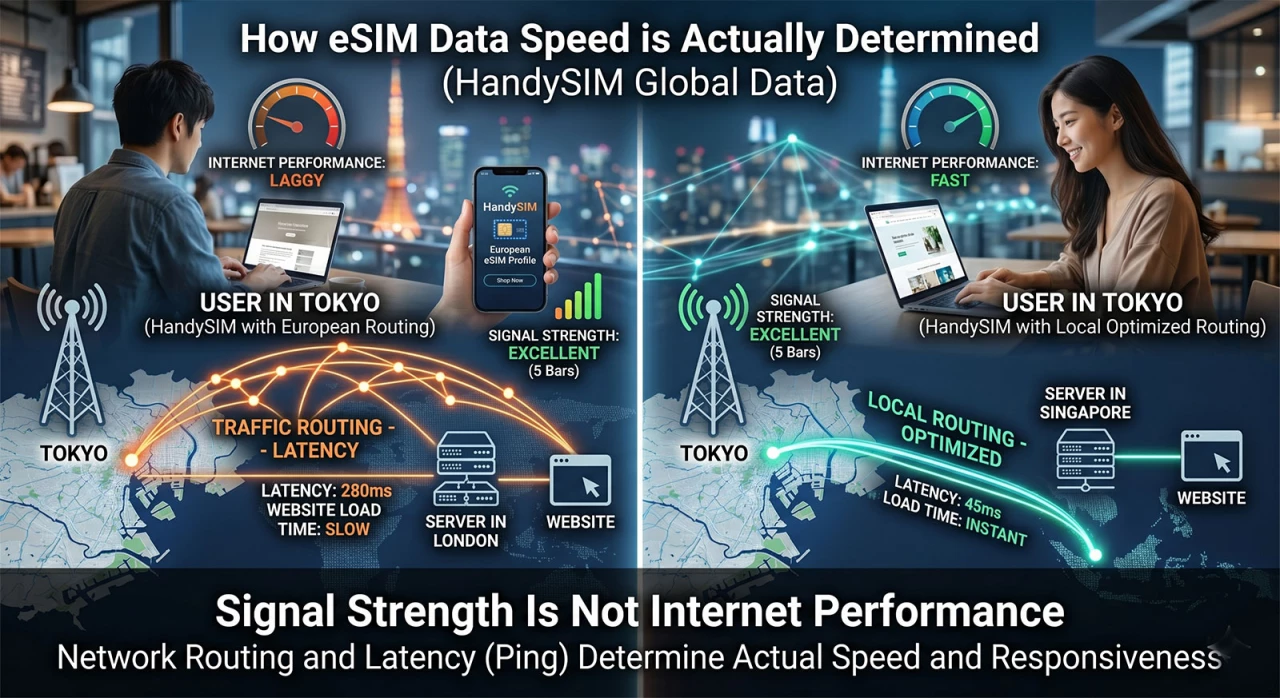
It is vital to distinguish between signal strength (how well your phone hears the tower) and data speed (how fast packets travel through the network). While an embedded profile does not inherently throttle or boost your download rates, the specific service plan attached to it absolutely does.
When you purchase a data package, your carrier assigns a specific profile to your line. This profile tells the network tower exactly how to treat your data packets. If your plan includes low-priority data, your speeds will drop the moment a tower gets busy, even if you have a perfect five-bar signal.
Furthermore, data speeds are heavily influenced by the routing paths established behind the scenes. If you want to dive deeper into how digital architecture changes your overall smartphone experience, you can read our comprehensive What Is an eSIM? Guide.
This is where travelers run into real technical variance. If you put two different travel eSIMs into the exact same dual-SIM smartphone while standing in the middle of Paris, one might deliver blistering 5G speeds while the other crawls on a sluggish 3G connection. This discrepancy happens because of back-end logistics, not the chip itself:
Independent travel providers do not own physical cell towers; they lease capacity from local networks. A premium provider will sign contracts with the top network in a region (like Telekom in Germany or Orange in France). A budget provider might opt for a cheaper, secondary network with inferior infrastructure and spotty regional coverage.
When you use an international travel profile, your data is governed by inter-carrier roaming frameworks. These frameworks dictate whether your device is allowed to access ultra-fast 5G networks or if it is restricted strictly to older 4G LTE infrastructure.
This is a critical, hidden factor. Many travel data providers route your internet traffic through a centralized data center located thousands of miles away. For example, if you are traveling in Asia using a European-configured roaming profile, every website request you make must travel from your phone in Tokyo, across the ocean to a server in London, and back to Tokyo. This creates massive latency, making your internet feel slow and unresponsive despite having perfect signal bars.
Mobile networks use Quality of Service (QoS) tiers to manage traffic. Local contract subscribers always sit at the top of the pyramid. Roaming international tourists are usually placed in a lower priority tier. If the network experiences heavy usage, roaming traffic is intentionally delayed or slowed down to keep local lines running smoothly.
When cross-analyzing the two formats specifically for international travel, the functional advantages of digital profiles quickly overshadow traditional plastic cards:
| Feature | Physical SIM Card | Travel eSIM |
| Procurement | Requires visiting a physical kiosk, airport store, or waiting for mail delivery. | Purchased instantly online from anywhere in the world. |
| Activation Time | Manual swap using a SIM ejector tool; risk of losing original card. | Digital download and setup takes about 5 minutes. |
| Profile Management | One physical card per slot. | Multiple digital profiles stored simultaneously on one device. |
| Dual-SIM Capability | Limited by physical hardware trays. | Allows you to keep your primary home line active for SMS while using local travel data. |
| Security | Easily stolen or lost if the device is misplaced. | Cannot be physically removed or stolen from the phone. |
The ability to maintain a Dual-SIM setup is perhaps the biggest operational win for travelers. By keeping your primary home carrier active on its physical card strictly to receive essential bank verification codes and emergency texts, you can route all heavy mobile data usage seamlessly through a dedicated local profile. If you are preparing for an upcoming trip, ensure your device is ready by checking our master list of all eSIM supported models.
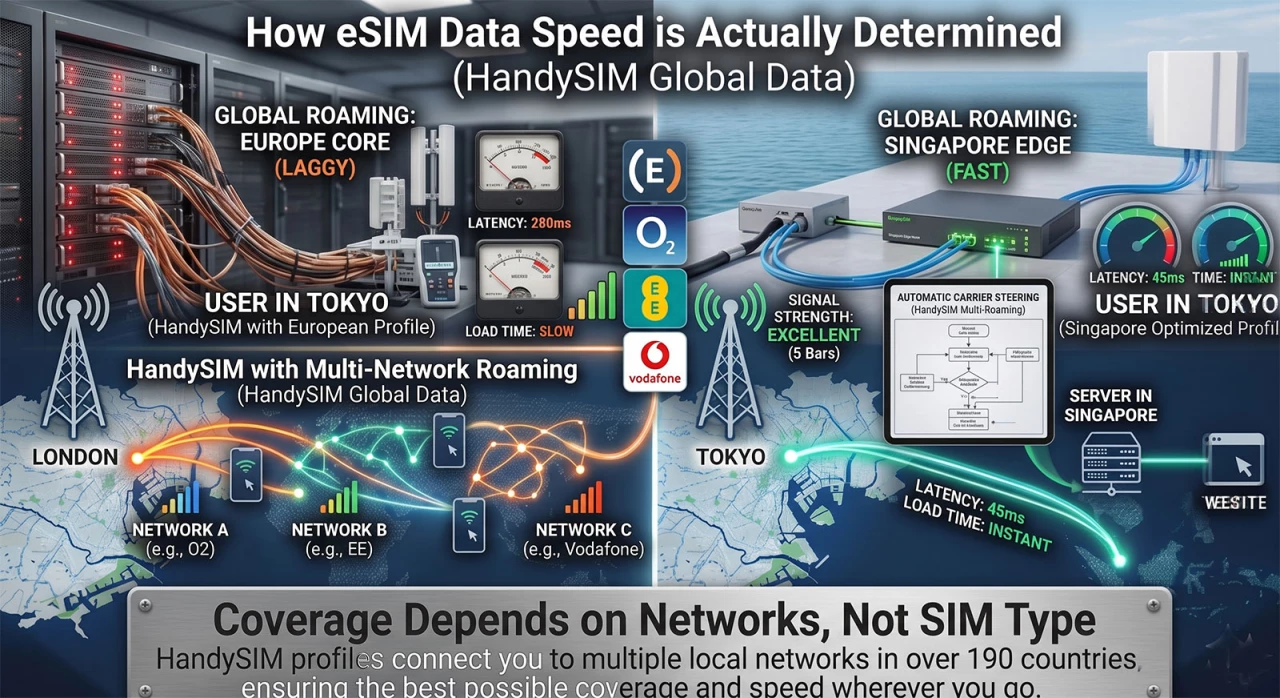
Sometimes, indirectly. A travel eSIM can actually provide superior geographic coverage compared to a traditional local physical SIM because travel packages often include multi-network roaming agreements, allowing your phone to switch between competing local networks automatically.
When you buy a standard physical SIM card from a local carrier store inside a foreign country, you are bound exclusively to that specific carrier's cellular towers. If that network has a dead zone in the countryside or inside a particular train station, you will completely lose service.
In contrast, high-quality international travel packages are explicitly engineered for flexibility. A single regional data plan often secures roaming privileges with two or three major competing networks inside a single nation.
┌───> Local Network A (Strong in Cities)
[Your Travel eSIM] ─┼───> Local Network B (Strong in Countryside)
└───> Local Network C (Strong Indoors)
If you wander into an area where your primary network partner has a weak signal, your phone’s operating system will automatically scan the environment and hot-swap your connection to a secondary local partner. This multi-network capability drastically reduces dead zones, giving you significantly better coverage than locals who are locked into a single provider.
If you are planning an international journey soon, you can secure these multi-network benefits directly through our high-speed, unthrottled regional packages, such as the Europe eSIM, the specialized Turkey eSIM, or our multi-country Asia eSIM packages.
Let’s dismantle five of the most pervasive technical myths currently floating around online communities regarding digital profiles:
The Reality: False. As established by core physics, the signal strength is completely identical if both profiles are running on the exact same network provider under the same account terms.
The Reality: False. A digital profile supports the identical 4G LTE and 5G technical architectures as a physical card. Any real-world speed drops are entirely caused by carrier-level data prioritization, network congestion, or back-end traffic routing configurations.
The Reality: False. The chip itself consumes practically zero power. The only scenario where you might experience accelerated battery drain is if you run your phone in Dual-SIM mode (keeping both your home line and your travel line active at the exact same time). This forces your phone's internal modem to power two separate radio connections to different cell towers simultaneously, which naturally consumes more battery juice.
The Reality: False. The ability to share your data via a personal hotspot is a policy choice dictated entirely by your provider, not a limitation of the hardware. While some restrictive carriers block tethering on unlimited plans, premium providers explicitly allow unrestricted hotspot usage.
The Reality: False. Once programmed and activated on your phone’s secure element chip, the profile acts as a permanent hardware component. It cannot degrade over time, accumulate dust, or suffer from loose mechanical contacts like an old plastic card sliding around inside a loose SIM tray.
When choosing how to stay connected during your travels, remember these fundamental truths:
By eliminating the physical liabilities of plastic cards while introducing multi-network flexibility, modern digital profiles are structurally the best choice for global travelers. Ensure you carefully read the package details of the data plan you are purchasing to match your travel needs, download your profile digitally, and step off the plane with an instant, high-speed connection.
No. An eSIM does not provide better or worse signal than a physical SIM card by itself. Both technologies serve the exact same purpose: securely authenticating your identity with a mobile network. Once authorized, your smartphone uses the same internal hardware, modems, and antennas to capture cellular reception, meaning the form factor of the SIM has zero impact on baseline signal strength.
This is a common misconception usually caused by overlapping hardware or provider upgrades. When users switch to an eSIM, they often upgrade to a newer smartphone with advanced antenna arrays or switch to a tier-1 network provider with superior local infrastructure. The noticeable boost in reception is a result of the better hardware or closer cell towers, not the eSIM chip itself.
Not directly. An eSIM operates on the same 4G LTE and 5G network bands as a physical SIM card. However, your actual data speed is dictated entirely by your subscription plan, local network congestion, and the roaming agreements established between your eSIM provider and the local network operators.
Mobile signal quality is determined by real-world physical and infrastructure variables, including:
Yes, absolutely. If you run two different travel profiles on the same phone, their performance can vary drastically. This discrepancy happens because different digital profiles rely on different back-end roaming agreements. One provider might lease capacity from a premium tier-1 local network with 5G access, while a budget provider might route traffic through a secondary carrier restricted to older 4G infrastructure.
Yes. Mobile networks always prioritize their local contract subscribers over visiting tourists. During peak usage hours or in crowded areas, local infrastructure uses Quality of Service (QoS) routing to intentionally slow down (throttle) international roaming traffic to ensure local users maintain a stable, high-speed connection.
Full signal bars only indicate that your phone has a strong physical connection to the cell tower—they do not guarantee available internet bandwidth. If the cell tower is congested due to a high volume of active users, or if your international provider routes your data through a distant server (causing high latency/ping), your internet will feel laggy and unresponsive despite showing perfect signal bars.
Yes, indirectly. High-quality travel eSIM profiles often feature multi-network roaming agreements. Unlike a local physical SIM card that locks you into a single carrier's infrastructure, a travel profile can automatically scan the environment and hot-swap between two or three competing local networks, effectively minimizing regional dead zones.
No. The built-in embedded chip itself consumes virtually no power. The only scenario where you might experience faster battery drain is if you run your device in Dual-SIM mode (keeping your home line and your travel line active at the same time). This forces your phone's internal modem to power and maintain two separate radio connections to different cell towers simultaneously.
Yes, from a physical standpoint. Because an eSIM is embedded directly onto your phone's motherboard, it cannot be lost, stolen, or damaged. It completely eliminates common physical failure points associated with traditional cards, such as chipped plastic, dirt accumulation on gold contacts, or mechanical issues inside a loose SIM tray.