24.10.2025
Imagine this situation. You have just landed at an exotic destination after a long and exhausting flight. You are in a rush to connect with your loved ones, order transport to the hotel, and load your navigation.
Instead, you find yourself in a long queue at an airport telecom kiosk. You waste valuable holiday time trying to communicate in a foreign language to understand their complex tariffs.
Then begins the struggle with tiny plastic cards. You look for a paperclip or a needle to open the phone slot, worrying about losing your primary home card.
Today, this scenario is completely unnecessary. You can simply open an app, select a digital plan, and be online in a matter of minutes.
Welcome to the era of digital profiles—the technology that is fundamentally changing how we connect with the world.
A digital SIM card (or embedded SIM) does the exact same job as the traditional plastic card we have known for decades. It connects you to a mobile operator's network.
The difference is that the new standard is a miniature chip factory-soldered directly onto your smartphone's motherboard. It cannot be removed or lost.
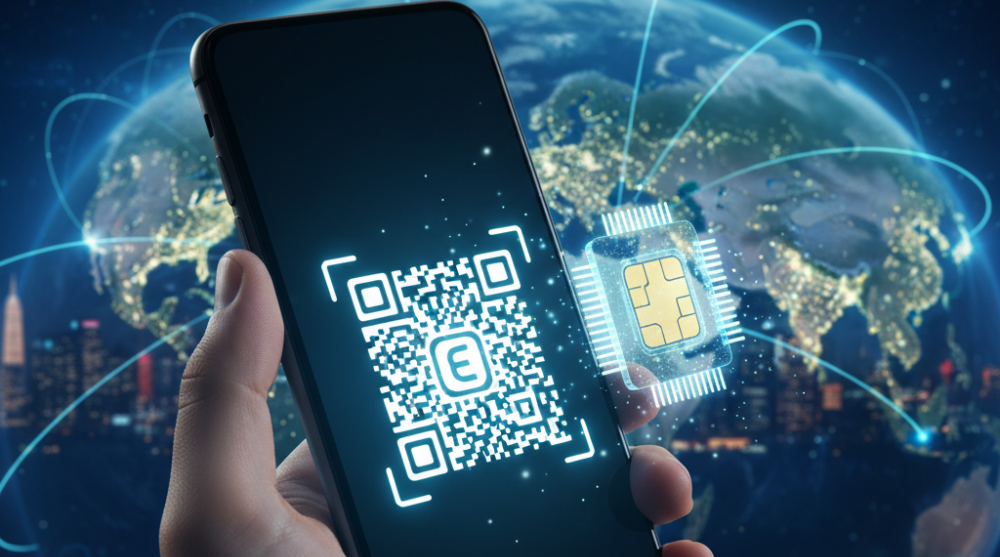
Instead of inserting a physical medium, you simply download a software profile over the internet. This profile contains all the necessary network settings and is installed securely onto the chip.
Why is this seemingly small hardware change such a massive step forward? The answer lies in the unmatched convenience, flexibility, and security the technology provides to the end user.
The most tangible benefit of digital connectivity is felt by anyone who frequently crosses borders. Before the introduction of this standard, options for travellers were highly limited.
The first option was to rely on expensive roaming from your home operator. This often leads to unpleasant surprises and unexpectedly high bills after returning home, especially outside your standard coverage zone.
The second option was purchasing a local physical card upon arrival. This means signing documents, handing over passport details to unknown merchants, and risking tourist tariff scams.
By using a digital profile from HandySIM, all these problems completely disappear. You gain total control over where, when, and how you buy mobile data.
You can purchase and configure your plan before you have even left your home. Upon landing, your phone automatically connects to the local network. There is no need to search for free airport Wi-Fi.
To be completely objective, we must also look at the downsides of this technology. Despite its huge advantages, digital profiles still have some limitations.
The first major negative is hardware fragmentation. While all new flagship devices from Apple, Samsung, and Google support the standard, the budget device market is still lagging behind.
Many users buy a mid-range phone, only to find out before their trip that it lacks the required chip.
The second drawback is related to transferring in case of damage. If your phone breaks or its battery completely dies during a trip, you cannot simply take the card out and put it into a friend's phone.
The digital profile is encrypted to the specific device. Moving it to a new phone usually requires an internet connection and the issuance of a new QR code by the provider.
Finally, the initial installation requires an active internet connection. If you forget to download your profile at home and land at an airport without public Wi-Fi, you will not be able to activate the purchased plan.
One of people's biggest worries when travelling is whether they will lose touch with important contacts at home. This is where the dual active lines feature comes in handy.
Most compatible devices simultaneously support one physical card (your home one) and one digital travel profile.
This means you can keep your home number fully active for incoming calls and SMS messages. This is critically important for receiving security codes from your bank or airline confirmations.
At the same time, through your phone's settings, you specify that all mobile data traffic passes exclusively through the downloaded travel profile.
This way, you continue using your primary WhatsApp profile and social media without generating any roaming charges to your home operator. You pay a fixed amount upfront, with no hidden fees.
The technology is not designed solely for travellers. It also brings significant advantages to how we use and protect our smartphones every day.
The physical card is one of the weakest security points of a modern phone. When a device is stolen, the first thing a thief does is remove the plastic card.
Once placed in another phone, they can attempt to access your bank accounts or emails by recovering passwords via SMS.
Because the new standard is built directly into the motherboard, it cannot be physically removed. If your phone is stolen, its connection to the network remains active.
This means you can track the location of the stolen device much more easily through features like "Find My" until you contact your operator to block the profile remotely.
Removing the mechanical slot for physical media gives smartphone engineers and manufacturers massive freedom.
The internal space in a modern phone is incredibly valuable. Removing the slot frees up room that can be used for larger batteries or more powerful processors.
Furthermore, fewer openings in the chassis mean significantly better structural integrity for the phone. This leads to increased resistance against dust and water ingress.
You can also store multiple digital profiles on a single device. This allows you to easily switch between a work and personal number without carrying two separate phones.
Choosing the right mobile data plan depends entirely on your travel itinerary. The flexibility of digital profiles allows you to optimize your expenses effortlessly.
If you are planning a grand tour of the Old Continent, there is no need to buy separate access for every single country. You can explore our eSIM plans for Europe, which ensure seamless border crossings.
For those heading across the ocean, coverage is just as hassle-free. Whether you find yourself in New York or Toronto, you can enjoy the same convenient connectivity across the USA, Mexico, and Canada with our eSIMs for North America.
If your journey is focused on the Far East—such as a combined trip to Bangkok and Hanoi—our regional Asia packages are the most logical choice.
The exact same convenience and cost savings apply to trips with our eSIM plans for Latin America or tropical getaways with our eSIMs for the Caribbean.
The transition to digital connectivity is extremely easy, but the first and most important step is to check your hardware.
Most modern flagships from Apple (iPhone XS/XR and newer), Samsung Galaxy (S20 series and up), and Google Pixel are fully compatible with the technology.
If you plan to buy a new device specifically for your travels but have a limited budget, your options are more specific.
You can review our detailed selection of the best budget eSIM compatible phones to make an informed choice.
To be absolutely certain before making a purchase, we always recommend checking our Full list of compatible devices.
Once you have confirmed your smartphone's compatibility, the process of securing internet for your trip is intuitive and fast.
Visit the website and browse the wide selection of plans, filtering them by your final destination.
The setup takes about 5 minutes. It is very important to be sure of exactly what you are getting, so please ensure you carefully read the package you are purchasing, including the mobile data limits and validity.
After completing the payment, you will receive an encrypted QR code and detailed installation instructions in your email.
Download the profile via your phone's network settings while connected to your home Wi-Fi network, shortly before heading to the airport.
If you feel unsure about the technical steps or are doing it for the first time, you can watch the step-by-step video on how to buy, install and use an eSIM.
As soon as you land at your destination, simply go into your settings, activate the newly downloaded line, and turn on the data roaming option just for it. The connection to the local network will happen automatically.
No more struggles with lost plastic cards. No more stress from incomprehensible tariffs in foreign languages, and no more searching for paperclips at airports.
Digital profiles are not just a better or more modern alternative. They are the absolutely inevitable future of global mobile communications.
The technology offers unmatched freedom, cost transparency, and efficiency for both protecting your daily data and your peace of mind during global travels.
It is time to leave archaic plastic in the past and embrace the true convenience of reliable digital connectivity. No hidden fees, no surprises, and 100% transparency on what you consume.
An eSIM (embedded SIM) is the future because it eliminates the need for outdated plastic cards and mechanical trays. This technology allows users to switch carriers and data plans with just a few taps in their phone settings, without waiting for shipping or visiting a physical store. It fully digitalizes mobile connectivity, which is a natural step in the evolution of smartphones.
With an eSIM, traveling becomes seamless and stress-free. Instead of searching for local SIM kiosks at airports, swapping tiny plastic cards, and risking losing your primary SIM, you can purchase an international data plan online before you even board your flight. Upon landing, you simply activate the profile and get connected instantly.
Manufacturers (like Apple with their US models) are removing the physical SIM tray to free up valuable internal space. Getting rid of the slot allows for larger batteries, better camera components, and improved water and dust resistance, as it seals off one of the main physical openings in the phone's body.
The main benefits are affordability, convenience, and flexibility. You avoid expensive roaming bills from your home carrier. You can also store multiple eSIM profiles on a single device and switch between them depending on the country you are visiting, while keeping your primary number active for important calls and SMS verifications.
Yes, technologically, eSIM is fully ready to replace physical cards, and this transition is already underway. In the coming years, as the technology trickles down to budget-friendly devices, plastic SIM cards will gradually disappear, just like floppy disks and CDs did in the computer industry.
Most modern smartphones support a hybrid Dual SIM setup. Your physical SIM card remains active for your daily calls and messages from your home carrier, while the eSIM is set up as the "Primary for Mobile Data" (internet) when you are abroad. This keeps you reachable on your personal number while browsing the web at cheap local rates.
The main disadvantage is that if your phone dies completely or breaks, you cannot simply take the SIM card out and put it into another device to make an emergency call. Transferring an eSIM between two phones requires an internet connection and re-scanning a QR code or activating it through a provider's app.
Yes, eSIM offers a much higher level of security. Because it is soldered directly onto the phone's motherboard, it cannot be physically removed or stolen. If your phone is lost or stolen, a thief cannot throw away the SIM card to cut the internet connection—the device stays online, making it much easier to track via services like Find My.
Your profile remains securely stored in the carrier's cloud systems. If you get a new phone or repair your old one, you just need to contact your eSIM provider (or log into their app) to generate a new QR code, which will automatically deactivate the old profile from the lost device.
Integrating an eSIM chip requires extra costs for hardware components, software development, and licensing, which increases the manufacturing price of the device. To keep prices as low as possible, budget phone manufacturers still prefer cheap plastic trays, but the technology will become standard across all price tiers over time.