24.09.2026
When you plan a trip abroad and start researching your mobile connectivity options, you almost certainly encounter a very real and entirely logical question:
You are looking for an eSIM for a single country and you find one plan offering 10 GB for $8, another for $15, and a third for $25. At first glance, all three offer the exact same amount of mobile data. Why, then, is the price so completely different?
This confuses many users who assume that if the data allowance is identical, the service itself must be exactly the same. The truth, however, is much more nuanced and complex. The main thesis you need to understand is this:
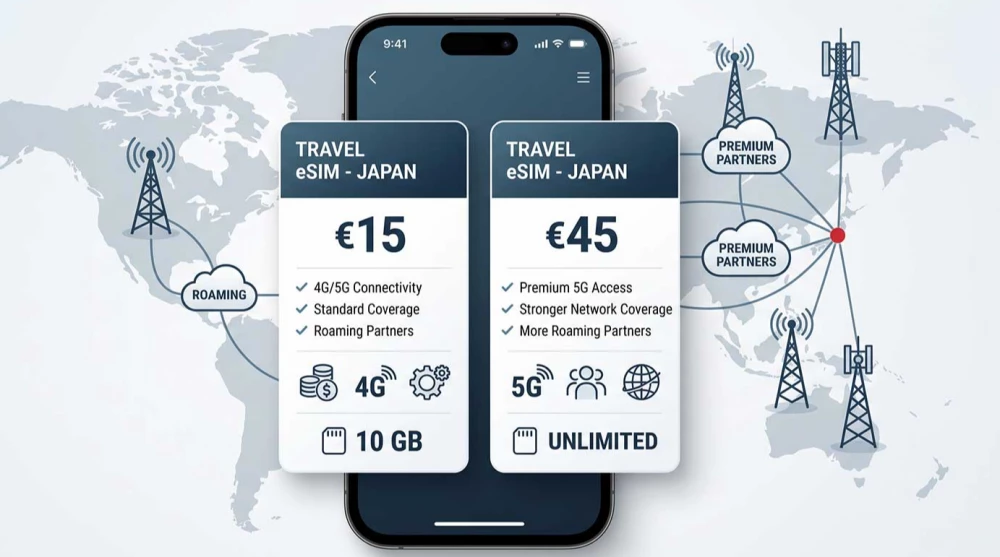
The amount of mobile data is only one of the factors that determine the price of an eSIM. The specific mobile network, the number of supported operators, 4G/5G access, data routing, hotspot and tethering conditions, validity period, geographic coverage, and included calls and SMS can turn two seemingly identical plans into entirely different products.
If there is only one thing you remember from this article, it should be this key phrase:
10 GB ≠ automatically the same product as another 10 GB.
Explore the various eSIM plans available to get an idea of just how diverse the offerings for a single location can be.
This is the foundation we need to build upon. To understand why prices fluctuate, we have to look "under the hood" of the technology itself. Two eSIM plans might be designed to work within the borders of the exact same country and offer the exact same number of gigabytes, but the infrastructure and terms behind them might include:
different local mobile operators;
different wholesale network providers (the companies building the bridge between the local network and your phone);
different roaming agreements;
a different number of accessible mobile networks (whether you connect to just one antenna or all available ones);
different access to fourth (4G) or fifth (5G) generation networks;
different validity periods for the data package;
different rules and limits for hotspot and tethering to other devices;
different conditions for when and how the plan activates;
completely different regional or global geographic coverage;
included or excluded options for voice calls, SMS messages, or a local phone number.
Let's look at a very simple and clear example to illustrate this difference:
|
Feature |
Plan A |
Plan B |
|
Data |
10 GB |
10 GB |
|
Validity |
30 days |
30 days |
|
Networks |
1 operator |
3 operators |
|
5G Access |
Yes |
Yes |
|
Hotspot |
Yes |
Yes |
|
Countries |
1 |
40+ |
|
Calls / SMS |
No |
Yes |
At first glance, if you only look at the gigabyte figure, you see 10 GB versus 10 GB. But in reality, as the table shows, you are not buying the same product at all. One is a basic local package, while the other is a comprehensive, multi-national communication service.
This is the first and perhaps the biggest reason for price variations. Not all mobile operators in a given country are created equal, and consequently, they do not provide wholesale data or roaming access at the same price point.
One eSIM plan for a destination might use the infrastructure of:
Operator A (the largest telecom in the country, with premium nationwide coverage)
while another, cheaper plan might rely on:
Operator B (a smaller, budget-oriented telecom provider).
Beyond the financial cost of the gigabytes themselves, different operators are distinguished by completely different characteristics:
the density of their nationwide coverage;
their overall investments in 4G and 5G infrastructure;
the total network capacity (whether speeds drop during rush hour or in crowded areas);
signal stability outside major cities, in mountainous regions, or along highways;
their agreements with external roaming partners.
The takeaway here is very clear:
You are not just buying gigabytes. You are buying access to a specific mobile network. The quality and reliability of that network always come with a corresponding price tag.
Here we delve into the difference between eSIM profiles that work with only a single network versus those that have access to multiple networks simultaneously.
These types of plans are tied exclusively to one specific provider. For example:
Network A
If you travel to an area where this specific operator has poor coverage or no signal at all (a blind spot), you are left without mobile data. Your phone is not authorized to search for alternatives.
These types of plans have active agreements with several local telecoms at the same time. For example:
Network A + Network B + Network C
If Network A loses coverage, your smartphone will automatically and seamlessly register with Network B or C. This is an incredibly valuable advantage when traveling outside major capital cities.
Of course, this does not automatically mean:
more operators = a better eSIM in every single second.
But it absolutely means:
More supported networks can provide more connectivity options. This added flexibility and the security of knowing you won't be left disconnected cost more during wholesale negotiations between companies.
Two plans sold for the exact same country can technically deliver their service through two completely different models.
In this scenario, the product uses infrastructure or an eSIM profile that is directly oriented toward the specific local market. Your phone behaves almost exactly as if you had purchased a physical SIM card from a local corner store.
In this model, the eSIM profile on your phone actually belongs to an international operator (often from another country entirely), which uses its international roaming infrastructure to register with a partner local operator at your destination. (For this model to work, the "Data Roaming" option must be enabled in your phone's settings).
These two distinct approaches have a serious impact on:
the wholesale cost of the plan itself;
the priority your device gets for network access during peak usage times;
how your mobile data traffic is routed;
latency (the delay or response time of your connection);
the geographic location of your IP address (which affects the online content and streaming catalogs you see);
the available supplementary features.
We do not present one model as universally better than the other—each has its distinct advantages in different situations. However, they certainly have different inherent costs.
This is one of the more technical and "invisible" reasons that many customers never realize, but it directly affects both quality and price.
Two eSIM plans might even use the exact same local antenna of the exact same local operator, but their internet traffic might be routed in completely different ways across the globe.
For example, a routing path might look like this:
Phone → Local Operator → Roaming Infrastructure in another country → The Internet
If you are in Japan, but your eSIM uses a roaming hub located in Europe, every single click you make travels from Tokyo to Europe and back again, just to load a local Japanese website. This routing directly impacts:
latency (the delay in your connection);
application response times;
IP geolocation (websites might think you are browsing from a different country);
the functionality of certain websites, banking apps, and streaming services.
More expensive plans often utilize optimized, localized, or regional routing servers to minimize this delay. Therefore, the same operator and the same number of gigabytes do not necessarily mean an identical internet experience.
Two eSIMs can operate on the same local network, but their roaming agreements might grant different tiers of network access.
For example:
|
Feature |
Plan A |
Plan B |
|
Operator |
Network X |
Network X |
|
Network Access |
4G / LTE Only |
4G + 5G |
Accessing 5G infrastructure costs providers more, which is why some budget-friendly plans intentionally restrict your connection to 4G speeds.
Here, however, we must make a very important clarification:
5G support does not mean guaranteed 5G signal everywhere.
Your real-world access to ultra-fast speeds depends entirely on the local infrastructure of the city you are in, your phone's hardware capabilities, your exact physical location, and the specifics of the roaming agreement.
We should not expect or demand logic that dictates 10 GB of mobile data has the exact same value everywhere in the world.
The price of mobile connectivity depends entirely on the economics of local operators, their infrastructure maintenance costs, and the specific contracts allowing access to their towers.
For example, plans for:
compared to plans for:
can have completely different pricing structures, even though both products might offer 10 GB for 30 days. The telecommunications market in North America is structured very differently from the market in Europe.
This allows us to definitively state:
There is no universal international price for 1 GB of mobile data.
When choosing a plan, you will frequently see offers with a strict limit and those promising endless access. These two models operate on fundamentally different economics.
For example:
You receive 20 GB for 30 days. You know exactly what you have available and you can consume it however you see fit—whether you use it all in one day or stretch it across the entire month, always at maximum speed.
versus:
You receive 3 GB of high-speed data per day, and once exhausted, your speed drops to 1 Mbps until the end of the 24-hour period.
The word "Unlimited" on its own is never enough for an objective comparison. We must analyze the details. You should always check:
the high-speed daily allowance;
the Fair Usage Policy (FUP);
the exact speed you are throttled to after reaching your daily cap;
whether there is a daily reset time;
the total validity of the package.
For a deeper analysis of this choice, you can read our guide on Unlimited eSIM vs. Fixed Data.
Even if you have decidedly chosen that you want a plan without total volume limits, your options can still vary drastically in price. Let's use a few very clear examples:
Offers 3 GB per day at high speed, after which the speed drops drastically to 1 Mbps.
Offers 2 GB per day, but after depletion, the speed drops to a very usable 5 Mbps (which is perfectly adequate for streaming video and normal browsing).
Offers a massive 10 GB per day at maximum speed, after which the speed becomes 5 Mbps.
All three packages can legally and logically call themselves "Unlimited," but in reality, they deliver completely different levels of service and high-speed data volume. Therefore, their prices will never be identical.
The key phrase to remember here is:
The word "Unlimited" does not tell you exactly what you are buying on its own.
To avoid any unpleasant surprises on your trip, we highly recommend familiarizing yourself with the rules behind these plans in our article regarding Fair Usage Policy (FUP).
This is another factor many travelers overlook. Let's compare the following three options:
10 GB / 7 days
10 GB / 30 days
10 GB / 90 days
The identical amount of data does not equal identical conditions or identical pricing. Maintaining an active profile on a mobile operator's network requires continuous resources. The longer your profile remains valid and occupies space in the system, the more expensive the wholesale service becomes.
This is the perfect moment to explain the fundamental difference between the terms:
data allowance and validity period.
With a plan featuring "20 GB for 30 days," the service concludes upon the occurrence of the first of these two conditions:
either all 20 GB have been fully used
or all 30 days have expired.
Two eSIM plans can look completely identical in terms of volume and price, but feature radically different rules for tethering and sharing internet with other devices.
20 GB. All available data can be fully utilized via the mobile hotspot feature, allowing you to share your connection with a laptop or a travel companion's phone.
Unlimited. Features a strict, separate limit solely for hotspot usage (for instance, you may only be allowed to share 1 GB per day, while the rest must be consumed on the primary device).
The hotspot feature is not supported at all and is actively blocked by the network.
These pricing differences exist because laptops and tablets naturally consume exponentially more traffic than smartphones. This flexibility is particularly crucial if you need the plan for:
connecting a laptop;
providing a tablet for children;
remote work;
family trips where you share internet with your spouse;
connecting a secondary, work-issued phone.
The vast majority of modern travel eSIM products fall into the category of:
Data Only (without classic telephony options).
However, there are more comprehensive products on the market that may include:
a local or international phone number;
the ability to receive incoming voice calls;
included minutes for outgoing calls;
the ability to send and receive SMS messages;
included international calling minutes.
Consequently, logic dictates that:
A plan with 10 GB Data Only
and
A plan with 10 GB + a phone number + calls + SMS
are by no means identical products, and therefore their underlying costs are different.
For some specific destinations, this distinction is highly pronounced. For example, with an eSIM China, there are standard data-only plans (which often help bypass local internet firewalls to access Western sites), as well as highly specialized plans featuring additional local services, instantly shifting the price category.
Imagine a user searching for mobile connectivity for their upcoming trip and browsing the options for an eSIM Vietnam. In the search results, they see two seemingly similar products.
20 GB. Works exclusively only in Vietnam.
20 GB. Works in Vietnam + Thailand + Malaysia + Singapore + dozens of other Asian destinations.
Both plans appear in the search results for Vietnam simply because both will guaranteed work there.
But they are definitively not the same product. Maintaining international roaming contracts across 15 different countries is vastly more expensive than maintaining a contract in just one. Therefore, the multi-national plan will logically cost more.
We continue logically from the previous section because this scenario frequently causes confusion for travelers heading to Europe. For example, a person searches for a plan specifically for France, Germany, or Italy. In the search results, they might see:
Offers 20 GB, which are valid strictly and exclusively within the territory of that specific country (e.g., France only).
and:
Offers 20 GB, which are fully usable across dozens of European destinations simultaneously, with no extra fees when crossing borders.
Both plans technically work perfectly in the user's searched country, but the regional product offers a much larger and broader geographic footprint, which forms the basis of its higher price.
If you are traveling through several countries (for instance, a multi-city European tour), a regional eSIM Europe plan will certainly hold much more practical value than a cheaper local plan that will completely stop working the moment you cross your first border.
Two separate eSIM products might start counting down their validity (starting the day timer) in completely different ways:
immediately upon successful installation on the phone;
only upon the first successful connection to a supported mobile network in the destination country;
via manual activation by the user at a specific chosen moment;
automatically on a pre-determined date selected by the customer.
Furthermore, there might be a different time window (a waiting period) during which the purchased QR code must absolutely be scanned and used before it becomes void.
While this is rarely the primary or sole reason for a massive price difference, activation flexibility is yet another reason why two seemingly identical products on your screen cannot be directly compared in reality.
In certain countries around the world, strict local laws and regulations make it mandatory to officially identify any user accessing local telecommunication services.
This process of electronic customer identification (eKYC) takes about 5 minutes. It may involve providing a passport, ID card, or taking a selfie for identity verification. Ensure users carefully read the package they are purchasing so they know what is required before activation.
Another, alternative roaming product for the exact same country might operate under a different international model and completely bypass this administrative process.
This once again clearly demonstrates that two eSIM products sold for one country can be fundamentally different, both in terms of user experience and administrative requirements.
This should be one of the strongest and clearest points to consider. The customer only sees the final, finished product on their screen, but behind it lies a complex chain of business relationships.
Here is a simplified example of how mobile data travels:
Local Mobile Operator → Wholesale Roaming Provider → eSIM Platform → End Customer
With a different product, the chain changes:
Completely Different Operator → Different Commercial Agreement → Different Wholesale Provider → End Customer
The final wholesale price depends on an enormous number of variables:
the economic standard of the country;
the pricing policy of the local operator;
the specifics of the signed roaming agreement;
the total amount of included data;
the validity period of the profile;
access to modern networks (4G vs. 5G);
regional coverage and the number of countries included;
pre-negotiated traffic volumes between the companies;
included supplementary services like telephony.
Because of this, in the world of telecommunications, a universal formula simply does not exist:
1 GB of mobile data = the exact same price everywhere.
To summarize what we've covered so far, let's look at how different destinations shape their specific products and pricing:
|
Destination |
What Can Influence the Final Product |
|
Europe |
The number of countries included in the package and the diversity of supported operators. |
|
UK |
Whether the product is local or roaming, accessible networks, and the inclusion of calls/SMS. |
|
USA |
Access to giants like AT&T or T-Mobile and the massive scale of regional geographic coverage. |
|
Vietnam |
The choice between a strict local plan versus one with expansive Asian regional coverage. |
|
China |
Access to an uncensored network, local versus regional profiles, and additional telecom services. |
Our goal here is not to objectively compare which country is "more expensive" to visit, but to visually demonstrate why the geographic name you type into the search bar is only the beginning of your comparison, not the end of it.
The logical question that follows is clear. The answer, however, is nuanced:
Not necessarily.
A higher price for a given plan can be attributed to multiple objective factors:
more supported alternative networks for better signal reliability;
coverage in a greater number of countries (which you might not even need);
a longer validity period;
included classic voice calls and SMS messages;
a different, more premium wholesale service provider;
a more liberal Fair Usage Policy (FUP);
a larger total volume of initial data;
specific supplementary services.
But remember the fundamental rule:
An eSIM for $25 is not automatically or magically faster than an eSIM for $10. It simply includes a different set of parameters.
Yes—this depends entirely on the specific nature of your personal trip.
Imagine you are traveling for business to only one single country for exactly 7 days.
Offers 20 GB, is valid for 30 days, works with one reliable local operator, and allows seamless tethering to your work laptop.
Offers the exact same 20 GB for 30 days, but works across 15 different countries.
If your plans are fixed and you will not be crossing the borders of the first country during your stay, the coverage of the other 14 countries in Plan B holds absolutely no practical value for you. You would be paying triple for a service you will never utilize.
The core idea here is this:
The best value does not automatically mean the cheapest or the most expensive eSIM plan on the market. The best value is the plan that perfectly matches the parameters of your specific trip.
To make a truly informed choice, you must look at the complete picture, not just the initial price tag.
|
Carefully Check |
Plan A |
Plan B |
|
Data |
10 GB |
10 GB |
|
Validity |
30 days |
30 days |
|
Supported Networks |
1 operator |
3 operators |
|
5G Access |
Yes / No |
Yes / No |
|
Hotspot Sharing |
Allowed |
Restricted |
|
Included Destinations |
1 country |
40+ countries |
|
Included Calls |
No |
Yes / No |
|
Included SMS |
No |
Yes / No |
|
Local Phone Number |
No |
Yes / No |
|
Fair Usage Policy (FUP) |
None |
None / Active |
|
Activation Terms |
On first connection |
On first connection |
|
Final Price |
$10 |
$30 |
And the logical conclusion to draw from this table:
10 GB = 10 GB
Internet + Networks + Coverage + Validity + 4G/5G + Policy (FUP) + Hotspot + Calls/SMS + Activation + Final Price
When a user searches for a specific destination on the HandySIM platform, they frequently see multiple different products and options.
The reason for this variety is that our platform aggregates and offers plans from different providers, local operators, and types of infrastructure coverage, rather than restricting you to a single, universal, and compromised package.
This gives every user the freedom to choose exactly what they need based on:
fixed data volumes;
unlimited data plans;
a specific budget and final price;
exact validity matching the days of their stay;
the number of supported networks for maximum security;
transit countries along their journey;
the need to share internet to a laptop via hotspot;
the necessity of classic voice calls and SMS;
all other specific characteristics of a particular plan.
The key sentence that describes our model is:
Different prices on our platform do not necessarily mean the exact same product with a different markup. Behind them lie real, technically distinct mobile services.
The choice is always in your hands, but here are some guidelines on when which option is more appropriate.
it covers your exact destination;
the included data volume meets your needs;
the local operator's network quality satisfies your requirements;
the hotspot conditions are suitable for your devices;
you categorically do not need standard phone calls or SMS;
you have no plans to visit or transit through other countries.
it offers backup access to more supported operators;
it flexibly covers the remaining transit countries on your itinerary;
it features a more suitable and transparent Fair Usage Policy;
it flawlessly supports full hotspot tethering for your remote work;
it includes critically important voice calls and SMS for business communication;
it provides a more suitable, longer validity period.
Before making your final choice and comparing two seemingly identical plans, always take half a minute to ask yourself these questions:
Exactly how much mobile data am I getting?
For how many days is this package valid?
Which local mobile operators does this plan actually use?
Do I have flexible access to more than one network if I lose signal?
Does the plan support access to fast 4G and 5G networks?
Is free tethering (hotspot) to other devices allowed?
Is there a hidden Fair Usage Policy (FUP) on the unlimited plans?
Which exact countries are included in the overall coverage?
Are traditional phone calls and SMS messages included?
Does it provide a real, local phone number?
At what exact moment does the profile's validity period begin?
Is an electronic customer identification process (eKYC) required?
What is the final total price for this complete package of services?
Let's circle back to the beginning and directly close the primary question we set out to answer:
Two eSIMs can offer the exact same amount of mobile data in the very same country, yet remain technologically and commercially completely different products.
The final price you see on your screen is the logical outcome of a complex combination of factors:
Mobile Network + Data Volume + Usage Policy + 4G/5G Access + Geographic Coverage + Data Routing + Validity + Connection Sharing + Calls/SMS + Activation Method + Wholesale Price
Therefore, the next time you are planning your trip, remember this piece of advice:
Do not compare eSIM plans based solely on the price of a single gigabyte of mobile data. Carefully compare what you are actually getting alongside those gigabytes. Making a smart choice today guarantees you peace of mind and reliable connectivity tomorrow.
eSIM prices vary because mobile internet is just one part of the overall cost. Providers negotiate different wholesale rates based on the specific local networks they access and the infrastructure they use. Features like multi-network support, 5G access, hotspot tethering, and included calls or SMS also add to the final price. Additionally, plans with different validity periods will naturally have distinct pricing structures. Therefore, an eSIM with premium features and broader coverage will cost more than a basic alternative.
Cheaper eSIM plans are not necessarily less reliable, but they often come with more restrictions. They might connect to a single, budget-friendly mobile network that has limited coverage outside major cities. These plans might also restrict speeds to 4G only or limit hotspot usage for your other devices. If you are staying in an urban area with good coverage, a cheaper plan can work perfectly well. However, travelers moving across rural regions might experience drops in connectivity compared to premium multi-network options.
Yes, providing 5G access often increases the wholesale cost for the eSIM provider. Commercial agreements for 5G infrastructure are typically more expensive than those for standard 4G networks. This premium translates to a slightly higher retail price for the end user seeking ultra-fast mobile internet. However, paying for 5G only makes sense if your smartphone supports it and the destination country has widespread 5G coverage. Otherwise, a cheaper 4G plan might offer the exact same practical experience during your trip.
Roaming networks significantly impact eSIM prices because providers must pay varying fees to local telecom operators. An eSIM that connects to three different premium roaming networks will inherently cost more than one restricted to a single local network. These roaming agreements dictate network priority, speed caps, and overall reliability during peak hours. Furthermore, some roaming paths route your internet traffic through servers in other countries, which adds to the infrastructure costs. Ultimately, the quality and number of roaming agreements directly shape the final product price.
Unlimited eSIM plans cost more because they allocate a significantly larger volume of mobile internet for the user. Providers must anticipate heavy usage and secure enough network bandwidth to handle it without crashing the system. Even with a Fair Usage Policy (FUP) that slows down speeds after a certain daily threshold, the baseline cost of maintaining continuous access is higher. You are essentially paying a premium for the peace of mind that you will not run out of internet midway through your trip. This constant, unmetered access naturally demands a higher price point than fixed-volume packages.
Network coverage plays a crucial role in how an eSIM is priced by the provider. Plans that guarantee national coverage using top-tier local operators are much more expensive to maintain. Conversely, budget plans might rely on secondary operators with spotty signals in rural or mountainous regions. If a plan covers multiple countries across an entire continent, the combined cost of all those international agreements increases the price further. Premium coverage ensures you stay connected everywhere, which easily justifies the higher upfront cost.
No, different eSIM providers negotiate commercial agreements with completely different local mobile networks. One provider might partner with the largest local telecom, offering exceptional speeds and nationwide coverage. Another might choose a budget operator to keep the final price as low as possible for the consumer. Some advanced eSIMs even support multiple networks simultaneously, switching automatically if a local signal drops. You must always check which specific local networks the eSIM uses before making a purchase.
The amount of mobile internet included in your plan is a major foundational factor in the final price. Purchasing a massive 50 GB allowance requires the provider to reserve much more bandwidth on the local network than a smaller 5 GB package. Wholesale telecommunication costs are still heavily calculated based on the sheer volume of traffic consumed by the user. Larger internet allowances provide more freedom for video streaming and heavy browsing, which inherently costs more to facilitate. Therefore, a higher allowance will always result in a proportionately higher purchase price.
Yes, two eSIMs can offer vastly different internet speeds even if they operate in the exact same country. One plan might include full access to local 5G towers with high network priority during peak hours. Another plan might deliberately throttle speeds to 4G or artificially cap the download rate after a specific daily limit is reached. The geographical routing of the internet connection can also introduce latency, slightly slowing down your browsing experience. This is why you should always review the speed policies and network details before buying.
Wholesale costs are the fundamental building blocks of the final retail price you pay for an eSIM. Providers purchase mobile internet access in bulk from local telecommunication companies at varying commercial rates. If a local operator charges a high premium for access to their towers, the eSIM provider must directly pass that cost onto the consumer. Factors like the local economy, telecom monopolies, and international trade agreements heavily influence these wholesale rates. Consequently, high wholesale costs will always dictate a more expensive final product.