30.03.2026
Traveling to Tunisia and want internet without expensive roaming from day one? This guide covers eSIM options, coverage, and practical tips to stay connected during your trip.
Tunisia is one of the most accessible and popular destinations in North Africa – a perfect combination of golden beaches, the endless Sahara Desert, and ancient cities with rich history like Tunis, Carthage, and Sousse. For international travelers, it offers exotic experiences within reach, but when it comes to mobile internet, the reality in the Maghreb is quite different from that of the European Union or North America.
In Tunisia, mobile connectivity can be excellent in modern resorts and major administrative centers, but outside of them, signal quality varies drastically. For the modern traveler, this means only one thing – without stable and predictable internet, you lose navigation, the ability for secure communication, and basic convenience for reservations or payments. Tunisia is not a place where you want to remain "blind" to the digital world, especially if you plan excursions into the country's interior.
The easiest and most secure way to have internet in Tunisia without going through cumbersome local procedures is through an 👉 eSIM for Tunisia, activated before the plane even touches the runway.
Before packing your bags for Hammamet or Djerba, it is important to evaluate the four main ways to stay online. Each has its pros and cons, but the difference in price and convenience can be enormous.
This is the option you should avoid at all costs. Tunisia falls into "Zone 3" or "World Zone" for most international providers. This means standard data roaming prices are staggering – often costing a fortune for just 1 MB. Even if you activate a roaming add-on, it usually includes a symbolic amount of data at a high price. Unpredictable fees and the risk of "bill shock" at the end of the month make this choice completely disadvantageous.
A local SIM card is cheap in terms of price per gigabyte, but the acquisition process is filled with bureaucratic hurdles. To purchase a card in Tunisia, you must present a passport for registration. There are often long queues at airports, and in cities, the language barrier (Arabic and French) can make communication with staff difficult. Additionally, data activation sometimes takes time, and you must physically swap your original SIM card, which carries the risk of losing the small chip.
Free WiFi is widespread in large resorts and modern cafes in Tunis and El Jem. It is a good option for checking emails in the evening but is completely unreliable for security. Public networks are often slow, congested, and easy to hack. Furthermore, you cannot rely on WiFi when you are in the medina (old market), in a taxi, or on your way to the desert.
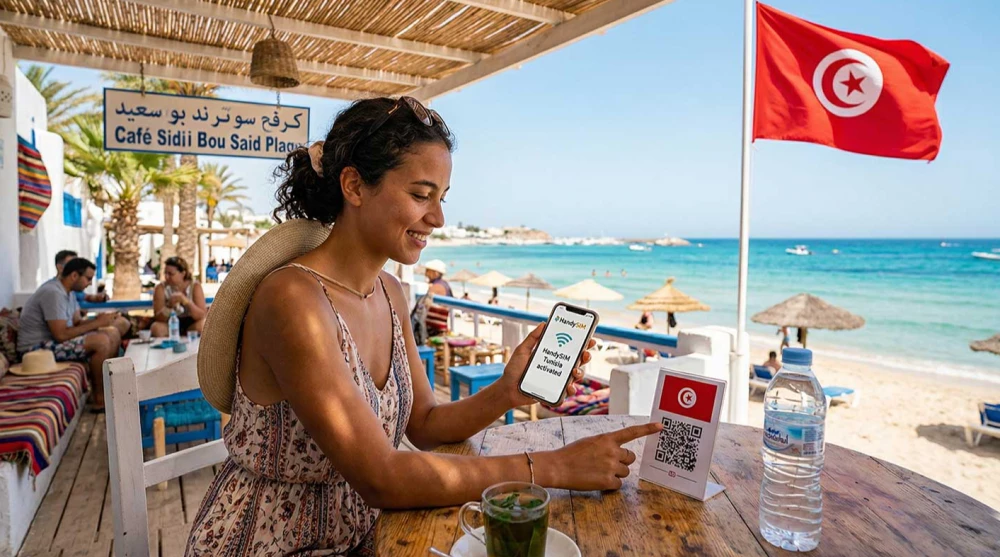
The digital SIM card is the modern standard for travel. It requires no physical documents on-site, no paper forms, and no waiting at counters. You buy your plan online, scan a QR code, and install the profile on your phone while still at home. Immediately after landing in Tunisia, you simply activate the line and have internet in the same second.
👉 Check all internet plans for Tunisia
| Method | Price | Convenience | Speed | Risk of Hidden Fees |
| eSIM for Tunisia | Low and Clear | Very High | High (4G/LTE) | Low (Prepaid) |
| Local SIM | Low | Low (Bureaucracy) | Medium to High | Medium (Loss of chip) |
| Home Roaming | Extremely High | Medium | Medium | Very High |
| Hotel WiFi | Free | Low | Often Slow | High (Data Security) |
Three main telecommunications companies operate in the country, sharing the market:
Conclusion: When you use an eSIM for Tunisia, your phone automatically connects to the best available network in the area (often Ooredoo or Orange), guaranteeing you an optimal experience without manual settings.
Yes, internet in Tunisia is fast and stable in coastal areas and major cities. In the desert and the interior of the country, coverage can be limited.
Yes, eSIM works excellently in Tunisia and allows instant access to mobile internet without registration or visiting an office.
Mobile internet coverage in Tunisia is highly dependent on where you are located. The country is divided into a highly developed coast and a wilder interior.
You have no worries here. 4G signal is almost everywhere, and the speed is sufficient for video calls, streaming, and work. In the capital, Tunis, 5G functionalities are already being tested in certain zones.
Internet in tourist enclaves is very good. However, keep in mind that during peak evening hours, when thousands of tourists return to hotels and start uploading photos, the network can become congested. Having your own 👉 eSIM for Tunisia gives you an advantage over those relying on overcrowded hotel WiFi.
If you plan a jeep safari in the Sahara or a visit to the "Star Wars" sets in Tataouine, prepare for long periods without any signal. Infrastructure in the desert is scarce, and you will often see "No Service." This is normal for these latitudes.
Many tourists expect that a 4G icon on the display means instant loading. In Tunisia, this is not always the case. The network is busy, and latency can be higher than in Europe or North America. In the evening, when locals and tourists are online simultaneously, speeds may drop. Additionally, the thickness of the walls in the old medinas (old cities) often blocks the signal, so you may need to step outside to load a complex map.
In Tunisia, internet is not just for entertainment; it is a safety tool. Google Maps is absolutely essential for navigating the labyrinths of the medinas, where every street looks the same.
For transportation, it is much safer and cheaper to use apps like Bolt (available in larger cities) instead of haggling with street taxi drivers who often "forget" to turn on the meter. WhatsApp remains the primary channel for contacting your local guides or tour operators. Without constant internet, you lose control over your logistics and safety.
A common occurrence in Tunisia is seeing a full signal bar on your phone but nothing loading. This usually means that the cell tower you are connected to is overloaded.
Quick Fix Solutions:
To choose the right plan, here is a quick breakdown of average consumption:
HandySIM Recommendation:
The process is simplified and takes less than two minutes:
Important: Before you fly or immediately after landing, ensure that Data Roaming is turned on for the new eSIM profile. Without this setting, the internet will not work.
If Tunisia is just the beginning of your African or Mediterranean adventure, we have solutions for neighboring destinations. Travelers often combine their holiday with other exotic locations.
👉 Morocco – for lovers of the authentic Maghreb.
👉 Egypt – for fans of pyramids and the Red Sea.
👉 Turkey – the most popular destination for a quick getaway.
For those planning a grand tour of the continent, we also offer a 👉 regional eSIM for Africa, which saves you from needing to buy separate cards at every border crossing.
Install eSIM Before Your Flight
Activate your 👉 digital SIM for Tunisia while still at home or at the airport with good WiFi. This way, you will have internet immediately upon landing without wasting time searching for local networks.
Turn on Data Roaming for eSIM
To ensure your eSIM plan for Tunisia works correctly, make sure "Data Roaming" is enabled only for this specific profile. This will not incur charges from your home operator but is a technical requirement to connect to the local Tunisian network.
Download Offline Maps
There are many areas in Tunisia with weak signals, especially as you move away from the coast. Download Google Maps offline for the Tunis, Sousse, or Djerba regions to have navigation even in coverage "holes."
Carry a Power Bank
Phones consume more battery when constantly searching for a signal in busy networks. Always carry an external battery, especially during long excursions into the desert.
Slow Internet? Try This
If you have coverage but data is not loading: toggle Airplane Mode on and off, wait 10–15 seconds, or restart your phone as a last resort. This usually "refreshes" the session with the cell tower.
Don't Rely Solely on WiFi
Hotel WiFi is often only free in the lobby and is extremely slow in the evening. Use your mobile data from your eSIM for Tunisia for important tasks like online banking and navigation.
Turn Off Automatic Updates
Apps and the operating system can consume a large amount of data in the background. Set your phone to update only via WiFi so you don't exhaust your precious data package on system updates.
Protect Your Personal Data
Avoid entering passwords, credit card details, or logging into social networks via public WiFi networks in Tunisia. Mobile data via eSIM is encrypted and much more secure against cyberattacks.
HandySIM Advice
Always choose a plan with slightly more data than you think you will need. In an unfamiliar country like Tunisia, internet is not just a convenience for uploading photos; it is your primary tool for safety, translation, and orientation. An 👉 eSIM for Tunisia with 10 GB is often a better choice than 5 GB, so you don't have to look for a top-up at the last minute.
Tunisia is an easy and hospitable destination, but mobile internet there does not always follow European or North American standards of ease. With the right preparation and a pre-installed eSIM, you will avoid bureaucracy, airport queues, and high roaming bills. Travel with peace of mind, enjoy your mint tea and the sands of the Sahara, staying connected to the world every second.
Yes, in coastal areas and major cities, the internet is fast and stable (4G/LTE). In popular resorts such as Hammamet, Sousse, and Djerba, the network is excellent; however, in the interior of the country and the Sahara Desert, coverage is very limited and often non-existent.
Yes, eSIM technology is supported by the major networks in Tunisia and is the easiest way to stay connected. It allows tourists to activate mobile data immediately upon landing without going through cumbersome registration procedures or visiting local offices.
Yes, roaming in Tunisia for international tourists is among the most expensive in the world. The country falls into "Zone 3," where the price per megabyte can be extremely high. Using a standard SIM card without a specialized package almost always leads to massive bills.
Yes, to purchase a local physical SIM card in Tunisia, it is mandatory to present an original passport. The process involves official registration in the operator's system, which often takes time and can be complicated by the language barrier.
For most tourists, eSIM is the better choice as it eliminates the need for passport registration and searching for open shops at the airport. With an eSIM, you don't risk losing your original SIM card and can keep your home number active for essential banking SMS notifications while using affordable data for the internet.
The main operators are Tunisie Telecom, Ooredoo, and Orange. Tunisie Telecom has the widest network in the provinces, while Ooredoo and Orange offer higher speeds in tourist centers. With a regional eSIM, you automatically connect to the most stable network at your current location.
You can only rely on WiFi in hotel lobbies and large cafes, but it is often slow and congested in the evening. For navigation via Google Maps, secure payments, and communication on the go, it is highly recommended to have your own mobile data, as public WiFi networks are not reliable.
The most efficient solution is to install an eSIM profile on your phone before you travel. Immediately after landing and turning off airplane mode, your device will automatically connect to a local operator. This allows you to order a taxi through a mobile app (such as Bolt) at a fair price—instead of negotiating with drivers at the terminal—and navigate to your hotel without delay.
For a standard one-week holiday, a package of 5GB to 10GB is fully sufficient for most tourists. This covers daily use of maps (about 200MB), social media for uploading photos (400MB), and WhatsApp chats. If you plan a two-week stay or will be working remotely, it is better to choose a 15GB or 20GB package to avoid the need for topping up.
This is a common technical issue that is usually solved with a few simple steps. First, check if the Data Roaming option is turned on in your eSIM profile settings—without it, data will not flow. If the problem persists, it may be due to a congested cell tower or an incorrect APN. For a full explanation and steps to fix it, see our detailed 👉 guide: eSIM has a signal but no internet.