preloader

Cart

Internet in Argentina for Tourists – eSIM, Operators & Coverage Guide

07.04.2026

Argentina is a land of extremes – from the cosmopolitan and ever-pulsating Buenos Aires, often called the "Paris of South America," to the wild, rugged, and endless Patagonia. It is the eighth-largest country in the world, which automatically means one thing: the logistics of your connectivity will be a challenge. For the modern traveler, activating an eSIM for Argentina is the most reliable way to secure mobile data immediately upon landing. Here, internet is not just a luxury for uploading photos of Iguazu Falls; it is your critical tool for survival, navigation, and daily logistics in a country where distances are measured in thousands of kilometers and Spanish is the primary means of communication.

When planning your trip, you must understand that Buenos Aires is not a representative sample of all of Argentina. In the capital, you will find fast 4G and an ever-expanding 5G signal, but the moment you head to El Chaltén or the steppe regions of La Pampa, the connection often becomes unpredictable or disappears entirely. In Argentina, internet means safety. Being able to call a taxi through a legitimate app in Buenos Aires or check an offline map in the Andes can change your entire experience.

Is there good internet in Argentina?

Yes, but only if you plan correctly. In cities, the infrastructure is excellent, but in Patagonia and the northern provinces, the signal is sparse. The most secure and technologically advanced way to guarantee internet in Argentina is to activate an eSIM before you even take off.

Which operator has the best coverage in Argentina?

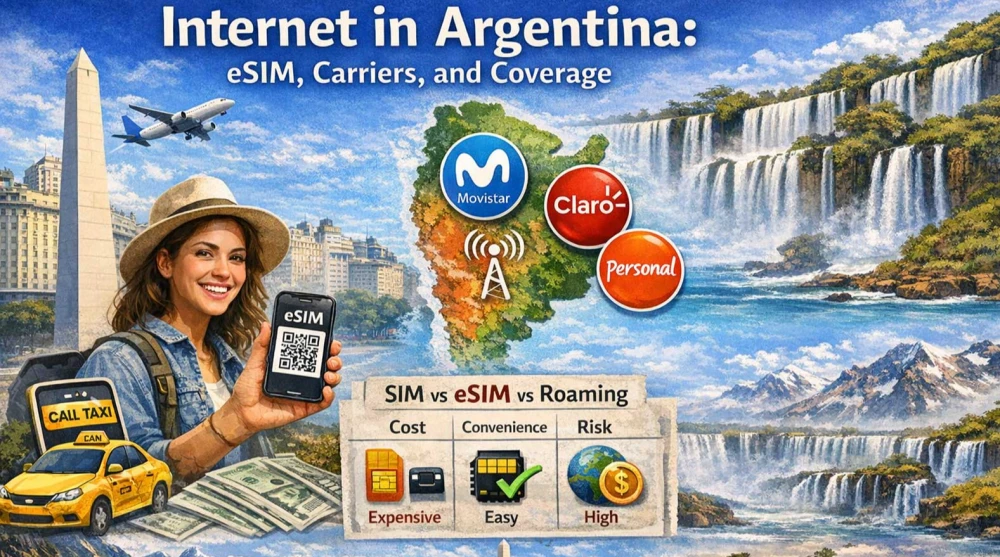
Movistar and Claro are the leaders in national coverage. Movistar is extremely stable in central regions and Patagonia, while Claro offers an excellent balance between speed and range along major road arteries. Personal is very fast in cities, but its coverage in remote areas often lags behind its competitors.

The Bottom Line: The easiest way to get stable internet in Argentina is an eSIM activated before your flight. This saves you time, avoids language barriers, and gives you data the second your plane touches the runway at Ezeiza Airport (EZE).

2. How to Get Internet in Argentina?

The Argentine telecommunications market is specific, highly regulated, and often bureaucratic for foreigners. Here are your real options for connectivity:

2.1 Roaming (The Most Expensive Trap)

Roaming in Latin America for tourists from the Eurozone is a true financial challenge. Due to the vast distances and lack of direct agreements between many European and Argentine operators, prices per megabyte are astronomical.

  • Extremely Expensive: Bills of €100–€200 for very little data usage are a daily occurrence for unwary tourists.
  • Unstable: Roaming traffic is often routed through international servers, leading to high latency and slow loading even with full signal.
  • Risky: Just one automatic update of your phone's operating system can exhaust your entire vacation budget.

2.2 Local SIM Card (A Bureaucratic Challenge)

Buying a physical card (known in Argentina as a "chip") seems like a cheap solution but hides many pitfalls:

  • Registration (KYC): In Argentina, every SIM card must be registered with an identity document. For tourists, this means a passport. The process often requires a visit to an official operator office, not just a newsstand.
  • Device Blocking: Local cards often don't activate immediately or require confirmation through Spanish voice menus. If registration is not completed within 24 hours, the card is blocked.
  • Language Barrier: Staff in small towns rarely speak English, making explaining a technical problem almost impossible.

2.3 WiFi (Insecure and Limited Solution)

WiFi is widely available in Buenos Aires cafes, but outside of them, it becomes a rarity.

  • Weak and Overloaded: Hotel networks in Patagonia are often satellite-based and extremely slow in the evenings when all guests are online.
  • Lack of Mobility: You cannot use Google Maps to navigate the subway or call an Uber from the street if you rely solely on WiFi.
  • Cybersecurity: Public networks in Argentina are often unencrypted, endangering your banking data and private information.

2.4 eSIM (The Best Solution for 2026)

eSIM technology for Argentina is the absolute gold standard for the modern traveler. It eliminates the need for physical cards and gives you full control over costs.

  • Digital Activation: Everything happens on your smartphone. No need to look for stores or swap tiny plastic cards.
  • More Than One Operator: Most eSIM profiles allow you to connect to the strongest available network in the area.
  • Ready Upon Landing: You can order a taxi and connect with loved ones while the plane is still taxiing to the terminal.

👉 Browse all eSIM plans for Argentina from HandySIM

3. eSIM vs SIM vs Roaming: Comparison Table

MethodPriceConvenienceSpeedRisk
eSIM for ArgentinaLow⭐⭐⭐⭐⭐High (4G/5G)Low
Local Physical SIMLow⭐⭐HighMedium (blocking)
RoamingVery High⭐⭐⭐MediumHigh (bills)
Public WiFiFreeLowHigh (hackers)

4. Mobile Operators in Argentina: Which to Choose?

The Argentine market is dominated by three major companies, each with its strengths and weaknesses.

  1. Movistar: This is the operator with one of the most stable infrastructures in the country. Movistar offers excellent 4G coverage and is a leader in implementing 5G in Buenos Aires and Córdoba. Their network is extremely reliable for tourist purposes.
  2. Claro: Known for its large market share across Latin America. Claro is exceptionally strong in urban centers and offers very good data speeds. Their coverage along major national roads (Rutas Nacionales) is among the best.
  3. Personal (Telecom Argentina): Often awarded as the operator with the fastest internet in Argentina. However, their coverage in smaller provincial villages can sometimes be weaker compared to Movistar.

Pro Tip: If you plan to visit both cities and nature, look for an eSIM plan that allows switching between Movistar and Claro networks for maximum stability.

5. Why Internet in Argentina is Different from Europe

Many travelers make the mistake of expecting European connectivity standards in Argentina. The reality is more complex:

  • Geographical Scale: Argentina is massive. Building fiber optic cables and cell towers in the Andes or Patagonia is a logistical nightmare. This leads to "dead zones" in coverage that can last for hundreds of kilometers.
  • Cell Density: In cities, you have 5G, but outside them, the signal quickly drops to 3G or Edge, which is only enough for text messages in WhatsApp.
  • Satellite Dependency: In the southernmost parts of the country, many networks rely on satellite links, meaning bad weather (strong winds or snow in Patagonia) can seriously slow down the internet.

6. Regional Coverage: What to Expect Where?

  • Buenos Aires: The internet here is flawless. You will have a 4G or 5G signal almost everywhere, including most subway stations. Cafes and hotels offer good speeds.
  • Patagonia (El Calafate / El Chaltén): This is a critical situation. El Chaltén is known as the "trekking capital" but also as a place with very poor internet. Expect a slow connection that often drops. Important: Do not rely on the internet to find the trail in the mountains – use offline maps!
  • Mendoza: In the city and major wineries (Bodegas) of Luján de Cuyo, the signal is stable. In the Uco Valley, however, you may experience interruptions.
  • Northwest Argentina (Salta / Jujuy): It’s fine in the cities, but in mountain passes and salt flats (Salinas Grandes), the signal is nearly zero.
  • Iguazu: Around the falls, the signal is good, but be careful – your phone might automatically connect to a Brazilian operator, which could activate unnecessary roaming charges.

7. Internet and Safety in Argentina

In Argentina, having data is directly linked to your safety:

  • Taxi Services: Using apps like Uber or Cabify in Buenos Aires is significantly safer than hailing a taxi from the street. These apps require internet to confirm your driver and route.
  • Dollar Exchange Rate: In Argentina, there is the so-called "Dólar Blue" (unofficial rate). You need internet to check the current rate daily and avoid being cheated when exchanging currency.
  • WhatsApp Communication: Almost all tour and restaurant reservations in Argentina are confirmed via WhatsApp.

8. How Much Mobile Data Do You Need?

  • Maps & Navigation: About 200–300 MB per day during active travel.
  • Social Media (Instagram/TikTok): These are the biggest consumers – between 500 MB and 1 GB per day if you upload videos.
  • WhatsApp: Negligible (about 100 MB per week), unless you send many video files.

👉 HandySIM Recommendation: For a two-week tour of Argentina, a package of 15 GB to 20 GB is fully sufficient for normal use without restrictions.

9. HandySIM Tips: Professional Advice for Internet in Argentina

To get the most out of your eSIM for Argentina, follow these proven tips:

Basic Tips (For Every Traveler)

  1. Dual SIM Strategy: Use your home SIM card only for receiving important SMS (like bank codes), and set the eSIM as your primary source for "Mobile Data."
  2. Airplane Mode for "Refresh": If you notice your phone shows signal but the internet isn't loading, turn on airplane mode for 10 seconds. This forces the device to look for the nearest and least congested tower.
  3. Restart When Crossing Provinces: When traveling by domestic flight (e.g., from Buenos Aires to Bariloche), restart your phone after landing to ensure it connects correctly to the local infrastructure.
  4. Photograph the QR Code: Before installing the eSIM, take a screenshot of the QR code or send it to a travel companion's email. If for some reason you need to set up a new phone, you will have access to the code.
  5. Do Not Delete the eSIM After Installation: This is critical! Once deleted from the settings, an eSIM usually cannot be reinstalled with the same code. Keep it until the end of your trip.

Pro Tips (For Advanced Users and Digital Nomads)

  1. Lock Data to the eSIM: Go to Settings -> Mobile Data and disable "Allow Cellular Data Switching." This prevents the phone from automatically switching to your expensive home SIM if the eSIM signal weakens.
  2. Disable Data Roaming on the Primary SIM: This is vital. Roaming should be turned ON only for the eSIM profile. For your primary card, it must be turned off to avoid hidden fees.
  3. Switch to 4G/LTE: In some areas of Patagonia, the 5G signal is unstable, and the phone constantly wastes battery searching for it. Manually switching to "LTE Only" can save your battery and provide a more stable net.
  4. Offline Google Maps + Translate: Before heading to the mountains, download an offline map of the area and a Spanish language pack. This works with GPS without needing mobile data.
  5. Disable Auto Updates: Apps often update in the background and can consume 2–3 GB in one night. Turn off automatic updates in the App Store or Play Store.
  6. Be Careful with Hotspots: Sharing internet with other devices drains the battery extremely quickly. Use it only for short checks.
  7. Background App Refresh: Turn off this feature for apps like Instagram, Facebook, and TikTok. They constantly pull content even when you aren't using them.
  8. Manual Network Selection: If the network setting is "Automatic" but the internet is slow, try manually selecting another available operator (e.g., from Movistar to Claro).
  9. Check APN Settings: Although most eSIMs set up automatically, always check the instructions from HandySIM to ensure the APN (Access Point Name) is correct.
  10. Power Bank is Law: Travel in Argentina involves long distances. Without an external battery, you risk being left without navigation in the middle of Buenos Aires.
  11. "Full signal ≠ internet": If the cell tower is overloaded (e.g., at a central square during a protest or festival), you might have signal but no data movement. Just move a few blocks away.
  12. Install via System Browser: Always activate the eSIM through your phone's settings or Chrome/Safari, not through the built-in browsers of apps like Facebook or Instagram.
  13. WiFi for Photo Backup: Use hotel WiFi only for uploading your photos to the cloud (iCloud/Google Photos) to save your mobile data package.
  14. Check Coverage Along the Route: If you are taking a long bus journey, let loved ones know you will be offline for the next 5–10 hours.
  15. Always Have a Plan B: Write down your hotel address on paper or in your phone's notes. Argentina is unpredictable – be prepared.

10. Regional Travel: Explore Latin America

If Argentina is just part of your grand South American tour, HandySIM offers convenient regional solutions:

11. Conclusion

Argentina will offer you sights and emotions you will remember for a lifetime – from the passionate tango to the icy blues of Perito Moreno. For your adventure to be smooth and secure, a reliable internet connection is absolutely mandatory. By choosing an eSIM for Argentina from HandySIM, you get not just data, but the freedom to explore this incredible country with confidence and security.

Are you ready for Argentina?

👉 See the best eSIM plans for Argentina here

Yes, eSIM works in Argentina and is fully supported by the major mobile operators. It is the fastest and most modern way to get mobile internet in Argentina, eliminating the need for physical SIM card swaps or visiting local offices for registration.

Is roaming expensive in Argentina for European tourists?

Yes, standard roaming is extremely expensive. Prices per megabyte for tourists from Europe often reach €15. Using a prepaid eSIM for Argentina is a solution up to 90% more cost-effective to avoid massive bills upon your return.

Do I need a passport to buy a SIM card in Argentina?

Yes, a passport is required by law to register any physical SIM card. This process is often slow and bureaucratic, making digital technology the best way to get internet in Argentina for tourists, as activation is done entirely online without documents.

Can I rely on WiFi in Argentina?

Not entirely. While there are many hotspots in Buenos Aires, they are often slow and congested. Outside of major cities and in regions like Patagonia, public WiFi is rare, making a reliable mobile internet in Argentina critical for your navigation and safety.

Is eSIM better than a local SIM card in Argentina?

Yes, for most travelers, eSIM is the more convenient choice. A local SIM card requires a physical visit to a store and bureaucratic registration, whereas activating an eSIM for Argentina takes only minutes. This allows you to keep your original card in your phone, keep your WhatsApp number, and have working internet in Argentina for tourists immediately upon landing.

How much mobile data does a tourist need in Argentina?

For a standard 10-14 day trip, a package of 15GB to 20GB is usually quite sufficient. Argentina is a massive country, and you will use Google Maps and taxi apps (like Cabify) constantly, making stable internet in Argentina for tourists mandatory for smooth travel.

Is there coverage in Patagonia and remote areas?

Coverage in Patagonia is variable and depends on the operator. In cities like El Calafate, there is a signal, but it often disappears in national parks. Using an eSIM that supports Movistar or Claro networks is the most reliable way to have mobile internet in Argentina, even in more remote areas.

Can I use my phone without issues in Argentina?

Most modern smartphones support the frequencies used in the country, but it is important that your device is factory unlocked. Installing an eSIM for Argentina ensures you won't have hardware incompatibilities and will have the best way to get internet in Argentina. This gives you the freedom to use high-speed 4G and 5G networks instantly without searching for local stores.

How can I get internet immediately after landing in Argentina?

The easiest way is to configure your eSIM 24 hours before your flight. The process is simple: scan a QR code and add the plan. When you land at Ezeiza Airport (EZE) in Buenos Aires, just turn off airplane mode and you already have working internet in Argentina for tourists. This allows you to immediately order a taxi via Cabify and navigate to your hotel without unnecessary waiting.

Why do I have a signal, but the internet is not working?

This problem is usually caused by incorrect APN settings or "Data Roaming" being turned off for the eSIM profile. Sometimes, the network in crowded zones can be congested, even with full bars. For detailed steps on how to handle this, read our guide on how to fix an eSIM problem (has signal but no internet).


Viber WhatsApp
Cookie