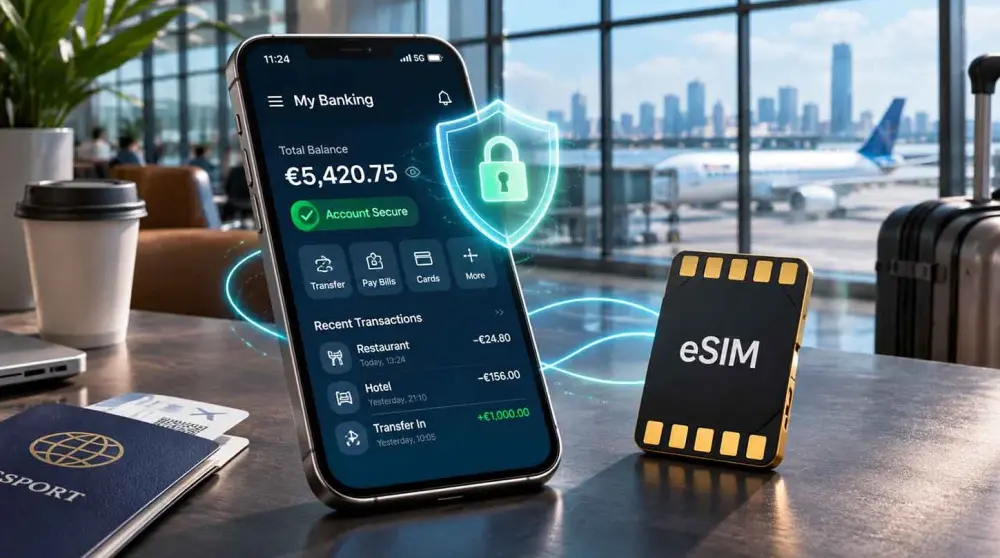
Yes, using a travel eSIM for online banking is generally safe. A travel eSIM relies on the same core mobile network security technologies as a traditional physical SIM card, meaning it does not introduce new vulnerabilities simply because it is digital. Your banking apps also maintain their own independent layers of protection regardless of which cellular provider you use. When travelling abroad, relying on mobile data is often a more predictable choice than connecting to unfamiliar public Wi-Fi networks, which can expose you to additional risks. However, accessing your accounts from another country can still trigger extra security checks from your bank, so understanding how both mobile networks and banking security operate is essential.
How Secure Is a Travel eSIM for Online Banking?
Security during mobile banking is a shared responsibility between the cellular network, your banking application, and your device. Understanding how these layers interact helps clarify what an eSIM actually protects.
eSIM Uses the Same Mobile Network Security as a Physical SIM
An eSIM is simply a digital version of a physical SIM profile embedded directly into your smartphone's hardware. When your device connects to a local tower abroad, the eSIM uses standard cellular network authentication mechanisms to verify your identity and establish a connection. It is no less secure than a plastic SIM card. That said, cellular network protection secures the radio link between your phone and the network tower; it does not automatically provide end-to-end encryption for all internet traffic leaving your device.
Banking Apps Provide Their Own Security
The primary defense for your financial data comes from the banking application itself. Modern mobile banking platforms use strong HTTPS/TLS encryption to protect data in transit, alongside biometric authentication, two-factor authentication (2FA), real-time transaction verification, and device recognition. Ultimately, the security of your banking app does not depend on whether your phone runs on a physical SIM or a travel eSIM.
Travel eSIM vs Public Wi-Fi: Which Is Safer for Banking?
When managing finances on the road, choosing between a cellular connection and free wireless networks is one of the most practical security decisions you will make.
Security Risks of Public Wi-Fi
Public Wi-Fi networks in airports, hotels, and cafes are convenient, but they carry inherent uncertainties. Attackers can set up fake Wi-Fi hotspots with convincing names to trick travellers into connecting, or malicious network operators can redirect browsers to convincing phishing pages. On unsecured networks, unencrypted traffic can potentially be intercepted or manipulated. While connecting to public Wi-Fi does not automatically allow someone to read properly encrypted banking app data, it significantly increases your exposure to fake login screens and network-level interference.
Why Mobile Data Is Often the Better Choice
Using mobile data via a travel eSIM removes the need to join unknown wireless networks altogether. Because your phone connects directly through SIM-authenticated cellular infrastructure, the risk of accidentally joining a rogue Wi-Fi hotspot is eliminated. Combined with your banking app's built-in encryption, mobile data provides a much cleaner, more predictable environment for checking balances and approving transfers.
|
Security Feature
|
Travel eSIM
|
Public Wi-Fi
|
|
Network authentication
|
Cellular SIM authentication
|
Depends on network
|
|
Fake hotspot risk
|
Not applicable in the same way
|
Possible
|
|
Banking app encryption
|
Supported
|
Supported
|
|
Connection privacy
|
Depends on network and services
|
Depends on network
|
|
Suitable for banking
|
Generally yes
|
Use additional caution
|
Can You Access Your Banking App Abroad with a Travel eSIM?
Having a secure connection is only half the equation; you also need to ensure your bank actually lets you log in while you are away from home.
Banking Apps Usually Work Over Mobile Data
Banking apps are built to function over any standard, working internet connection. A travel eSIM does not require any special banking compatibility or custom configuration to load your financial apps. As long as your mobile data connection is active, your app will communicate with your bank's servers normally.
Why Banks Sometimes Block Logins from Abroad
If your banking app refuses to log you in or temporarily freezes a transfer while you are travelling, it rarely means there is a technical fault with your eSIM. Financial institutions use automated fraud-detection systems that monitor for unusual login locations, foreign IP addresses, unrecognized devices, or sudden changes in transaction patterns. When these systems flag a login from abroad, the bank may require additional identity verification or temporarily restrict access to protect your account.
Does a Travel eSIM Change Your IP Address or Banking Location?
Many travel eSIM providers route mobile data through international network gateways, a process known as IP breakout. Because of this routing, your assigned IP address does not always match the exact country where you are physically standing. For example, you might be travelling in Asia while your mobile connection displays an IP address registered in Europe.
Banking security systems actively monitor IP geolocation. If your bank sees an IP address from an unexpected country—or notices your IP location jumping across borders within a short timeframe—it may trigger an automated security prompt or ask for extra verification before processing a payment. Using a VPN can have a similar effect on your bank's risk assessment, sometimes causing even stricter login checks.
Can You Receive Banking SMS Codes While Using a Travel eSIM?
Receiving one-time passwords (OTPs) is often the biggest hurdle for travellers managing online banking abroad.
Data-Only eSIMs and Banking Verification
Most travel eSIMs are data-only plans, meaning they provide mobile internet without a traditional cellular voice or SMS service. While your banking app will open and function smoothly over your travel eSIM's internet connection, any standard SMS verification codes will still be sent exclusively to the primary phone number registered with your bank.
Keeping Your Regular SIM Active
If your smartphone supports Dual SIM functionality, you can run your travel eSIM for mobile data while keeping your regular home SIM active specifically to receive banking SMS codes. Whether you can receive text messages while roaming—and whether any fees apply to incoming or outgoing services—depends entirely on your home mobile carrier's roaming terms.
App-Based Authentication
Whenever possible, switch your bank's verification method away from SMS before you depart. Most modern banks support push notifications directly inside the banking app, biometric confirmation, or in-app transaction approval. Because these methods operate over your mobile data connection, they work seamlessly with a data-only travel eSIM.
Using Online Banking with a Travel eSIM in Different Countries
Having reliable mobile data changes how you handle everyday finances across different travel destinations, reducing your reliance on unsecured networks.
Japan — Secure Mobile Banking While Travelling
Japan is a major destination for international visitors who frequently rely on mobile apps for digital transit cards, hotel bookings, and daily payments. Travellers using eSIM Japan can access their banking apps through mobile data without relying on public Wi-Fi networks at airports, hotels, or railway stations. Even with a stable cellular connection, keep in mind that your home bank may still request extra identity confirmation when it detects a login from East Asia.
South Africa — Banking Without Public Wi-Fi
When travelling through South Africa, maintaining your own cellular connection helps you manage cards, approve online bookings, and check exchange rates securely on the go. With eSIM South Africa, travellers can use mobile data for banking transactions instead of connecting to unfamiliar public Wi-Fi networks. Pairing this cellular access with an up-to-date operating system and a screen-locked device ensures your financial accounts remain well protected.
Latin America — Banking Across Multiple Countries
Multi-country itineraries across Central and South America require consistent internet access as you cross borders. An eSIM Latin America package can provide mobile connectivity across supported destinations, allowing travellers to access banking services throughout their journey—though exact country coverage always depends on the specific plan selected. Because crossing borders changes your connection country and IP address frequently, be prepared for occasional extra verification prompts from your bank.
United States — Banking with Mobile Data
International visitors in the United States often deal with frequent card authorizations, mobile wallet top-ups, and digital reservations. Using eSIM USA for mobile internet allows international visitors to access banking apps without depending on public Wi-Fi connections in busy terminals or cafes. As with any long-haul trip, an unexpected US login may prompt your bank's fraud filter to verify your identity.
Mexico — Mobile Banking During Your Trip
Whether you are checking account balances, transferring funds, or confirming hotel deposits, having a dedicated mobile connection simplifies financial management in Mexico. Travellers with eSIM Mexico can manage their banking activities using mobile data while keeping their regular SIM available for verification messages when needed.
Do You Need a VPN for Online Banking with a Travel eSIM?
Because reputable banking apps already encrypt all communication between your smartphone and the bank's servers, a VPN is not mandatory for safe online banking over a travel eSIM. While a trustworthy VPN can add an extra layer of general browsing privacy in certain situations, it is not a universal solution for financial security.
In fact, using a VPN can sometimes create unnecessary friction. Many banks actively flag, challenge, or outright block connections originating from known VPN server IP addresses to prevent automated fraud. Furthermore, not all VPN services are equally reliable—free or poorly managed VPNs can introduce their own privacy risks. For standard mobile banking over cellular data, your banking app's built-in encryption is typically sufficient on its own.
How to Keep Your Online Banking Secure While Travelling
Your connection method is only one part of safe financial management abroad. Follow these practical habits to protect your accounts:
-
Keep your banking app and your smartphone's operating system fully updated before you travel.
-
Use mobile data instead of unfamiliar public Wi-Fi networks whenever practical.
-
Enable biometric authentication and app-based two-factor verification on all financial accounts.
-
Keep your regular home SIM available in Dual SIM mode if your bank still relies on SMS verification codes.
-
Avoid opening banking links sent via unexpected SMS messages or emails, which are common phishing tactics.
-
Never share one-time verification codes, PINs, or banking passwords with anyone.
-
Contact your bank before departing if it enforces strict international access or card-usage restrictions.
Conclusion
Using a travel eSIM is generally a safe, reliable way to access online banking abroad. Because an eSIM uses standard cellular authentication, it does not weaken your banking app's built-in security, and having dedicated mobile data reduces your need to rely on unfamiliar public Wi-Fi networks. While international IP routing, SMS delivery, and automated bank checks can occasionally affect account access, planning ahead prevents most issues. Services like HandySIM provide straightforward mobile connectivity for international trips, helping you manage your finances safely wherever you travel.