05.05.2026
If you're looking for internet in Thailand without expensive roaming, here you'll find the best options—eSIMs, local SIM cards, and how to get online instantly.
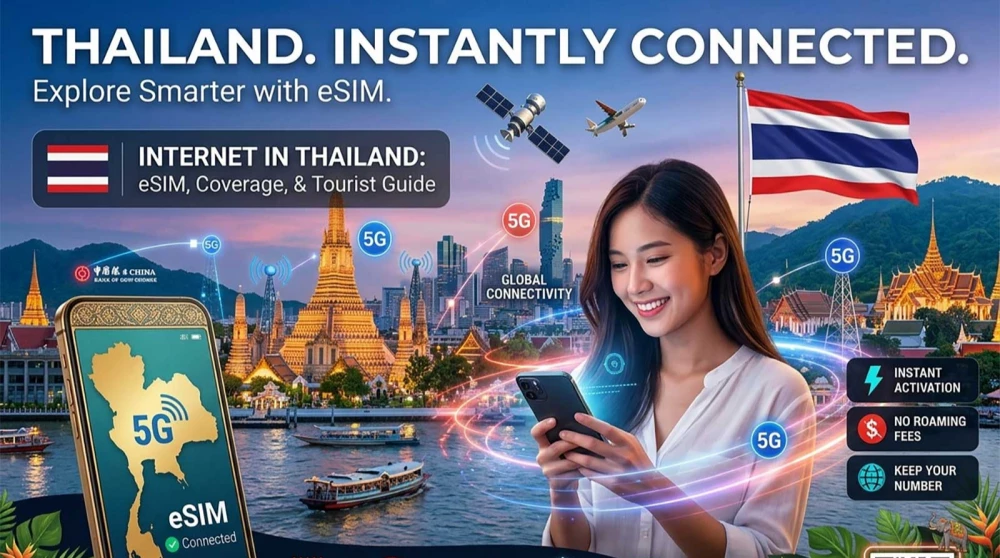
The easiest way to get mobile data in Thailand is via a tourist eSIM with instant activation – no searching for physical stores, no queues, and no complicated settings.
Thailand is one of the easiest countries for internet in Asia – if you choose the right solution. Despite the highly developed telecommunications infrastructure and the deep integration of digital services into daily life—from paying for street food to booking island ferries—the choice between traditional roaming, purchasing a local physical SIM card, and modern eSIM technology can make a huge difference. The wrong choice can cost you a lot of money, nerves, and wasted time, while the right one guarantees peace of mind from the second you land.
Using your standard SIM card with a plan from your home operator in Thailand is the most disadvantageous and risky option for your budget. Since the country is located far outside the European Union (typically falling into Zone 3 or Zone 4 depending on your carrier's tariffs), mobile data prices are astronomical. Even background updates for a few apps or accidentally loading a short video on social media can rack up a bill of hundreds of dollars in minutes. There is absolutely no reason to rely on this option, as the risks of shocking invoices upon your return are immense and completely unjustified.
The traditional approach for thousands of tourists every day is purchasing a local Thai SIM card upon arrival. While this option is popular and relatively easy, it comes with several significant inconveniences that you should be prepared for.
Pros:
Cons:
The digital SIM card (eSIM) is the smart choice for the modern traveler. It gives you the best of both worlds – a reasonable price and maximum comfort, eliminating the need for physical cards and waiting at counters.
Please always ensure that users carefully read the package they are purchasing to make sure it fully meets their specific data and duration needs.
To help you make the most informed choice, here is a clear comparison between the three main ways to connect to the internet in Thailand. As seen below, the digital approach provides unmatched convenience.
| Feature | eSIM | Local SIM | Roaming |
| Price | Low | Very Low | High |
| Convenience | Very High | Medium | High |
| Activation | Instant | On-site | Automatic |
| Keep Home Number | Yes | No | Yes |
👉 Explore all eSIM plans for Thailand and secure your connection before your flight.
The Thai telecommunications market is highly competitive and dominated by several massive companies offering world-class network coverage that rivals many Western countries.
All major operators in Thailand are excellent. There is really no "wrong choice" when it comes to coverage in popular destinations. Your digital card will automatically connect to the best available network.
Being mobile in Thailand is a core part of the adventure, and a stable internet connection is your most reliable guide through the chaos of local traffic.
Thailand is a visually stunning destination that practically encourages constant sharing of photos, videos, and impressions. Which data package is best for you?
Recommendation: For a standard 10 to 14-day holiday in Thailand, a 10–15 GB package is the absolute sweet spot. It gives you full peace of mind that you won't go offline without paying for unnecessary and unused capacity.
Installing your digital profile is intuitive, secure, and takes only a few minutes. The process is designed so that even people without technical knowledge can manage it effortlessly.
Mobile data in Thailand is not just a luxury for posting beach photos – it is an absolutely key tool for survival, safety, and comfort in this dynamic country.
To make your experience truly flawless and protect your data, we have prepared a list of the most important technical tips – the golden core for every traveler.
Data Roaming ON
This is technically mandatory for your tourist card to function. Don't worry – as long as your home SIM's roaming is off, you won't have fees. You are simply allowing the new eSIM to connect to the local Thai network.
eSIM Primary Data
In your device settings, ensure the new eSIM is set as the primary source for "Mobile Data." This ensures your phone won't use expensive roaming from your home operator for internet traffic.
Disable Updates
Both iOS and Android are programmed to download massive system updates (often 1–2 GB) in the background. This can exhaust your package in minutes. Turn off automatic updates over mobile data in your app store settings.
Airplane Mode Fix
If the connection seems slow or stuck, toggle Airplane mode on for 10 seconds and then off. This forces your device to scan again and latch onto the nearest and strongest cell tower.
Hotspot Warning
Be careful when sharing internet to a laptop. Computers are data-hungry and often start automatic synchronizations or system updates that consume many times more data than a phone.
Offline Maps
Download the map of Bangkok or Phuket in Google Maps beforehand. This saves a massive amount of data, preserves battery, and is vital if you end up in a weak signal zone in the jungle.
Power Bank
Constant GPS navigation, high screen brightness, and 5G signal searching drain the battery extremely fast. A reliable external battery is a must-have accessory.
Don’t Delete eSIM
This is a critical rule! The installation QR code is usually one-time use. If you delete the profile from your phone's settings, you lose it forever and will have to buy a new plan.
Before heading to the airport for your Thai adventure, make sure you have checked these three critical steps:
If your trip includes a larger tour of Southeast Asia, check out our specialized guides and plans for neighboring countries:
Thailand is one of the easiest, most affordable, and pleasant destinations for using mobile data worldwide. The infrastructure is brilliant, speeds are high, and the lack of heavy internet restrictions makes communication completely free and relaxed.
With the right choice of digital SIM card, you will be online within seconds of your arrival. You will avoid unnecessary stress, tedious airport queues, and, most importantly, protect yourself from unpleasant roaming costs.
👉 Explore the plans for Thailand and get online immediately upon landing.
Yes, enabling data roaming in your phone settings is required for your eSIM to connect to the local network. This will not incur charges from your primary provider as long as the eSIM is selected for mobile data. Does eSIM work in Thailand? Yes, it is the most efficient way to stay connected.
Yes, most eSIM plans allow you to share your internet connection (hotspot) with other devices. This is an excellent way to provide a connection for a laptop or tablet while traveling, and the eSIM works seamlessly in Thailand.
All mobile apps for navigation, messaging, and social media work normally with an eSIM. You can rely on them for constant connectivity throughout Thailand.
Yes, eSIM technology is widely supported and works excellently in Thailand. All major local operators (AIS, DTAC, TrueMove H) support eSIM, allowing tourists to activate mobile data in minutes without needing to visit a physical store or swap a physical chip
Thailand has one of the most advanced 5G networks in Southeast Asia. Coverage is excellent in Bangkok, major cities, and popular resorts. By using an eSIM, you get access to these high-speed networks as soon as your phone registers with the local infrastructure. Does eSIM work in Thailand? It is actually the best way to access these 5G speeds instantly.
Roaming through a traditional home provider outside of the EU is usually extremely expensive and can lead to unwanted bills. Using an eSIM in Thailand is a much more affordable alternative, providing a fixed data package at a transparent price with no hidden fees.
The easiest way is to purchase and install your eSIM profile before your departure. Once you land in Thailand, simply activate the line in your phone settings, and you will have a stable mobile data connection the moment you step off the plane.
Your needs depend on the length of your stay and your usage habits. For a standard 10–14 day vacation, a package between 10 GB and 15 GB is usually more than enough for navigation, social media, and calls via apps. If you plan to stream video or work remotely, look for plans with more data. The good news is that eSIM works reliably in Thailand and often allows for easy top-ups if your initial package runs out early.
An eSIM offers significantly more convenience as it eliminates the need to search for sales kiosks at the airport, wait in lines, or provide your passport for on-site registration. With an eSIM, you keep your primary SIM card in your phone for important calls while using affordable mobile data for browsing. While local physical cards might be slightly cheaper in some cases, the risk of losing your original card and the time wasted makes them less preferable for modern travelers in Thailand.
Although Thailand has impressive coverage, the signal may weaken or disappear in very remote jungles, small uninhabited islands, or deep in mountainous regions. However, in major tourist zones, beaches, and transport hubs, the connection is very stable. It is important to know that your eSIM works in Thailand through the networks of leading operators, guaranteeing you the maximum possible range even in less populated areas.