16.04.2026
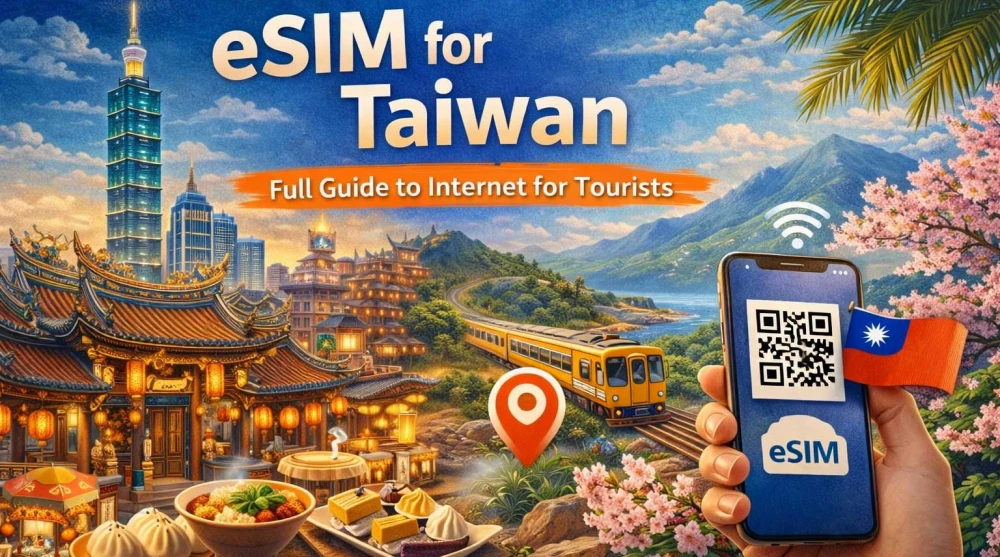
Traveling to Taiwan and want internet without expensive roaming from day one? This guide covers eSIM options, coverage, and practical tips to stay connected.
Taiwan is a destination often described as "the future that has already happened." From the moment you step into Taoyuan International Airport, you will feel the pulse of one of the most technologically advanced nations in the world. But for your experience to be complete, stable internet isn’t a luxury—it’s critical infrastructure. Many tourists make the fundamental mistake of relying solely on public WiFi or expensive roaming, only to realize too late that this simply doesn’t work in real-world conditions, leaving them isolated and without navigation at the most critical moments.
Whether you need to decipher complex Traditional Chinese characters via Google Lens, hail a ride via Uber, or simply find that legendary food stall at the Shilin Night Market, your connection must be flawless. In Taiwan, the internet is everywhere, but it has its "catches." The towering skyscrapers of Taipei, the dense subtropical jungles to the east, and the deep tunnels of the High-Speed Rail pose serious challenges to mobile signals. In this comprehensive guide, we’ll explore how to prepare for the island's digital world and why choosing the right digital SIM card is the smartest move for any modern traveler.
The easiest and most secure way to get internet in Taiwan is an eSIM for Taiwan, activated before your flight takes off.
When it comes to connectivity on the island, you have four main paths. Each has its pros, but the differences in cost and convenience are drastic, especially when compared to the needs of today's "data-hungry" user.
For international tourists, roaming in Taiwan falls into the most expensive tariff zones. Prices often exceed $10-$15 for a single megabyte. Think about it: a single background app update or receiving a short video on WhatsApp could cost you hundreds of dollars in minutes. Roaming is a concept of the past that simply isn't worth a penny in Taiwan. Standard daily roaming packages from home carriers are too small and often vanish the moment you open your maps for navigation.
Taiwan is more organized than many other Asian countries, but buying a physical card still requires significant effort and time.
Taiwan offers "iTaiwan"—a massive network of free hotspots—but it has serious limitations that tourists often don't anticipate.
This is an international eSIM, which is a digital profile installed directly onto your smartphone by scanning a QR code.
👉 Get your eSIM for Taiwan from HandySIM and be online the moment you land
| Method | Price | Convenience | Speed | Risk |
| eSIM | Low | ⭐⭐⭐⭐⭐ | High (5G/4G) | Low |
| Local SIM | Medium | ⭐⭐⭐ | High | Medium (loss of SIM) |
| Roaming | Extreme | ⭐⭐ | Medium | Very High (bills) |
| WiFi | Free | ⭐⭐ | Variable | Medium (security) |
For those planning a longer trip through the region and combining Taiwan with other countries, the Regional eSIM for Asia is often an even smarter option, covering over 15 countries.
The Taiwanese telecom market is dominated by three main giants. Choosing the right network is the difference between having internet in the mountains or staring at a "No Service" icon.
This is the state-owned telecom giant and the largest operator on the island. They have the most extensive network of base stations.
A very popular operator focusing on technological innovation and lightning-fast speeds in metropolitan areas.
Known for very good coverage in enclosed spaces, underground malls, and metro stations. They offer very competitive 5G services and are often innovators in mobile apps.
👉 HandySIM Conclusion: For tourists, the most reliable option is a plan running on the Chunghwa Telecom network, as it guarantees a signal even where others fail.
Here, the internet is not just fast—it’s everywhere. 5G signal covers almost every corner of the city. Taipei is designed with connectivity in mind, so even in the narrow alleys of old districts, you will have a flawless connection.
Taiwan is an island of mountains. When climbing toward Alishan or Hehuanshan, the signal remains stable along main roads but can disappear in deep canyons or dense forests.
These are heavenly spots for diving. Coverage there is concentrated around ports and main settlements. If you plan a boat trip, don't rely on constant streaming in the open sea.
If you aren’t a technical person, you can safely skip this part—the important thing is that most modern phones work without any issues in Taiwan.
Unlike some countries that use outdated standards, Taiwan is at the peak of mobile technology. Their networks are fully compatible with European and American devices. The key here is network density—there are so many base stations on the island that the signal manages to penetrate even the thick reinforced concrete walls of Taipei's skyscrapers. Our eSIM solutions are pre-configured to recognize the best network automatically, saving you the need for manual settings.
This is a real phenomenon that confuses many people. You might see 4 or 5 bars of signal on your screen, but nothing loads.
Quick Fixes:
To plan your budget correctly, here is an approximate usage for an active tourist:
Taiwan is often just the first stop. If your itinerary continues, HandySIM has ready-made plans:
👉 Regional Solution:
The Regional eSIM for Asia is the most convenient option—it works automatically in all these countries without needing to change settings at every border.
To get the most out of your digital SIM card, follow these 12 golden rules:
Taiwan is an incredible destination that blends ultra-modern skyscrapers with ancient traditions and wild nature. Being without internet here is like entering a library blindfolded—the information is all around you, but you have no access to it.
Choosing a digital SIM card is not just a technological convenience; it is your insurance for security and peace of mind. With it, you avoid expensive roaming, save valuable time from your vacation, and ensure you’ll always find your way back to your hotel or your next adventure. Prepare early and enjoy Taiwan without any technological barriers.
Choose an eSIM for Taiwan from HandySIM and start your adventure today with the most reliable connection in your pocket!
Yes, Taiwan offers some of the fastest and most stable internet access in the world. The infrastructure is exceptionally modern; in major cities, a 5G signal is the standard, and even in subways and public zones, the connection remains excellent.
Yes, Taiwan fully supports eSIM technology. Most modern smartphones can easily activate a digital data plan. This is the preferred method for tourists as it requires no physical card swapping and allows for activation even before arrival.
For international travelers, roaming in Taiwan is extremely expensive. Data prices can reach staggering heights per megabyte, making your home SIM card's data usage financially unviable. Using an eSIM is up to 90% cheaper.
Yes, Taiwan is a global leader in 5G implementation. Coverage in Taipei, Taichung, Kaohsiung, and other major cities is nearly 100%. A 5G signal is available even in subway stations and most shopping malls.
Chunghwa Telecom is recognized as the operator with the widest and most stable coverage, especially in mountainous and remote areas. Taiwan Mobile and FarEasTone are excellent alternatives for urban environments, offering lightning-fast 5G speeds, but for travelers planning to explore the entire island, Chunghwa remains the #1 choice.
For most tourists, an eSIM is the better option. While a local SIM card requires passport registration and waiting in lines, an eSIM activates instantly. With an eSIM, you keep your original number active for SMS and important calls while using affordable mobile data from the digital profile.
Buying at the airport is easy, but it wastes valuable vacation time. Queues can be long, and airport package prices are sometimes higher than eSIM plans purchased online. With a pre-arranged eSIM, you skip the bureaucracy and have internet the second you land.
For mountain treks (Alishan, Taroko), it is critical to use a plan running on the Chunghwa Telecom network. Before you head out, download offline maps in Google Maps, as the signal can drop in deep canyons. HandySIM’s eSIM profile often connects to the strongest available tower, giving you the maximum advantage in the wilderness.
For a standard one-week stay involving navigation, social media, and chatting, 10GB to 15GB is usually more than enough. If you plan to work remotely or upload a lot of 4K video content, we recommend an Unlimited plan to avoid any sudden disconnections.
The most secure way is to install your HandySIM eSIM profile while still at home or at the airport before departure. As soon as you land in Taiwan and turn off airplane mode, your phone will automatically connect to the local network. This allows you to immediately hail a ride, message your loved ones, or check the route to your hotel without searching for public WiFi.