01.06.2026
Picture this: you have just landed after a long flight. You turn on your smartphone to check your messages, find your hotel address, or order a ride. Everything seems normal—the internet works, your apps are updating, and you calmly head to your accommodation. A few days later, you receive a message from your mobile operator. Your phone bill has swelled to an unexpected size.
Many people travel outside the European Union assuming their mobile internet will work almost exactly as it does at home. Thanks to European regulations, we have grown accustomed to not worrying about fees and limits. However, outside the EU borders, the rules are entirely different, and mobile operators can charge you significantly more for every single online action.
Countries like Turkey, Egypt, Morocco, the USA, China, Japan, Singapore, and South Korea are among the most popular destinations for tourism and business. Yet, it is precisely there that a harmless check on a navigation map, exchanging a few messages, or watching a short video can result in an unexpected expense if you haven't checked your operator's terms in advance.
In this article, we will explore in detail what roaming outside the EU actually means, why it generates higher fees, which destinations are the riskiest, and how you can secure reliable and affordable mobile data abroad.
In telecommunications, "roaming" refers to your mobile phone's ability to connect to and use a foreign operator's network when you are outside the coverage area of your home network. Since your home operator does not have its own cell towers there, it signs agreements with local telecom companies.
Within the European Union, the "Roam Like at Home" regulation is in effect. It mandates that operators cannot apply extra charges for calls, SMS, and mobile data when you travel to another member state.
However, this regulation does not apply to countries outside the EU. Every non-EU country falls into a different tariff zone determined by your provider. This means that prices are dictated by private commercial agreements, leading to completely different and often much higher tariffs for the end consumer.
The reasons for high bills are rarely due to malicious actions on the subscriber's part. Most often, the problem lies in misunderstanding the billing structure:
The most common cause of a depleted limit or a massive bill is the fact that modern smartphones consume data constantly, without you even touching the screen. Here is what drains your mobile data the fastest:
The risk depends on your operator's agreements, but there are countries where travelers must be especially careful and check the conditions beforehand:
To travel with peace of mind, take a few minutes to check your plan before packing your bags:
The good news is that there are several effective ways to stay connected while traveling and keep your costs firmly under control:
The safest way to avoid surprises is simply to stop the data leak. Go into your phone’s settings and ensure that "Data Roaming" is switched off for your primary line. Your card will remain active for emergency calls or SMS (such as banking verification codes), but mobile data will be completely blocked.
Relying on wireless networks in hotels and cafes reduces costs. Keep in mind, however, that public networks are not always available when you are looking for directions on the street, and they are often not secure enough for online banking.
Purchasing a physical prepaid SIM card upon arrival is the traditional option. It is affordable, but it requires finding a store, waiting in lines, handing over your passport, and physically swapping the card in your phone—which is not always convenient after an exhausting flight.
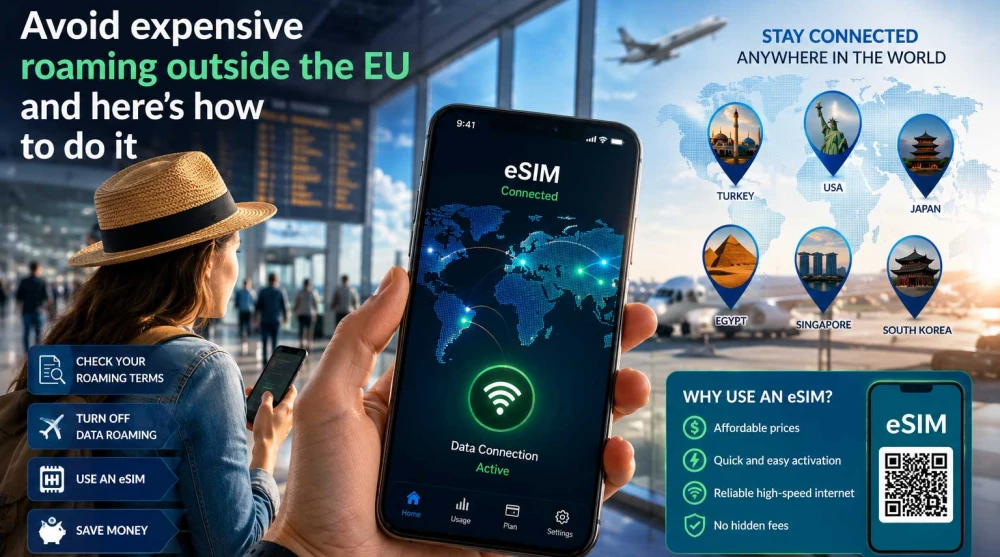
The most modern and effortless alternative. An eSIM is a digital SIM card embedded inside your phone. You can purchase and install a mobile data plan for your chosen country entirely online, while you are still at home. Getting everything set up usually takes about 5 minutes.
eSIM technology solves most of the headaches associated with traditional roaming:
Installation is fast, but it is crucial to configure your settings correctly:
Planning the right amount of data is key. Here is a rough guide based on your travel style:
To guarantee a stress-free trip, avoid these frequent oversights:
Roaming outside the European Union requires caution. The conditions depend entirely on your mobile operator's policies and vary significantly from country to country. The best strategy is always to stay informed beforehand.
Modern technologies like eSIM have proven to be a practical, affordable, and secure solution for mobile data abroad. They give you the freedom to organize your digital connectivity exactly as you organize your flights and hotels—in advance. Before your next trip, estimate how much mobile data you will need and choose a plan that gives you peaceful control over your expenses.
It is a service that activates automatically when you use your phone for calls, texts, or mobile data on a foreign operator's network outside the European Union. Unlike within the EU, where you use your services under similar conditions, every connection here is charged according to specific tariffs set by each country.
The main reason is the lack of a unified regulation for price caps between European operators and those in the rest of the world. When you are abroad, the local network charges your home operator for every megabyte or minute used at its own commercial rates, and these high costs are subsequently passed directly onto your monthly bill.
The highest bills accumulate in exotic destinations (Asia, Africa, Latin America), but also in many countries in close proximity to the EU—such as Turkey, Egypt, Albania, Montenegro, or Serbia. These countries fall into the most expensive tariff zones of home operators, where the price for 1 MB of data can be many times higher than standard domestic rates.
Even when your phone is in your pocket with the screen locked, dozens of apps continue to consume mobile data without your knowledge. The biggest "hidden" consumers are automatic app and operating system updates, photo and file syncing with cloud services (iCloud, Google Photos), and constant social media refreshing to receive real-time notifications.
The safest way is to check your tariff plan via your operator's mobile app or website before crossing the border. In many cases, the operator sends an informational SMS with prices upon entering a foreign network, but it is best to check the conditions in advance to know exactly which price zone your destination falls into.
Yes, it can be financially risky if you do not have a specific and cost-effective package activated for that country. If the data roaming option remains active in your settings, your phone will immediately begin exchanging traffic with the foreign network. This can quickly accumulate a serious bill, especially if the phone starts using data in the background.
The most effective steps to protect your budget are:
Buying a local physical SIM card requires time and effort—searching for a local shop at the airport, waiting in lines, providing a passport, and physically swapping plastic cards. A digital eSIM card is a much more convenient alternative: you buy it entirely online, installation usually takes just a few minutes, and it allows you to keep your personal number active for important calls while surfing on a more cost-effective mobile data package.
The main advantage is freedom and security—you can choose and install your package while packing your bags at home. The moment the plane lands at your destination, you already have a stable internet connection. There is no risk of losing your original SIM card, no need to hunt for Wi-Fi, and you avoid unexpected fees from your home operator.
The volume depends on your plans, but here is a realistic guide for a one-week trip:
Important Reminder:
Before finalizing your purchase, make sure you carefully read the package conditions you are choosing. Check exactly which countries it covers and its validity in days, so you can enjoy your trip with complete peace of mind.