15.03.2026
Get internet in Mexico in seconds with eSIM – no contracts and no roaming fees. In this guide, you’ll see how it works and which options are best for your trip.
Mexico is a destination that offers everything – from the megalopolis of Mexico City with its rich history and culture, to the stunning beaches of Cancun, Tulum, and Playa del Carmen. Whether you are here to explore ancient Mayan ruins or to enjoy the nightlife in the Riviera Maya, staying connected to the global network is your most important tool. In a country with such vast distances and dynamic traffic, mobile internet is not just a convenience, but a necessity for survival, safety, and comfort.
During your trip, you will rely on your smartphone for every step. Navigation via Google Maps is critical in cities like Guadalajara and Monterrey, where traffic is intense and distances are enormous. Transportation apps like Uber are the primary way to move safely in Mexico City and Cancun, saving you the need to negotiate with street taxis. Communication via WhatsApp is the standard for contacting hotels, local guides, and restaurants. Last but not least, real-time bookings for tours or emergency flight changes require a stable connection. ➡ This is why the internet is almost mandatory for tourists in Mexico.
When you arrive in Mexico, you will find that you have several main options to stay connected. The first is purchasing a local physical SIM card, which usually requires a visit to a store and registration with personal data. The second is international roaming, which is known for its extremely high data fees in North America, often reaching significant amounts per megabyte. The third option is using public WiFi, which, although common in malls and cafes, is often slow, overloaded, and poses risks to the security of your passwords.
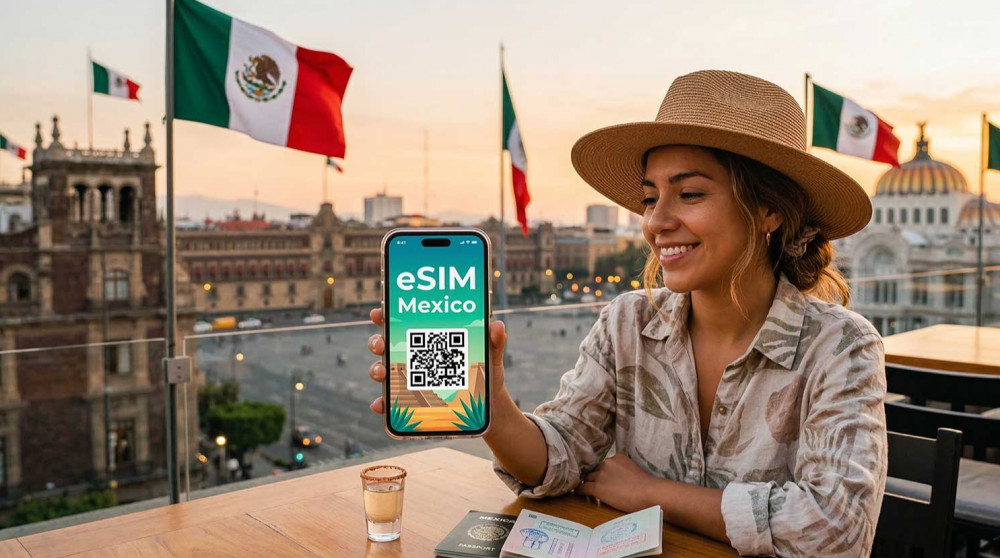
The most modern and efficient solution today is the eSIM. This technology allows you to install a digital profile on your phone before you even take off from home. Thus, as soon as you land at the airport, you automatically connect to a local 4G network. There is no need to look for kiosks at airports, wait in lines, or swap physical cards with the risk of losing your original one. ➡ eSIM is undoubtedly the most convenient and secure option for tourists in Mexico.
To make an informed choice, here is a detailed comparison of the main internet connection methods:
| Method | Price | Convenience | Activation | Security |
| eSIM | Low | Very High | Remote (Before the trip) | High (Encrypted) |
| Local SIM | Medium | Medium | Must find a store (e.g., OXXO) | Medium |
| Roaming | Very High | High | Automatic, but very expensive | High |
| Public WiFi | Free | Low | Often requires registration | Low |
To be prepared before the start of your adventure in the land of the Mayans and Aztecs, check out our plans here:
👉 Mobile Internet for Mexico – eSIM Plans
The telecommunications market in Mexico is well-developed, but with a clear leader in terms of coverage. Most international eSIM solutions, including those from HandySIM, rely on the most stable partners in the region.
To make your stay in Mexico as pleasant and trouble-free as possible, our team has prepared several key highlights that every traveler should know:
Mexico has very good 4G coverage, with speeds in large cities and popular resorts often reaching 20–100 Mbps.
The two busiest airports are Mexico City Airport (AICM) and Cancun Airport. Although both offer free WiFi, the experience of thousands of tourists shows that these networks are often overloaded and slow. Sometimes the registration process requires you to provide personal information or simply does not work at certain terminals.
In Cancun, the airport is huge, and the WiFi signal is not the same everywhere. Imagine landing after a 12-hour flight and needing to urgently contact your transfer or order an Uber. Relying on airport WiFi can be stressful. ➡ Your eSIM starts working immediately upon landing, giving you independence and security in your first minutes on Mexican soil.
Mexico is a huge country – the distance between the capital Mexico City and Cancun is over 1500 km! Tourists often undertake long trips by bus (like the comfortable ADO lines) between Cancun, Tulum, and Playa del Carmen, or organize day trips to Chichen Itza.
While moving along major highways, the 4G signal is usually stable. However, you should be prepared for "holes" in coverage when entering the jungles of Yucatan, small mountain villages in Chiapas, or archaeological zones like Palenque. At the site of Chichen Itza itself, the signal can be temperamental due to the thousands of tourists loaded onto the same cell. In such moments, the Telcel network is your safest bet for sending a message or a photo.
The internet is not just for social media; it is your digital shield and guide:
Data consumption in Mexico can be higher than expected because you will often use maps and streaming while traveling long distances. Here is a realistic breakdown:
➡ This averages to about 1GB per day.
For a standard 10-14 day vacation, a 15GB package is the best choice. If you are a digital nomad and work through your mobile hotspot, consider a larger package to avoid last-minute top-ups.
Mexico is often just the beginning of a larger journey. Many tourists combine their visit with a trip to the USA or Canada. If your adventure involves crossing borders, you don't need to buy separate cards for each country.
Special Tip for Travelers:
If you are planning a large tour across the entire continent, check out our regional plans for North America. They give you the full freedom to move from Mexico to neighboring countries without changing your phone settings. For example, if after the beaches of Cancun you decide to head to Miami or New York, you can seamlessly use our packages for the USA. If your route continues further north to Vancouver or Montreal, our plans for Canada will provide you with a stable connection everywhere. This is the most economical and convenient way for multinational travel in this region.
Mexico is a huge, vibrant, and wonderful country that requires good logistics and a constant connection to be fully explored. From the noise of Mexico City to the turquoise waters of Cancun, mobile internet is your faithful companion. The easiest, most economical, and most modern way to secure this connection is through a digital eSIM, which saves you time and gives you security from the first second. Don't let a lack of navigation or slow WiFi ruin your dream vacation.
👉 Browse all eSIM plans for Mexico and start your unforgettable adventure now!
The easiest way to have internet in Mexico as a tourist is through an eSIM card, which allows you to connect to the local network immediately upon landing. Alternatives include purchasing a local SIM card from a store like OXXO or using roaming, which is often far too expensive. For maximum convenience and security, we recommend exploring the plans offered by HandySIM.
Yes, the technology is widely adopted and supported by the major networks in the country, including Telcel and AT&T. Most modern smartphones are compatible with this digital standard, which eliminates the need for physical chip swapping. You can activate your profile online in just a few minutes.
A local SIM card often requires registration and searching for a physical store, which takes valuable time away from your vacation. With an eSIM, activation is done remotely, and there is no risk of losing your primary card since everything is digital. This is a faster and more secure solution for the modern traveler.
Telcel is the undisputed leader in Mexico with the most extensive network infrastructure, covering even more remote areas. AT&T also offers excellent speeds in major cities, but Telcel remains the most reliable choice for traveling off the beaten path. Our plans prioritize connecting to the most stable towers available.
In these popular tourist destinations, the 4G signal is fast and reliable, allowing for seamless streaming and remote work. In Tulum, however, the signal may weaken along the beach area due to the dense jungle and ecological restrictions on telecommunications towers. You can find full information on speeds and packages here: 👉 Mobile internet for Mexico – eSIM plans.
In more remote areas and the jungles of Yucatan, the signal can be variable, but along major highways and near small towns, the connection is stable. The best coverage in the countryside is offered by the operator Telcel, to which our eSIMs connect automatically. It is highly recommended to download offline maps before heading to more isolated archaeological zones.
Yes, these apps are critical for safe and affordable transportation in large cities like Mexico City and Cancun. They require a constant internet connection to see the route and price in real-time. With an active mobile connection, you will save yourself from negotiating with street taxis and avoid the risk of getting lost.
For a standard vacation with daily use of maps, social media, and WhatsApp, 1GB per day is usually sufficient. If you plan to work or upload a lot of video content, it is better to choose a larger package of 15GB or 20GB. You can always track your consumption through your phone's settings.
Yes, it is highly recommended to install the eSIM profile while you still have a stable WiFi connection at home or at the airport. The installation takes about 5 minutes, and the plan will activate automatically the moment your phone connects to a Mexican network upon arrival. This ensures you have internet the second the plane touches down.
If your trip includes visiting several countries in the region, it is best to choose a regional package. Our special plans for North America allow you to cross the borders between Mexico, the USA, and Canada without changing your card or settings. This is the most cost-effective solution for transcontinental adventures.