12.03.2026
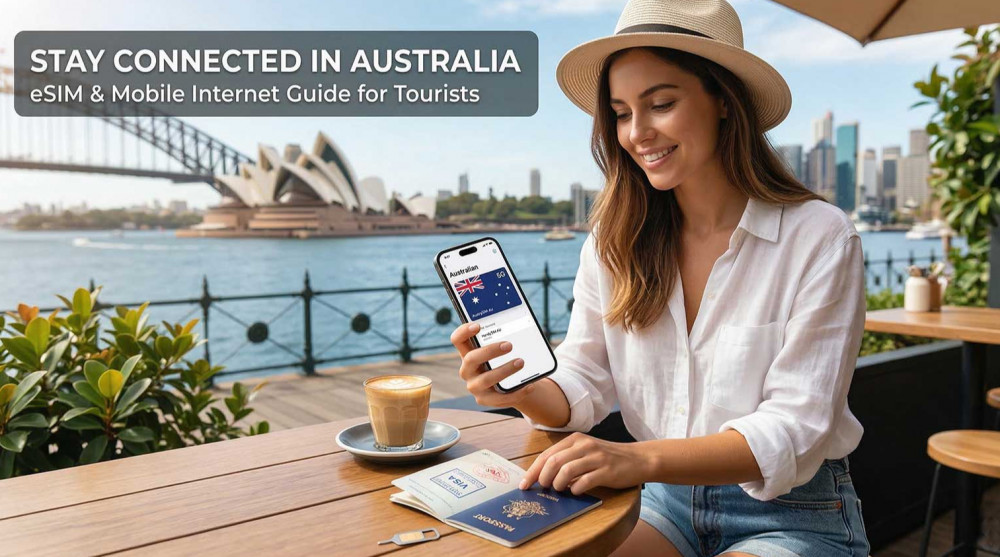
Traveling to Australia? Stay connected with fast and reliable internet using eSIM – discover coverage, speeds, and the best options.
Australia is a bucket-list destination for almost every traveler. From the iconic Sydney Opera House and the turquoise waters of the Great Barrier Reef to the rugged beauty of the Outback and the majestic Uluru—this continent offers a scale that is difficult to comprehend from a distance. In a country almost as large as the whole of Europe, but with vast uninhabited spaces, reliable mobile internet is critically important for navigation, safety, and communication.
When planning your adventure "Down Under," the first thing you must understand is that distances in Australia are enormous. A simple trip between two cities can take 10 hours of driving through areas where real-time navigation is your only guide. Using standard roaming from a home provider in Australia is an extremely expensive luxury that can cost you hundreds, or even thousands, of dollars for just a few days of using Google Maps or social media. Megabyte charges are exorbitant, making the search for an alternative solution the number one priority for every budget-conscious or savvy tourist.
This is where modern eSIM technology comes to the rescue—the solution that has changed the way we travel. Instead of wasting time searching for telecom stores at airports or struggling with physical SIM slots, you can activate your data plan with just a few clicks on your phone. In this article, we will examine in detail all the options for internet in Australia to help you choose the most effective, affordable, and reliable method for your unforgettable journey.
Access to mobile internet in Australia is well-developed, but choosing the right method depends on your travel style, budget, and coverage needs. Here are the four main ways you can stay online:
This is the easiest but most misleading option. Most tourists simply turn on their phones upon landing without realizing the consequences.
The Australian telecom market is dominated by three major networks. You can purchase a prepaid card from:
These are portable routers that create a local WiFi network around you.
This is the "gold standard" for modern tourists. An eSIM is a built-in chip in your smartphone that allows you to add a second mobile plan digitally.
Absolutely—Australia is one of the countries with the best support for eSIM technology in the world. Local networks are fully adapted to digital cards and support both 4G (LTE) and the super-fast 5G standard.
When you purchase an international eSIM for Australia, your device automatically connects to one of the leading national networks. Most often, these are Telstra or Optus. These partnerships ensure that you will have a signal in both densely populated coastal areas and along major highways. It is important to check before purchasing if your phone is network-unlocked and supports eSIM technology.
To choose the right plan, you should know the three main mobile operators in Australia:
How much data do you need in Australia depends on your way of traveling and the duration of your stay. Here are a few consumption scenarios:
In Australia, apps like Uber and Deliveroo are vital. Social networks will be full of your photos from the beaches, and streaming services like Spotify will be your best friend during long drives.
Free WiFi is available in many places in Australia, including major airports, public libraries, and in most hotels and cafes (like Starbucks or McDonald's). However, public networks are often slow, time-limited, or require tedious registration. For secure navigation and seamless payments on the go, your own mobile connection via eSIM remains a far more reliable option.
This is the section that every tourist should read carefully. Australia is huge, and populated areas are concentrated mainly along the coast.
Yes, Australia is one of the leading countries in the adoption of 5G technologies. Operators Telstra and Optus have invested billions in their infrastructure. In major urban centers, download speeds over 5G can reach up to 1Gbps, which is faster than many home WiFi networks. Most international eSIM plans from HandySIM automatically support switching to 5G when the network is available.
One of the greatest advantages of modern smartphones is the support for Dual SIM mode. This means you can leave your home physical SIM card in the phone to receive important SMS messages from your bank or payment confirmations, while at the same time using an eSIM for all your mobile data in Australia. This way, you avoid expensive roaming but remain reachable on your home number for emergencies.
To make your stay as comfortable as possible, follow these proven tips:
When you choose HandySIM, you choose peace of mind. Our plans for Australia are specially selected to offer the best ratio between price and data volume, using the fastest available networks in the country.
👉 View all HandySIM eSIM plans for Australia
Australia is a continent of contrasts, where modern technology meets the wilderness. Staying connected during your trip is not just a matter of uploading photos to social media—it is a matter of navigation, safety, and easy logistics.
Using an eSIM is undoubtedly the easiest, cheapest, and most effective way to secure mobile internet in Australia. You save yourself the stress of searching for stores and the shock of high roaming bills. Activate your plan before your flight and enjoy the magic of Australia with full confidence.
Tourists have several main options: using international roaming, purchasing a local physical SIM card, or activating an international eSIM. The most preferred method currently is the eSIM, as it allows for online purchase and activation without the need to visit a telecom office. This guarantees you internet connectivity immediately after landing at the airport, saving you time and unnecessary expenses.
Yes, Australia is one of the leading countries in supporting eSIM technology, and all major networks work perfectly with digital cards. Most modern smartphones manufactured after 2019 (such as iPhone XS/11/12+, Samsung S20+, and Google Pixel 3+) are fully compatible. It is only important to ensure that your device is factory unlocked to all carriers before purchasing your plan from HandySIM.
Telstra is the undisputed leader in terms of coverage, especially in remote and rural areas of the country. Optus is an excellent alternative that offers high speeds and a stable signal in cities and along the coast, where most tourists travel. Our eSIM plans utilize these reliable networks to ensure you have the best possible connection during your journey.
For a standard two-week trip, we recommend a package between 10GB and 20GB, depending on how often you use navigation and social media. Since Australia is a vast country, you will often rely on Google Maps for long journeys, which consumes a significant amount of data. You can always start with a smaller plan and easily top up through our website if necessary.
In the central parts of Australia, known as the Outback, mobile signal is very limited and completely absent in some places. Even the largest operators have coverage mainly around major highways and larger settlements in the desert. It is recommended to download offline maps and not rely solely on mobile internet if you plan treks in these isolated areas.
Yes, the 5G network is highly developed in Australia and is available to tourists in almost all major cities such as Sydney, Melbourne, and Brisbane. The speeds are impressive and allow for lightning-fast content uploads and high-quality video calls. Most HandySIM plans automatically connect to the 5G network when your device supports it and you are in a coverage area.
Most modern phones support the Dual SIM function, which allows you to use two cards at the same time. You can keep your home SIM card to receive important calls and SMS messages from banks while using the eSIM for your mobile data in Australia. This is the safest way to avoid expensive roaming without losing connection to your original number.
It is highly recommended to install and configure your eSIM while you still have a stable WiFi connection at home or at the airport. The process takes about 5 minutes and prepares you for immediate data use as soon as you arrive. If you wait until you land in Australia, you may experience difficulties accessing your email or activation instructions without available internet.
Free Wi-Fi is available in many public places such as airports, libraries, large shopping centers, and some cafes. However, these networks are often slow, have time limits, and can be insecure for personal data. Your own eSIM connection is a much faster and more secure alternative, allowing you to pay bills and navigate without interruptions.
Categorically yes, an eSIM is many times more cost-effective than the standard roaming offered by international mobile operators. Roaming data charges for Australia are often shocking, whereas with HandySIM, you pay a fixed price for a selected package and have full control over your expenses. With an eSIM, you get local data rates without the risk of massive bills at the end of the month.