preloader

Cart

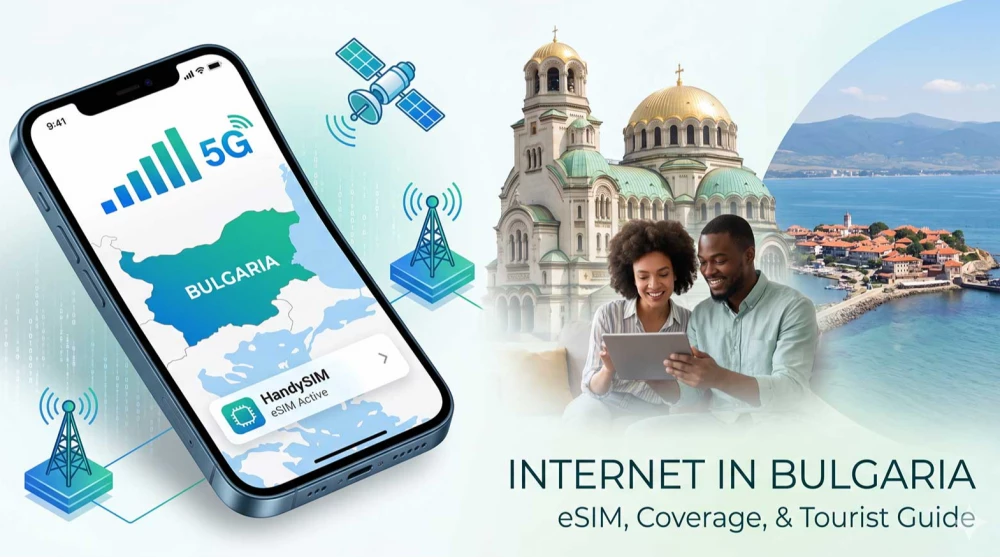
Internet in Bulgaria: eSIM, Coverage & Mobile Data Guide for Travelers

21.04.2026

Traveling to Bulgaria and want internet without expensive roaming from the start? Get an eSIM in seconds and stay connected with fast data and reliable coverage across the country.

Bulgaria offers some of the fastest mobile internet speeds in Europe, but choosing the right way to stay connected is key. In this guide, you will learn how to get internet in Bulgaria without unnecessary costs and why eSIM for Bulgaria is the most convenient solution for tourists. While traveling, you will use your phone constantly for navigation, bookings, and communication—therefore, reliable internet is a necessity, not a luxury.

The best way to get internet in Bulgaria without roaming charges is through a pre-activated eSIM.

Using this technology allows you instant access to the network immediately upon landing, without airport queues, and without wasting precious holiday time looking for physical stores or dealing with tedious document registration.

1. How to Get Internet in Bulgaria: The Main Options

The way you connect to the network depends primarily on where your journey begins and your specific needs for internet in Bulgaria.

1.1 Roaming (EU vs. Non-EU Countries)

  • Travelers from the European Union: Thanks to European regulations, you can use your home plan without extra charges. Important: Check your roaming data limit (FUP). It is often much smaller than your total home package, and once exceeded, charges become high.
  • Travelers from outside the EU (USA, Turkey, Serbia, UK, etc.): Standard roaming in Bulgaria for you is extremely expensive. Bills can reach hundreds of euros in just a few days, making a dedicated mobile internet Bulgaria solution mandatory for cost control.

1.2 Local SIM Card: What You Need to Know

Buying a prepaid card on the spot seems easy, but it has downsides:

  • Requires Registration: By law, every SIM card in Bulgaria must be registered with an ID or passport. This means you must physically go to an operator's office.
  • Time-Consuming: In tourist areas and major cities, long queues are common.
  • Swapping Cards: You have to remove your original SIM card, which carries the risk of losing it and leaves you without a connection on your primary number (for banking codes and messages).

1.3 eSIM: The Fastest Path to Connectivity

The fastest path to mobile internet in Bulgaria is via eSIM—a digital card that you install directly on your phone.

  • Convenience: With an eSIM, you get internet immediately, with no queues and no time wasted in shops.
  • Security: Your primary SIM card stays in your phone, and you simply add a second profile for data.

This is the fastest way to have internet in Bulgaria upon arrival, with no on-site setup required.

2. Connectivity Options Comparison

FeatureeSIM (HandySIM)Local SIM CardRoaming (Non-EU)
InstallationDigital (QR Code)Physical SwapAutomatic
RegistrationNot RequiredMandatory in-storeNone
PriceFixed & AffordableLowVery High
ConvenienceMaximumMediumHigh (but expensive)

3. Mobile Operators in Bulgaria

There are three major networks in Bulgaria competing for signal quality and eSIM Bulgaria offerings.

  • Yettel Bulgaria: They offer one of the most stable networks with excellent 5G coverage in cities. At HandySIM, we use their plans because they activate quickly and provide high speeds without complex identification.
  • Vivacom: They possess the widest coverage in the country. If you plan to visit remote villages or less popular mountain routes, their network often performs best.
  • A1 Bulgaria: A highly reliable operator with a powerful 5G network in major resorts and cities.

4. Coverage by Region: Where is the signal strongest?

  • Cities (Sofia, Plovdiv, Varna): You will find 5G and speeds that are among the best in the world. You can easily stream video or work remotely.
  • The Seaside (Sunny Beach, Nessebar): Coverage is excellent all along the Black Sea coast. Important: In July and August, networks in resorts can get congested, and internet may be slightly slower in the evenings.
  • The Mountains (Bansko, Borovets): In the resorts, the connection is perfect. However, if you go on long hikes deep into the woods, the signal may drop in certain spots.

5. Internet on the Move: Traveling across the country

  • On Highways: The signal is stable almost everywhere, making the use of Google Maps and Waze easy and safe.
  • On Trains and Buses: On Bulgarian trains, internet is often weak in tunnels. Buses often offer free WiFi, but it is usually slow when many passengers are connected.

6. Why is the internet slow despite full signal?

Sometimes your phone shows full bars, but the internet is slow. This happens due to cell congestion (e.g., at a crowded beach or a festival).

Quick Fixes:

  1. Toggle Airplane Mode on and off. This forces the phone to look for a less congested frequency.
  2. If 5G is slow, try switching to 4G in your settings—it is often less crowded and performs better in high-density areas.

7. How much data will you need?

Here is an estimated usage for mobile internet in Bulgaria:

  • Navigation (Maps): Approx. 100-200 MB per day.
  • Social Media (Instagram/TikTok): Approx. 500 MB per day.
  • 7-day stay: We recommend at least 5-10 GB.
  • 2-week stay: 15-20 GB is the sensible choice.

8. How to install your eSIM for Bulgaria

  1. Choose a plan: Select the right package from HandySIM.
  2. Scan the QR code: You will receive it immediately via email.
  3. Activate: In your phone settings, select "Cellular/Mobile Data" and add the new plan.
  4. Turn on Roaming: Ensure the "Data Roaming" option is ON for the new eSIM.

9. Traveling to Neighboring Countries

Since Bulgaria is in the EU, your card may work in neighboring EU countries. For destinations around Bulgaria, check out our plans:

For a larger trip, our eSIM Europe offer is the best solution.

10. Useful Tips from HandySIM

  1. Mountains = Offline Maps: Download your maps in advance for areas like Rila, Pirin, and the Rhodopes, where the signal can drop in deep valleys.
  2. Watch the Border: When traveling toward Serbia or Turkey, your phone might automatically connect to their networks. With our eSIM, this risk is eliminated.
  3. Public Transport in Sofia: You can pay for the metro and buses directly with your card or phone, which requires an active internet connection.
  4. Taxi Apps: Uber does not operate in Bulgaria. Use apps like Taxi.me or Yellow, which require reliable mobile data.
  5. Hotel WiFi: Hotel WiFi is often slow or overloaded in the evening. Your eSIM will provide a much faster and more secure connection.
  6. Food Delivery: If you want to order food to your address, you’ll need apps like Takeaway or Glovo, which require a good connection.
  7. Power Bank: Constant GPS use for navigation in an unfamiliar city drains the battery quickly.
  8. Banking Security: Avoid logging into banking apps via public WiFi in Bulgaria. Use the secure mobile data from your eSIM.
  9. Setup Before Flight: Install your eSIM profile while still at home or at the airport so you are online immediately upon landing.
  10. Check Balance: Monitor your data usage through your phone settings so you know when it’s time for a top-up.

11. Before You Go: Checklist

  • [ ] Phone supports eSIM
  • [ ] eSIM profile is installed
  • [ ] Data Roaming is turned ON for the eSIM

12. Conclusion

Bulgaria is a fantastic destination, and having reliable internet will make your stay much easier. With the right eSIM, you will have fast and secure internet everywhere in Bulgaria—from Sofia to the mountains and the sea.

Ready for your trip?

Explore eSIM plans for Bulgaria from HandySIM and be online as soon as you land.

Is internet fast in Bulgaria?

Yes, Bulgaria consistently ranks among the top countries in Europe for mobile internet speeds. With widespread 5G and high-speed 4G LTE, travelers can expect seamless video streaming, fast downloads, and reliable VoIP calls in all major cities and resorts.

Does eSIM work in Bulgaria? Absolutely.

All major Bulgarian mobile operators support eSIM technology. Using a digital travel eSIM is the most efficient way for tourists to access local networks without the need for a physical SIM card or complex registration.

Is roaming free in Bulgaria for EU travelers?

Yes, if you have a SIM card from an EU/EEA country, you can use your plan in Bulgaria at no extra cost under the "Roam Like at Home" policy. However, be sure to check your "Fair Usage Policy" (FUP) limit, as roaming data is often more restricted than your domestic allowance.

Is mobile internet expensive in Bulgaria?

No, Bulgaria offers some of the most affordable mobile data rates in the European Union. Prepaid plans and travel eSIMs provide excellent value for money, offering high data volumes at a fraction of the cost found in Western Europe or North America.

Which mobile operator has the best coverage in Bulgaria for tourists?

The "best" operator depends on your itinerary. Vivacom is widely regarded for the most extensive coverage in rural and mountainous areas. Yettel and A1 offer exceptional 5G speeds in urban centers like Sofia, Plovdiv, and Varna. For most tourists, Yettel provides a perfect balance of speed and reliability, which is why HandySIM utilizes their high-speed infrastructure.

Is eSIM better than a local SIM card in Bulgaria for travel?

For most travelers, yes. While a local SIM card might be slightly cheaper, it requires a physical visit to a store and a mandatory passport registration. An eSIM offers instant activation, no paperwork, and allows you to keep your original SIM card in your phone for receiving important banking codes and messages.

Can I get internet in Bulgaria without buying a local SIM card?

Yes, you can use international roaming (which is often expensive) or rely on public WiFi (which poses security risks). The most modern and cost-effective alternative is an eSIM. It provides a local data connection without the need to visit a physical store or swap out your home SIM card.

Will I have mobile internet coverage in mountains and rural areas in Bulgaria?

Bulgaria has excellent overall coverage, but the terrain is mountainous. You will find strong signals in ski resorts like Bansko and Borovets. However, in deep valleys or high mountain trails in Rila and Pirin, the signal can be intermittent. We recommend downloading offline maps if you plan on trekking in remote areas.

How much mobile data do I need for a 7–14 day trip to Bulgaria?

For a typical 7-day trip involving navigation, social media, and occasional video calls, 5–10 GB is usually sufficient. For a 14-day stay or for digital nomads who need to work remotely, we recommend 15–20 GB to ensure you don't run out of data while exploring the country.

What is the easiest way to get mobile internet in Bulgaria immediately after landing?

The easiest method is to purchase and install an eSIM before your flight. Once you land at Sofia or Varna Airport, simply turn on your device, enable data roaming for your eSIM profile, and you will be online instantly. This bypasses the need to find a kiosk, wait in line, or navigate language barriers.


Viber WhatsApp
Cookie