19.03.2026
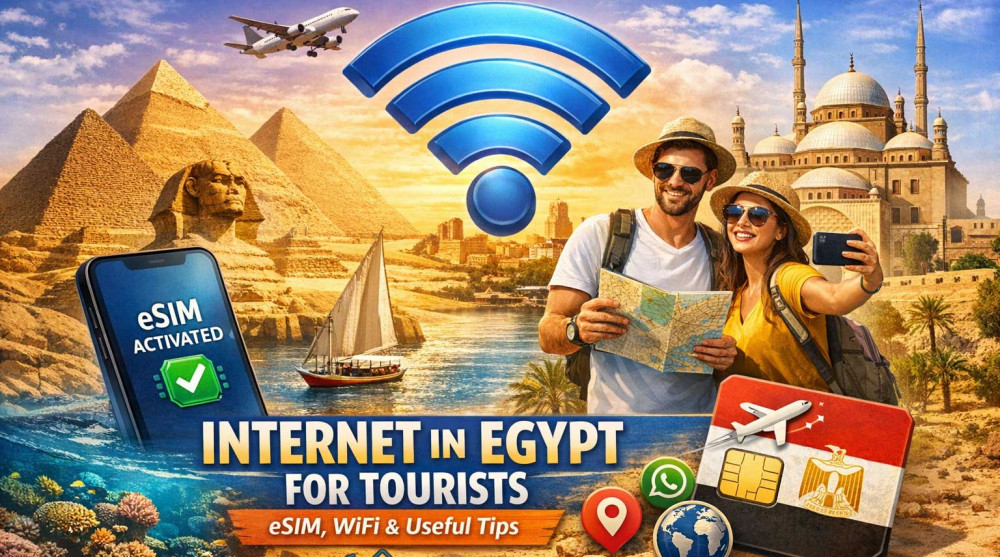
Get internet in Egypt in seconds with eSIM – no contracts and no roaming fees. In this guide, you’ll see how it works and which options are best for your trip.
If you are planning a holiday in Egypt and think you can rely on the free hotel WiFi – think again. In the Land of the Pharaohs, internet access is often more elusive than a hidden treasure in a tomb. The chance of getting frustrated by your second day is nearly 100% if you aren’t prepared with a personal mobile data plan.
Egypt is a true tourist paradise, drawing millions with its ancient monuments and coral reefs. However, its digital infrastructure is often a labyrinth of slow connections and overloaded networks. From the majestic chaos of Cairo to the turquoise waters of Hurghada and Sharm El Sheikh, a stable connection is a rarity.
Traveling across the country involves crossing vast desert distances and navigating megacities where traffic follows its own rules. In this context, the internet isn’t just a convenience for social media – it is a critical tool for your safety and orientation.
➡ Mobile internet is almost mandatory for tourists in Egypt.
When you land in Egypt, several main paths for digital connectivity will open up. Here is the blunt truth about each option:
In Egypt, WiFi often exists only "nominally"—it says it’s there, but it doesn't actually work. In 90% of hotels, the internet is notoriously slow and usually only accessible in the lobby. Even in the most luxurious 5-star complexes, you will see the icon for full signal, but pages simply won't load. This is a classic "trap" for tourists, who are often forced to pay extra for "Premium" speed that rarely justifies the price.
This is the easiest way to end your holiday with massive debt. Egypt falls into the most expensive tariff zones for most European and international operators. Data prices can be staggering, and a single automatic app update on your phone can generate a bill for hundreds of dollars in just a few minutes.
You can choose to stand in long lines immediately after a flight, providing your personal data and passport for registration. However, you must be very careful—the "tourist" SIM cards sold at airports in Cairo or Hurghada are often overpriced. It is not uncommon for the actual data package to be smaller than what was promised on the packaging.
This is the standard for the modern traveler in the 21st century. It saves you the language barrier with local vendors, the search for offices outside resorts, and the need to keep track of your original physical SIM card. You install it online before your flight and have a stable connection the second the plane’s wheels touch the runway.
➡ eSIM is the most convenient option for Egypt – no hidden fees and no wasted time.
To better visualize the differences, here is a detailed comparison of the connection methods:
| Method | Price | Convenience | Activation | Limitations |
| eSIM | Low | Maximum | Online | Requires a compatible smartphone |
| Local SIM | Low | Medium | At the airport | Lines and risk of data scams |
| Roaming | Very High | High | Automatic | Risk of massive bills |
| WiFi | Free | Zero | On-site | Limited range and speed |
Most tourists find out too late that free internet is a myth. Prepare in advance:
The Egyptian telecom market is dominated by several major players. For a tourist, it is vital to know which network you are connecting to:
Important: When using HandySIM, your device usually connects to Vodafone or Orange—the two most reliable operators, guaranteeing maximum service quality.
Egypt has its own digital quirks that often remain hidden from the average tourist. Here is what we’ve learned from experience:
Many hotels in Hurghada and Sharm El Sheikh limit the connection to only 1 or 2 devices per room. Every time your phone enters sleep mode, the session ends, and you have to go through a tedious login process. If you are a family with children and several tablets, this quickly becomes a nightmare.
In Egypt, you will often see the 4G icon on your screen, but the actual speed may feel like an old 3G network. This is due to cell congestion or poor network configuration. Latency (ping) is high, meaning that even if you have signal bars, video calls may lag or drop.
Around 7:00 PM - 9:00 PM, "peak hour" hits. All the tourists return to their hotels and simultaneously start uploading photos and videos. In resorts like Hurghada, the network literally "kneels" under the load. If you have an important work call, plan it for the morning hours.
Some European and American websites may load slowly not because of your speed, but because of the way internet traffic leaves the country. Egypt's infrastructural limitations sometimes lead to delays when accessing specific international services.
Airports in Cairo (CAI) and Hurghada (HRG) have WiFi, but it is notorious for its instability. Usually, the system requires an Egyptian phone number to receive an SMS confirmation code—something a newly arrived tourist doesn't have.
Furthermore, airport SIM card shops are known for using the language barrier to sell you packages that expire early or contain "social megabytes" that don't work for navigation. With an eSIM from HandySIM, you are online the second the plane doors open.
Egypt is not a place where you want to be offline. Here are the main reasons:
Since you won't want to use the slow hotel WiFi, your entire consumption will fall on your mobile plan. Egyptian apps and sites are also "heavy."
➡ Total Consumption: A minimum of 1GB per day is a reasonable limit for comfort.
Our recommendation: For a standard weekly holiday, take a package of 10GB to 15GB. If you plan to work remotely or spend evenings streaming, a 20GB+ package is mandatory.
Egypt is often just part of a larger adventure across the Middle East or North Africa. Many travelers combine the pyramids with visits to other iconic places. HandySIM allows you to stay connected without changing cards:
To ensure the internet doesn't turn you into a "digital pharaoh" without a connection, follow these tips:
Egypt is magic, history, and adventure, but only if you aren't fighting with technology half the time. In a country where public internet is often a mirage and roaming is unjustifiably expensive, eSIM is your only logical salvation.
By choosing a digital SIM card, you gain the freedom to move confidently through Cairo, use the best transport services, and share the magic of the pyramids in real-time. Don't leave your connection to chance—prepare in advance and enjoy your vacation stress-free.
👉 View all available eSIM plans for Egypt and choose yours now
The infrastructure in many Egyptian resorts was not designed for the massive number of tourists connecting simultaneously, leading to significant network congestion. Many hotels restrict free access to the lobby area only and offer "Premium" speeds for an extra fee, which often remains unstable regardless of the price. To avoid frustration and constant reconnection issues, the most reliable solution is to rely on your own mobile data via an eSIM.
Vodafone Egypt is the undisputed leader in terms of coverage, especially in more remote areas, desert roads, and smaller resort zones. Orange is an excellent choice for major cities like Cairo and Alexandria, where it offers very high data speeds. Most tourist packages for eSIM for Egypt utilize the networks of these two giants to guarantee a dependable connection wherever you go.
Yes, there are counters for the major operators at the airports, but they are often overcrowded, and you may face long lines immediately after your flight. You should be aware that airport prices are "tourist rates" and are often higher than those in official city offices, and registration requires presenting your passport. Using an eSIM saves you this wait and allows you to be online the second the plane touches down.
Text messages on apps like WhatsApp and Viber work seamlessly, but voice and video calls are sometimes restricted or unstable due to local regulations. Call quality depends heavily on network load and the specific operator you are connected to. In such cases, using a VPN or simply sending voice notes is often a more reliable alternative for communication.
An eSIM is entirely digital and is activated by scanning a QR code, which eliminates the need to open your phone and risk losing your original SIM card. A physical tourist card requires visiting a store and often has a fixed expiration date that may not align with your stay. With an eSIM, you have full flexibility and the ability to easily top up online without having to search for local vendors.
Mobile coverage along the banks of the Nile and in historical centers like Luxor and Aswan is surprisingly good and stable. Most cruise ships offer WiFi, but it is usually satellite-based, very slow, and expensive, making personal mobile data the preferred option. However, keep in mind that when passing through more isolated stretches between cities, the signal may temporarily weaken.
Yes, a constant internet connection is absolutely mandatory for ordering a taxi through Uber or Careem, as the apps track your location in real-time. These services are the best way to avoid haggling with local taxi drivers and to pay a fair, fixed price. Without internet, you cannot hail a car or track your route, which is important for your safety in large cities like Cairo.
The process is extremely fast and takes about 5 minutes, as everything happens entirely online via your email. Once you purchase the plan, you receive a QR code that you simply scan in your phone's settings before you leave or upon arrival. It is important to perform the installation while you have a stable WiFi connection so that the digital profile can load correctly on your device.
Currently, Egypt is actively developing its 5G infrastructure, but it is primarily available in the central parts of Cairo and certain zones of the new administrative capital. For most tourist areas like Hurghada and Sharm El Sheikh, the standard remains 4G/LTE, which is perfectly sufficient for navigation and social media. eSIM plans provide you with access to the fastest available technology in the specific area where you are located.
For standard use of maps, chats, and uploading photos, a package of 10GB to 15GB is usually entirely sufficient for one week. If you plan to work remotely or stream video in the evenings (due to slow hotel WiFi), it is better to look for packages of 20GB or more. We always recommend having a small buffer, as Egypt is extremely photogenic and data consumption grows quickly.