07.09.2026
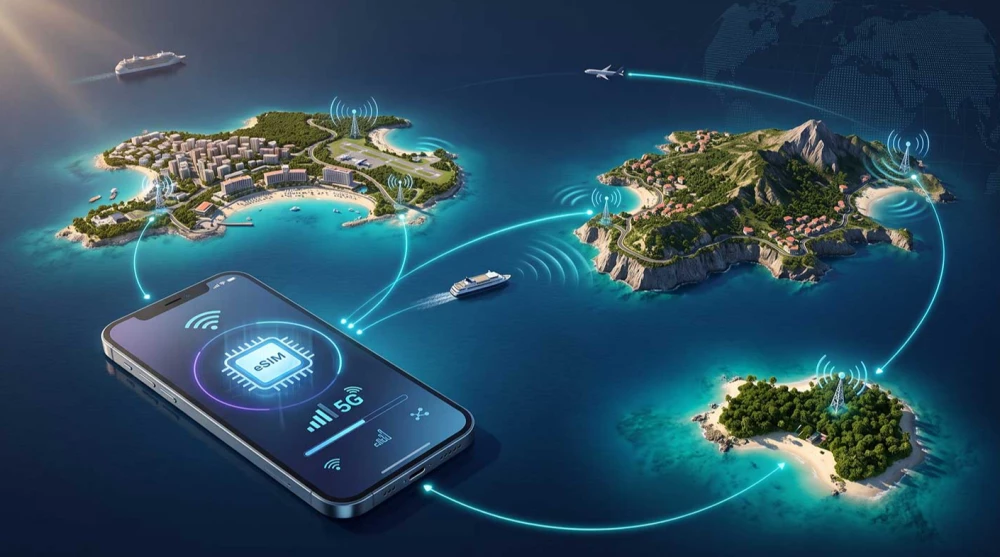
When planning a tropical getaway, a Mediterranean cruise, or an adventurous island-hopping itinerary, one of the most common questions travellers ask is whether their digital connectivity will seamlessly follow them across the water. A persistent and widespread misconception in the travel community is that journeying to an island automatically requires the purchase of a different physical SIM card or a completely separate digital profile.
It is easy to see why this confusion exists. When you fly from mainland Spain to the Canary Islands, or from mainland Portugal to Madeira, the geographical separation makes it feel as though you are entering a completely different telecommunications zone. Travellers frequently wonder if their standard connectivity will abruptly stop working once they leave the shores of places like mainland Greece to visit Crete or Rhodes, or when departing mainland Italy for Sicily and Sardinia. The same anxiety applies to travelling from mainland France to distant overseas regions like Réunion.
The reality of modern telecommunications is far more integrated and traveller-friendly than many people realise.
Travel eSIMs can work just as well on islands as on the mainland. What matters is whether the destination and local mobile networks are included in the specific eSIM plan.
An island does not automatically mean a separate eSIM is required. As long as you understand how mobile network geography operates, you can easily secure continuous, high-speed internet access across oceans and archipelagos. You can explore a wide variety of comprehensive travel eSIM plans designed specifically to keep you connected regardless of whether your feet are on a continent or an island.
From a purely technological standpoint, there is nothing fundamentally different about using an eSIM on an island compared to using it in a massive landlocked metropolis. Your smartphone’s internal digital SIM chip functions identically regardless of whether you are standing in the centre of Berlin or on a remote beach in the Mediterranean.
The device still seeks out and connects to a terrestrial mobile network in exactly the same way it always does. The radio frequencies, the cell tower handshakes, and the data transmission protocols do not change just because the landmass is surrounded by water.
The factors that actually determine whether you will have a functional internet connection are entirely logistical:
The availability of physical local mobile network infrastructure on the island.
The specific networks supported by your chosen eSIM provider.
The geographical coverage boundaries explicitly outlined in the plan.
The actual signal coverage quality at the user's precise location on the island.
The question is not whether eSIM technology works on an island. The question is whether your particular eSIM plan has access to a network there.
If your eSIM is partnered with a local telecommunications operator that has built cell towers on that island, your digital profile will connect flawlessly.
In the vast majority of popular global travel scenarios, no additional eSIM is necessary when moving from a mainland to an island governed by the same nation.
Mobile network operators generally treat their domestic islands as part of their standard national coverage zone. If the island is part of the same mobile network coverage included in your initial plan, the existing eSIM simply continues working without requiring any manual intervention, re-installation, or extra fees.
This concept is particularly easy to understand when looking at Spain, one of the world's most popular island-hopping destinations.
You do not need to buy a separate eSIM simply because you travel from mainland Spain to the Spanish islands.
The major Spanish telecommunications companies—such as Movistar, Orange, Vodafone, and Yoigo—operate their networks across the entire Spanish national territory. This includes the archipelagos.
Canary Islands
Whether you are hiking a volcano or relaxing on a black sand beach, your standard Spanish coverage extends to:
Tenerife
Gran Canaria
Lanzarote
Fuerteventura
La Palma
La Gomera
El Hierro
Balearic Islands
Similarly, if you are sailing through the Mediterranean, you will remain seamlessly connected across:
Mallorca
Ibiza
Menorca
Formentera
A single, well-chosen eSIM Spain plan that covers the relevant Spanish networks can continue working effortlessly when travelling between the mainland and these islands.
If your itinerary looks like this: Madrid → Tenerife → Mallorca, no separate eSIM is required simply because you move between the mainland and the islands. Your phone will simply connect to the local towers in Madrid, disconnect during your flight, and immediately reconnect to the exact same Spanish network upon landing in Tenerife.
To give you a clearer picture of how standard coverage applies across the continent, here is a breakdown of the main European examples and how they are typically treated by eSIM providers.
|
Country |
Popular islands / destinations |
General consideration |
|
Spain |
Canary Islands, Mallorca, Ibiza, Menorca |
Usually covered through standard Spain plans |
|
Portugal |
Madeira, Azores |
Check the plan coverage, but generally included in Portugal plans |
|
Greece |
Crete, Rhodes, Corfu, Cyclades |
Check supported Greek networks |
|
Italy |
Sicily, Sardinia |
Check supported Italian networks |
|
France |
Corsica |
Check French network coverage |
|
Finland |
Åland Islands |
Check the individual plan, as autonomous regions can vary |
|
Denmark |
Faroe Islands |
Check separately, as they often operate on independent networks |
|
UK / Crown Dependencies |
Jersey, Guernsey, Isle of Man |
Check separately, as these are not standard UK networks |
There is an incredibly important message that travellers must remember when reviewing this table:
Political geography and mobile-network geography are not always identical.
You should never imply or assume that every European eSIM automatically includes every island or territory remotely associated with a European nation. A comprehensive Europe eSIM will cover the massive mainland networks, but certain autonomous islands maintain their own distinct telecommunications infrastructure.
This section explains why overseas territories require much more attention and diligent checking than nearby islands such as Mallorca or Sicily.
An overseas territory may be politically associated with a mainland country, share the same passport, and use the same currency, while simultaneously operating under completely different mobile networks and international roaming arrangements. Because these territories are often located thousands of miles away from the mainland, the mainland telecom operators do not build towers there. Instead, local island operators run the networks, meaning your eSIM provider must have a specific, separate roaming agreement with them.
France has numerous overseas departments and collectivities spread across the globe.
Examples include:
Réunion
Guadeloupe
Martinique
French Guiana
Mayotte
Saint Martin
Buying an eSIM that simply lists France as its covered destination does not necessarily mean that every French overseas territory is automatically included. While you might be legally on French soil in the Caribbean or the Indian Ocean, the digital network is entirely separate from the mainland networks of Orange France, SFR, or Bouygues Telecom.
Customers must always check the exact destination list. If you are travelling to the Indian Ocean, you must specifically seek out an eSIM Reunion to guarantee connectivity.
The United Kingdom has a complex web of associated territories with highly independent infrastructure.
Examples include:
Gibraltar
Bermuda
Cayman Islands
Turks and Caicos
Jersey
Guernsey
Isle of Man
These destinations should not simply be treated as ordinary UK mobile coverage. If you buy a UK eSIM that connects to EE, O2, or Vodafone UK, it will likely drop to zero signal the moment you land in Jersey or Bermuda. Different local networks (such as Sure or JT) operate in these areas, and distinct roaming arrangements must apply for an eSIM to function.
The United States also possesses several territories outside the contiguous 50 states, spanning the Caribbean and the Pacific Ocean.
Examples of specific coverage requirements include:
Does an eSIM that covers the USA automatically cover every US territory?
Not necessarily. While some premium US plans may include Puerto Rico or the US Virgin Islands due to their proximity and network integration (like AT&T or T-Mobile's extended coverage), remote Pacific territories like Guam operate on highly localized networks. Coverage should always be meticulously verified for the specific plan and destination before you travel.
When discussing island connectivity, it is crucial to make an important distinction regarding expectations versus reality:
eSIM coverage does not mean guaranteed mobile signal everywhere.
An eSIM plan may officially support a specific island, and the profile may install and activate perfectly, while the local mobile operator simply has limited physical cell tower coverage in certain geographic extremes.
Islands are often defined by dramatic, rugged geography that makes building telecommunications infrastructure incredibly difficult. You may experience total signal loss in:
Deep mountain ravines;
Remote, untouched beaches;
Dense national parks;
Sparsely populated rural areas;
Steep valleys;
Coastal areas surrounded by towering cliffs.
It is vital to understand that this is not an eSIM-specific problem. The digital nature of your SIM card is not the cause of the signal drop. A traveller who visits a local shop and buys a physical, plastic SIM card using the exact same local network would face the exact same coverage limitations. The limitation is physical, not digital.
Because island topography can be so unforgiving, network choice can become especially important the moment you step outside major tourist resort areas.
On a large island, the telecommunications landscape might look like this:
Network A may have excellent, high-speed coverage in the main towns, around the airport, and across the primary resort beaches.
Network B may have invested heavily in building towers on higher ground, resulting in stronger rural, mountainous, or coastal coverage where Network A drops off.
Network C may offer ultra-fast 5G connectivity, but only have a small coverage footprint limited strictly to the capital city.
This creates a natural opportunity to explain the immense advantage of premium eSIM plans that offer access to multiple local networks. If your physical SIM card loses signal, you are entirely disconnected. If your eSIM is programmed to support both Network A and Network B, your smartphone will automatically switch to the stronger network as you drive from the resorts into the mountains, ensuring maximum possible uptime on the island.
The marketing surrounding modern connectivity is heavily focused on 5G, but travellers should set realistic expectations when heading to island destinations.
An eSIM supporting 5G does not guarantee 5G everywhere you go. The actual speed and generation of connectivity you experience depends on a complex combination of factors:
The physical local network infrastructure (has the island operator actually built 5G towers?).
Your precise physical location relative to those towers.
Your specific smartphone device and its supported frequency bands.
Current network availability and congestion.
The specific roaming agreement between your eSIM provider and the local operator.
A phone may therefore routinely move between:
5G → 4G/LTE
as you travel across the island. Dropping from 5G to 4G does not mean there is anything wrong with your eSIM; it simply reflects the reality of the physical infrastructure available at that specific geographic coordinate.
Island hopping is one of the most thrilling ways to explore a region, and it is a scenario where eSIM technology truly outshines traditional plastic SIM cards.
Consider these highly realistic and popular travel routes:
Mallorca → Ibiza → Menorca
Athens → Mykonos → Santorini → Crete
Tenerife → Gran Canaria → Lanzarote
Mainland Italy → Sicily → Sardinia
If all destinations are included in the same eSIM plan, there is normally no reason to install a new eSIM every time you move to another island.
When you board a short flight or a fast ferry from Mykonos to Santorini, you do not need to panic about connectivity. As you depart, your phone will eventually lose the signal from the first island. When you arrive at your new destination, you simply disable Airplane Mode. The device registers with an available supported network on the new island, authenticates your existing eSIM profile, and restores your internet access immediately. The transition is completely seamless.
When travelling between islands by boat, it is vital to manage your connectivity expectations.
Being covered on two islands does not mean continuous coverage across the sea between them.
When the ferry is close to land or navigating narrow channels between closely clustered islands, your phone may still easily receive a terrestrial mobile signal from the towers on the shore.
As the ferry moves farther offshore into open water, the connection will follow a predictable degradation path:
Strong signal → weak signal → no terrestrial signal
Once you are entirely out of range of land-based cell towers, your eSIM will show "No Service". This is not a malfunction. When the ferry eventually approaches the coastline of another island, the phone will detect the new towers and automatically reconnect to a supported terrestrial network. This is completely normal behaviour for any mobile device.
This brings us to a highly important practical section regarding maritime travel. Travellers must acutely understand the difference between terrestrial and maritime telecommunications.
These are normal mobile towers firmly located on land. These are the networks your travel eSIM is designed to connect to safely and affordably.
This is connectivity provided aboard some commercial ferries and cruise ships, potentially through highly expensive satellite-backed systems (such as Cellular at Sea).
Travellers should be particularly careful with their primary, domestic physical SIM when on the water. Maritime roaming can be treated very differently from normal terrestrial roaming by your home provider. If your primary SIM accidentally connects to a maritime network while you are sleeping on a ferry, you could wake up to hundreds of dollars in astronomical roaming charges.
When travelling by ferry or cruise ship, consider disabling Data Roaming on your primary SIM if you do not need it.
Your prepaid travel eSIM will generally not be able to incur surprise maritime charges, as it is a prepaid digital product restricted to terrestrial roaming, but protecting your primary home number is crucial.
Cruise ship holidays frequently involve visiting multiple islands across regions like the Caribbean or the Mediterranean. The functionality of your travel eSIM on a cruise ship must be split into two distinct situations.
When your cruise ship is docked in a harbour, anchored in a bay, or sailing very close to the coastline, the travel eSIM may connect normally to a supported terrestrial mobile network. You can stand on the deck and upload photos using the local island's infrastructure.
When the ship navigates into open international waters, terrestrial mobile coverage will disappear completely. The eSIM itself has not stopped working, broken, or expired—there simply may be no supported terrestrial network within radio range of the ship.
When the ship approaches the next supported destination on the itinerary, the phone can reconnect automatically.
A travel eSIM should not be confused with a satellite or maritime internet service. If you need constant Wi-Fi while in the middle of the ocean, you must purchase the cruise ship's internal satellite Wi-Fi package.
To ensure a stress-free trip without connectivity surprises, every traveller should follow a practical checklist before purchasing a digital profile for an island getaway.
Before buying:
Search for the exact destination: Do not assume; type the name of the specific island into the provider's search bar.
Check the countries and territories included in the plan: Read the detailed coverage list meticulously.
Check which local mobile networks are supported: Knowing if you connect to Vodafone, Orange, or a smaller local carrier helps you anticipate signal quality.
Check whether 4G or 5G is available: Verify the maximum theoretical speed allowed by the plan.
Make sure every destination on a multi-stop trip is included: If island hopping, verify all stops.
For remote areas, check the local operator's coverage map: If heading into the jungle or mountains, Google the local network's physical coverage map.
Do not assume that an overseas territory is included simply because its associated country is listed.
Planning a complex, multi-national island itinerary used to require purchasing several different SIM cards or risking expensive regional roaming. Today, the process is streamlined.
Consider an adventurous route like:
Spain → Portugal → Madeira
Or a Mediterranean historical tour:
Italy → Malta → Greece → Cyprus
Instead of manually opening dozens of regional plans and cross-referencing which islands belong to which telecommunications zone, travellers can utilize smart search tools. By entering the exact destinations they actually intend to visit into the HandySIM search engine, the platform does the heavy lifting.
HandySIM can filter the thousands of available plans and immediately show options covering all selected destinations under a single, unified digital profile. This eliminates the need to install multiple eSIMs and ensures a frictionless transition every time you cross a border or land on a new island.
Choosing the right scope of coverage is essential for maximizing both connectivity and budget. Here is a suggested comparison to help you decide.
|
eSIM type |
Best for |
Example |
|
Local |
One country or destination |
Spain + Spanish islands |
|
Regional |
Several countries/islands in one specific region |
Italy + Malta + Greece |
|
Global |
Complex routes across entirely different regions |
Thailand + Indonesia + Maldives |
When looking at this table, it is vital to remember an important point:
Local does not necessarily mean mainland only.
As discussed earlier, a local Spain plan does not automatically stop being useful because the traveller visits Mallorca or Tenerife. If your entire holiday takes place within the borders of one nation—even if it is spread across a mainland and an archipelago—a Local eSIM is almost always the most cost-effective choice.
Avoid these frequent pitfalls to ensure a smooth digital experience:
Buying another eSIM unnecessarily when your existing mainland plan already covers the island.
Assuming every overseas territory is automatically included with its associated mainland country.
Confusing eSIM plan coverage with guaranteed physical network coverage in remote geography.
Assuming 5G is available everywhere on the island.
Not checking which local networks are supported before venturing into rural areas.
Leaving Data Roaming enabled on your primary domestic SIM while at sea, risking maritime charges.
Assuming mobile coverage continues uninterrupted throughout a long ferry journey across open water.
Buying separate eSIMs for every single island when one regional or multi-country plan could easily cover the entire route.
The flexibility of digital profiles makes them ideal for exploring the world's most sought-after islands.
Whether chasing the sun or exploring rugged northern landscapes, eSIMs are incredibly popular in:
Tenerife, Gran Canaria, Lanzarote, Fuerteventura
Mallorca, Ibiza, Menorca
Madeira, Azores
Sicily, Sardinia
Crete, Rhodes, Corfu
Cyprus, Malta
Faroe Islands
Jersey, Guernsey, Isle of Man
For tropical escapes and distinct territories, travellers frequently rely on eSIMs in:
Puerto Rico
US Virgin Islands
Martinique
Guadeloupe
Cayman Islands
For exotic luxury and backpacking adventures, staying connected is essential. If you are heading east, you can easily secure an eSIM Thailand for places like Phuket or Koh Samui. For sprawling archipelagos, an eSIM Indonesia will keep you online in Bali. Those seeking luxury resorts can utilize an eSIM Maldives or an eSIM Mauritius for uninterrupted island connectivity.
To synthesize everything we have covered, let us look at the best strategy for three highly practical travel scenarios.
Example: Barcelona → Mallorca → Ibiza
The strategy here is simple: One suitable local Spain eSIM can cover the entire trip. There is absolutely no reason to buy a separate eSIM for each Spanish island. You install the profile before leaving home, and it effortlessly manages the network handshakes as you fly or sail between the Balearics.
Example: Italy → Malta → Greece
When your island hopping takes you across international borders within the same geographic sphere, a European regional eSIM may be much more practical than buying three several local eSIMs. It offers the ultimate convenience of never having to swap profiles or monitor three separate data allowances.
Example: Thailand → Bali → Maldives
For a massive, multi-leg journey spanning different telecommunications zones in Asia and the Indian Ocean, a multi-country or Global eSIM may be vastly more convenient than installing three separate profiles. This ensures that the moment your seaplane or international flight lands, you immediately have the data necessary to arrange transport and contact your hotel.
Yes. Travel eSIMs can work just as well on islands as they do on the mainland.
The technology is robust, proven, and highly adaptable. The important distinction you must make as a traveller is the difference between:
An island within normal national mobile coverage
and
A separate overseas territory or distinct telecommunications zone.
Spain serves as the clearest, most reassuring example:
Travelling from mainland Spain to Tenerife, Gran Canaria, Mallorca or Ibiza does not mean you need another eSIM.
However, for far-flung overseas territories and more unusual, remote destinations, travellers must take the proactive step to check the exact coverage list of the specific eSIM plan before buying. Do not rely on assumptions based on political maps; rely on the explicit network data provided by your eSIM platform.
Planning an island-hopping trip? Search your actual destinations and compare comprehensive eSIM plans that cover your complete route, ensuring you never miss a moment to share your remote island adventures with the world.
Yes, travel eSIMs work perfectly on islands as long as the local mobile network is included in your plan. The technology behind an eSIM functions identically whether you are on the mainland or an island. Your device simply connects to the available local cell towers supported by your eSIM provider. You will experience the exact same connectivity and speed as you would with a physical SIM card.
No, you do not need a separate eSIM just for the Canary Islands if you already have a Spain eSIM. The Canary Islands are fully covered by major Spanish mobile networks like Movistar, Orange, and Vodafone. A standard Spain eSIM plan will seamlessly provide high-speed mobile data across all the islands in the archipelago. Your phone will simply connect to the local Spanish towers as soon as you land.
Yes, a single Spain eSIM provides complete coverage across both mainland Spain and all its islands. This includes popular destinations like the Balearic Islands (Mallorca, Ibiza) and the Canary Islands (Tenerife, Gran Canaria). You do not need to purchase or install additional data plans when flying between these locations. Your device will automatically transition between local network towers without any interruption to your service.
An eSIM functions in remote areas exactly as well as the physical local network infrastructure allows. If the local network operator has cell towers in the mountains or on secluded beaches, your eSIM will connect to them. However, rugged island terrain often causes natural signal dead zones where no terrestrial network can reach. Choosing a premium eSIM that supports multiple local networks gives you the best chance of staying connected in these remote spots.
Yes, a single eSIM can easily keep you connected across multiple islands during an island-hopping trip. If you purchase a regional or global plan, it will automatically switch to the supported local networks as you cross international borders. For domestic island hopping, a local country plan is usually sufficient to cover all islands within that nation. This completely eliminates the hassle of buying a new SIM card at every port or airport.
Your travel eSIM will work on a ferry while you are docked in port or sailing close to the coastline. As the ferry moves further into open water, the terrestrial mobile signal will gradually weaken and eventually drop. Once you are out of range of the land-based cell towers, your eSIM will safely display no service. It will automatically reconnect to a terrestrial network as soon as you approach your destination island.
A travel eSIM relies exclusively on land-based cell towers, so it only works when your cruise ship is near the shore. Once the ship enters international waters, you will completely lose your mobile data connection. Your travel eSIM cannot connect to the cruise ship's internal satellite Wi-Fi system. To get internet access while far out at sea, you must purchase the ship's dedicated maritime Wi-Fi package.
No, travel eSIMs are intentionally designed to connect only to standard terrestrial mobile networks on land. They do not support connections to expensive maritime or satellite networks commonly found on commercial ships. This restriction acts as a built-in safety feature, protecting you from unexpected and massive roaming charges while at sea. To avoid accidental fees on your primary home number, you should always disable data roaming on your main physical SIM during the voyage.
An eSIM covering a specific country does not automatically include coverage for its distant overseas territories. For example, a France eSIM will not provide mobile data in French territories like Réunion or Guadeloupe. These overseas regions operate on completely separate local networks and require distinct international roaming agreements. You must always check the specific destination list of your eSIM plan before traveling to an overseas territory.
The best eSIM for island hopping depends entirely on whether you are crossing international borders. For hopping between islands within the same country, a local national eSIM is the most cost-effective choice. If your route spans islands belonging to different nations, a regional or global eSIM offers the most seamless experience. This allows you to maintain continuous mobile data across your entire journey without installing multiple digital profiles.