
21.06.2026
Landing in a new country without a reliable internet connection is stressful. You step off the plane, and suddenly you cannot load directions to your hotel, translate a simple sign, or message your family to let them know you arrived safely. Mobile internet speed matters more than ever for modern travelers. We no longer just use our phones to send text messages; we rely on them as our primary navigation tools, digital wallets, and travel agents.
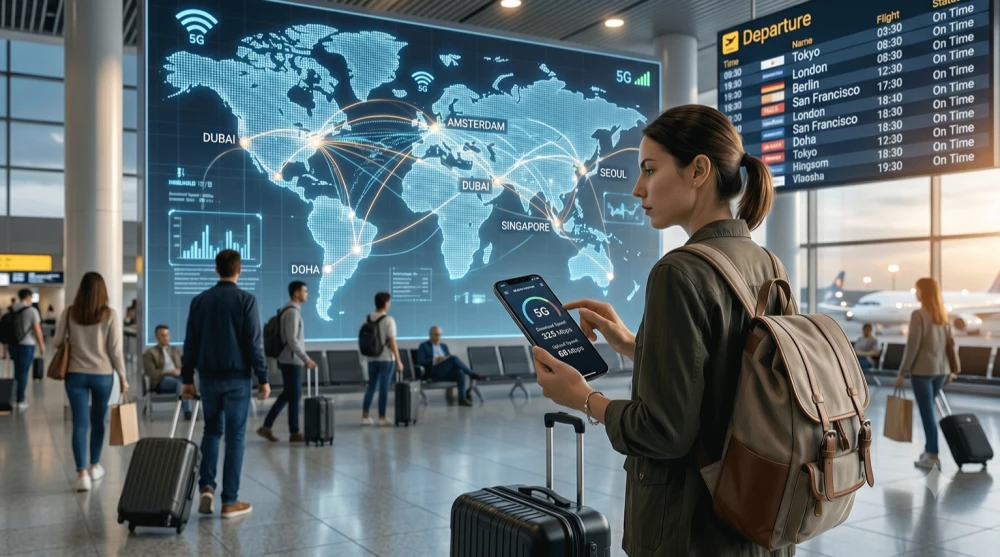
A massive part of this shift is how 5G is transforming connectivity around the world. The jump from 4G to 5G is not just about faster downloads. It is about network capacity. Crowded airports and busy city squares that used to suffer from dead zones now have enough bandwidth to support thousands of connected devices simultaneously.
Before you pack your bags, it helps to understand what kind of connectivity awaits you. Measuring mobile internet speed involves looking at a few different technical metrics, which determine how fast a web page loads or how smoothly a video call runs.
When network testing organizations rank global mobile performance, they do not just look at a single number. They analyze three specific metrics that define your actual, real-world experience on a smartphone.
Download speed is the metric most people care about. It measures how quickly data transfers from a server on the internet to your mobile device.
In real-world use, a high download speed means you can download a movie for your train ride in seconds rather than minutes. It is the backbone of seamless travel. High download speeds ensure that high-resolution maps load instantly, Spotify playlists stream without buffering, and heavy websites open the moment you tap a link.
Upload speed measures how quickly data travels from your device back to the internet.
While usually lower than download speeds, upload speed is critical for content creation and communication. If you are uploading a batch of high-resolution vacation photos to the cloud, sharing a video to social media, or sending a large email attachment to a client, you are relying entirely on your upload speed.
Latency, often called ping, measures the reaction time of your connection. It is the delay between your device sending a request and receiving a response, measured in milliseconds.
Low latency is the secret to a smooth internet experience. If you are on a Zoom call with your team back home, high latency causes frustrating audio delays and people talking over each other. For remote workers, digital nomads, and online gamers, low latency is just as important as raw download speed.
| Rank | Country | Average Download Speed |
| 1 | United Arab Emirates | ~320 Mbps |
| 2 | South Korea | ~280 Mbps |
| 3 | Qatar | ~275 Mbps |
| 4 | China | ~260 Mbps |
| 5 | Kuwait | ~240 Mbps |
| 6 | Singapore | ~220 Mbps |
| 7 | Norway | ~180 Mbps |
| 8 | Denmark | ~175 Mbps |
| 9 | Netherlands | ~170 Mbps |
| 10 | Saudi Arabia | ~160 Mbps |
Global telecommunications infrastructure is constantly evolving. A few nations have heavily invested in next-generation networks, pulling far ahead of the rest of the world.
The United Arab Emirates currently holds the crown for the fastest mobile internet on the planet.
Average mobile speeds here frequently exceed 300 Mbps. The UAE has aggressively rolled out 5G coverage, covering almost the entire populated area of the country. Telecom operators in Dubai and Abu Dhabi have built networks capable of handling massive amounts of traffic without breaking a sweat. The UAE consistently ranks at the top because of heavy government investment in smart city infrastructure and an unwavering commitment to adopting the newest telecom technology first.
South Korea has long been a pioneer in digital connectivity. They were the first nation to launch a commercial 5G network globally.
Their advanced telecom infrastructure is deeply integrated into daily life. From the highest skyscrapers in Seoul to the deep underground subway tunnels, connectivity is flawless. This nationwide 5G deployment means travelers experience zero drops in coverage, making a South Korea eSIM an incredibly powerful tool for navigating the country.
Qatar has poured billions into upgrading its mobile networks. A massive catalyst for this was hosting international sporting events, which required infrastructure capable of handling millions of data-hungry tourists simultaneously.
Their mobile network investments left a permanent legacy of incredible speed performance. Travelers walking through Doha will experience hyper-fast connectivity, minimal latency, and network stability that rivals premium fiber-optic home connections.
The sheer scale of network infrastructure in China is difficult to comprehend.
China has executed a massive 5G rollout, installing millions of base stations across the country. Connectivity in major cities like Shanghai, Beijing, and Shenzhen is blazing fast, supporting a society that relies almost entirely on mobile payments and digital mini-apps. Having a China eSIM ensures you can tap into this vast network seamlessly, bypassing the struggle of finding physical local SIM cards.
Kuwait is another Middle Eastern powerhouse dominating the speed rankings. The country recognized early that transitioning to a digital economy required world-class mobile networks. Mobile providers have blanketed the urban centers with high-band 5G, providing residents and travelers with ultra-fast download and upload speeds.
Singapore is a hyper-dense island nation, which makes it the perfect environment for deploying high-frequency 5G networks. The government and private telecom sectors work closely together to ensure seamless connectivity. Whether you are deep inside the Changi Airport or exploring Gardens by the Bay, mobile data flows effortlessly.
Ranking high despite its challenging geography is Norway. You might expect a country famous for remote fjords, deep valleys, and rugged mountains to struggle with mobile coverage. Instead, Norwegian telecom companies have built highly resilient networks that provide top-tier speeds not just in Oslo, but across rural landscapes as well.
Denmark represents classic Nordic efficiency. The country has a highly competitive telecom market, which forces providers to constantly upgrade their networks to attract users. This competition has resulted in widespread 5G availability, excellent latency, and consistently high download speeds across both cities and the countryside.
The Netherlands benefits from a perfectly flat landscape and a high population density, making network deployment incredibly efficient. Dutch providers have maximized their spectrum allocations to deliver lightning-fast mobile internet. Train rides between Amsterdam, Rotterdam, and The Hague offer uninterrupted, high-speed connectivity.
Saudi Arabia is rapidly modernizing its digital infrastructure. Huge investments in smart cities and massive technological hubs have driven a rapid expansion of 5G coverage. The country is quickly climbing the global ranks, offering excellent mobile data performance for both business travelers and tourists.
Speed and connectivity vary drastically depending on which continent you are visiting.
Europe remains one of the most reliable regions for mobile data.
Leading countries like Norway, Denmark, and the Netherlands set the standard, but the growth of 5G coverage across the continent is impressive. France, Germany, and the UK are heavily upgrading their urban networks. The beauty of European travel is the lack of roaming barriers within the EU, meaning an eSIM Europe allows you to maintain high speeds as you cross borders on a train.
When you look at the top of the speed charts, Asia dominates global mobile internet rankings.
This regional technology leadership is driven by early adoption, massive populations that skipped desktop computers and went straight to mobile, and fierce manufacturing competition. South Korea, China, and Singapore offer a glimpse into the future of mobile connectivity. Grabbing an Asia eSIM gives you front-row access to the fastest networks on earth.
Mobile internet performance in the United States and Canada is strong, but regional differences are vast.
Major metropolitan areas like New York, Los Angeles, and Toronto have ultra-fast millimeter-wave 5G. However, drive an hour outside the city limits, and speeds can drop significantly. The massive landmass of North America makes blanket high-speed coverage difficult, but a North America eSIM will keep you on the best available networks as you travel from coast to coast.
It is not magic that makes the internet faster in Dubai than it is in Berlin. It comes down to hardware, geography, and money.
The primary driver of speed is the deployment of 5G infrastructure. Countries that have auctioned off the right radio frequencies early and allowed telecom companies to build dense networks of small cellular antennas naturally lead the pack.
A cell tower is only as fast as the wire connecting it to the internet. Fiber backhaul networks are the invisible cables underground that link mobile towers to the core network. If a tower relies on older copper wires or microwave links, the mobile speed for the end-user drops. Leading countries have fiber connected to almost every single cell site.
Telecommunications are highly regulated. Countries with proactive government investment and smart city initiatives clear the bureaucratic hurdles, allowing operators to build towers faster and cheaper.
The key factors that influence mobile internet performance often come down to simple geography. It is significantly cheaper and easier to blanket a dense city-state like Singapore with high-speed internet than it is to cover the vast, sprawling landscapes of Canada or Australia.
For a digital nomad, mobile internet speed is not just about convenience; it is about livelihood.
Unbeatable speeds and flawless coverage make South Korea a remote worker's dream. You can work from a bullet train or a remote cafe with zero fear of dropping a video call.
With cafes built specifically for remote work and gigabit mobile speeds, Singapore offers immense reliability. The mobile network quality here ensures you can upload large project files in seconds.
The Netherlands offers the perfect blend of high speeds and incredible European quality of life. The connectivity reliability across the entire country means you do not have to stay trapped in Amsterdam to get work done.
If you want to work remotely from a cabin in the mountains, Norway is your best bet. The remote work experience here is unique because you do not have to sacrifice network quality for natural beauty.
Dubai has actively courted digital nomads with specialized visas and tax incentives. Backing up those incentives is a telecom network that ensures you are always online, always fast, and always productive.
You have several options for getting online when you travel. Choosing the right one dictates how smooth your trip will be.
Weighing the pros and cons of each option, digital travel plans clearly offer the best balance between convenience and cost. You skip the queues and the hidden fees, maintaining complete control over your connectivity.
The countries with the fastest mobile internet are redefining what it means to travel and work abroad. The United Arab Emirates, South Korea, and Qatar lead a global shift toward hyper-fast, seamless connectivity, proving that dead zones and buffering screens are becoming a thing of the past.
The key takeaways for travelers and remote workers are simple: high-speed infrastructure exists, but you must equip your device properly to take advantage of it. Relying on outdated methods like airport Wi-Fi or expensive home carrier roaming restricts your ability to experience these world-class networks.
Prepare your mobile connectivity before an international trip. Check your smartphone compatibility, choose a destination plan, and install your digital profile from the comfort of your couch. Before traveling, compare available plans, explore all eSIM destinations, and choose the option that best matches your itinerary and expected data usage.
The top spots fluctuate dynamically due to constant network upgrades, but countries in the Arabian Gulf and East Asia consistently lead the world. The United Arab Emirates (UAE) and Qatar frequently dominate the absolute global number one and two spots, with median mobile download speeds regularly exceeding 400 to 600 Mbps. They are closely followed by tech-forward nations like Kuwait, South Korea, and Singapore, driven by massive state and private investments in standalone infrastructure.
Global speeds are analyzed and indexed by specialized network intelligence platforms (such as Ookla Speedtest and OpenSignal). These companies aggregate billions of real-world crowdsourced consumer tests every day. The three key metrics used to determine global standing are:
Several structural factors dictate a nation’s position in the global index. The primary driver is infrastructure density—the sheer number of cellular towers deployed. Available wireless spectrum bands allocated to carriers and the underlying generation of technology (4G vs. 5G) also play major roles. Geography is equally critical: small, flat, heavily urbanized nations (like Singapore or Qatar) are far easier and cheaper to blanket with ultra-fast coverage than massive countries with complex, mountainous terrain.
Not necessarily. While 5G technology has a theoretical capacity to clear 1 Gbps, the practical speed depends heavily on how the carrier deploys it. If an operator utilizes "low-band" spectrum to achieve broad geographic coverage, your actual mobile internet speed might feel very similar to an optimized 4G LTE network. True, ultra-high-speed performance is unlocked only when connected to mid-band or high-band millimeter-wave frequencies, which are typically concentrated in dense metropolitan hubs.
The Middle East (specifically the Gulf Cooperation Council countries) and East Asia currently showcase the highest average speeds worldwide. Directly following them are Northern and Western European regions—such as Norway, Denmark, and the Netherlands—where coverage consistency and fiber-backed network reliability are exceptionally premium. North America delivers ultra-fast pockets in major metropolitan areas, but expansive rural zones lower the overall regional average.
The difference comes down to the carrier's investment in "backhaul"—the physical infrastructure that links local cellular towers back to the core internet backbone. The fastest networks connect almost every tower directly via high-capacity fiber-optic cables, whereas slower networks still rely on older, over-the-air microwave links. Furthermore, networks with a lower subscriber-to-bandwidth ratio deliver faster individual speeds because the tower's capacity isn't split among thousands of active devices simultaneously.
For the modern traveler, high-speed mobile internet directly impacts convenience, remote productivity, and safety. Fast connections ensure that navigation apps update instantly in an unfamiliar city, translation tools respond without lag, and travel documents load immediately. For digital nomads and business travelers, it facilitates smooth 4K video conferencing, instant file transfers, and dependable remote work capabilities from anywhere.
Yes, provided they connect using local network protocols, such as a travel eSIM. When you install a travel eSIM, your device registers directly on the local network infrastructure, gaining access to the exact same priority routing and high-speed channels enjoyed by residents. Conversely, if you rely on traditional international roaming from your home carrier, your data traffic is often routed all the way back through your home country, which spikes latency (ping) and frequently results in throttled data speeds.
The ultimate 5G experience is judged not just by peak download numbers, but by 5G Availability—the percentage of time users spend on an active 5G connection. Countries like South Korea, Singapore, the UAE, and the United States rank among the best in this category. In South Korea, for example, robust infrastructure ensures that users remain connected to lightning-fast 5G networks even while traveling deep inside underground subways and transit tunnels.
Global index rankings are updated every single month. Because telecommunications providers worldwide are continuously launching new spectrum bands, optimizing network software, and activating newly built towers, position shifts within the top 20 are common. A country can jump up multiple spots in a matter of weeks following a successful high-density 5G infrastructure rollout across its primary cities.